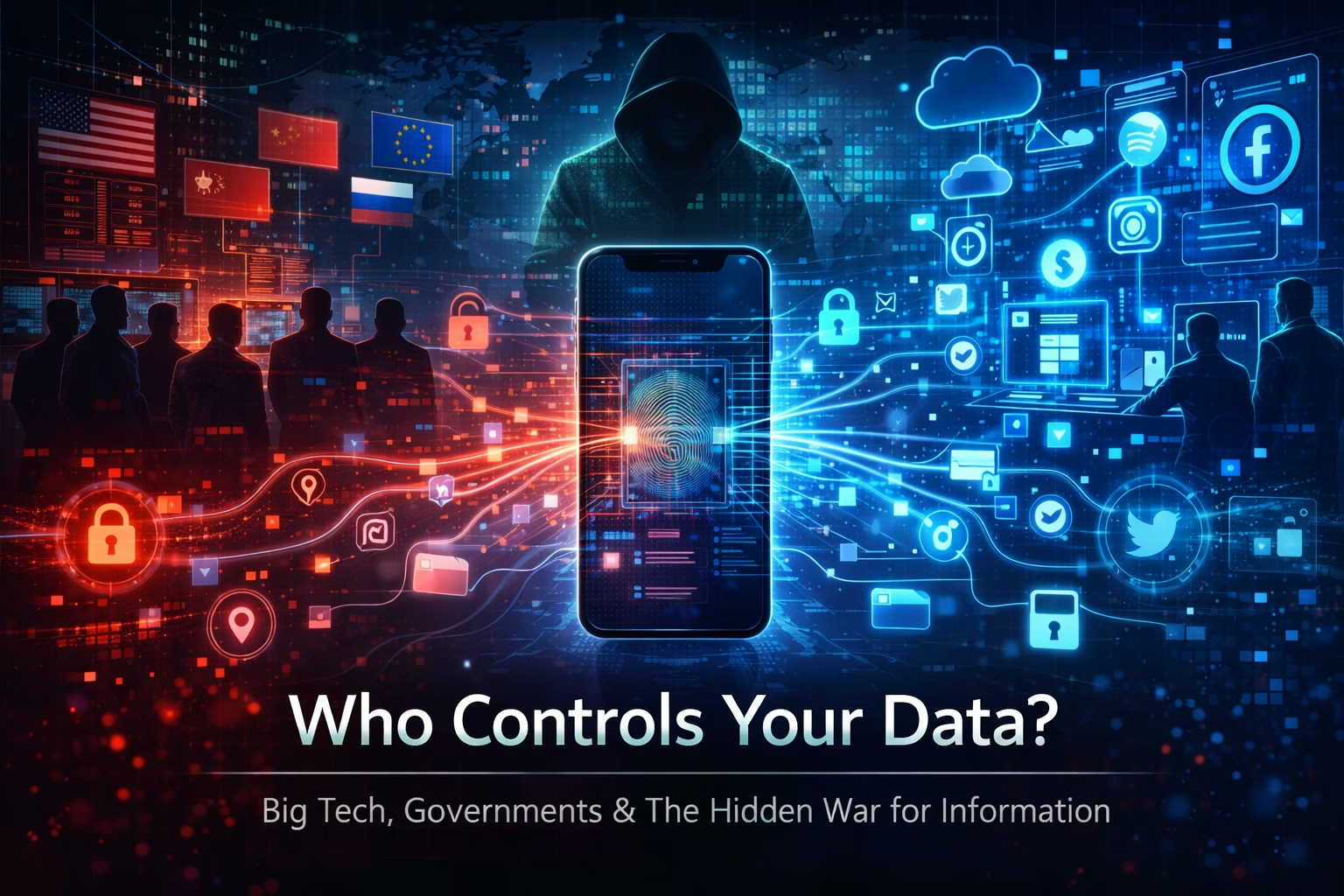
Big Tech & War: Who Controls Your Information?

From Silicon Valley boardrooms to government intelligence agencies, a silent war is being waged over your data. Discover how big tech giants, governments, and hackers compete for control of your information — and what you can do to protect yourself.
Introduction: The Invisible War Over Your Data
Imagine waking up tomorrow to find that every message you've sent, every search query you've typed, every location your phone has logged, and every purchase you've made over the past decade has been accessed — not by a criminal hacker hiding in a basement, but by a government agency operating under the legal framework of national security. You weren't informed. You didn't consent. And you have no recourse.
This isn't speculative fiction. This is the world we already inhabit — a world where big tech war control information dynamics shape geopolitics, civil liberties, and individual privacy in ways most people still don't fully grasp.
From Silicon Valley boardrooms to government intelligence agencies in Beijing, Moscow, Washington, and Brussels, a silent but consequential war is being waged — not with bullets or bombs, but with data, algorithms, and surveillance infrastructure. The weapons are platforms. The battleground is your smartphone. And the prize is influence over what billions of people see, believe, and ultimately do.
Who really controls your information? Is it Meta, Google, or Apple? Is it your government? Hackers lurking in the shadows? Or some uncomfortable combination of all three?
In this deep-dive analysis, we'll pull back the curtain on the intersection of big tech, global conflict, data privacy, and cyber warfare — and equip you with the knowledge to protect yourself in an era where information is the ultimate weapon.
Big Tech & Global Power: The Information Empires
To understand information control in wartime, we first need to appreciate just how much power tech giants have accumulated over the global flow of information. We're not talking about companies that make useful apps — we're talking about entities that exercise quasi-governmental authority over what billions of people can see, say, and know.
Consider the sheer scale: Google processes more than 8.5 billion searches every day. Meta's platforms connect over 3 billion people monthly. Amazon Web Services hosts the infrastructure for a significant portion of the internet itself — including critical government systems. Apple and Google together control the operating systems on over 99% of the world's smartphones. Microsoft's cloud services power enterprise and government operations across 190 countries.
This concentration of technological power means that a handful of tech giants function as the gatekeepers of global information. They decide what content gets amplified and what gets suppressed. They determine which apps can reach users and which get de-platformed. They control cloud storage that houses everything from personal photos to classified corporate documents to government communications.
During times of geopolitical tension and open conflict, this power becomes extraordinarily consequential. Tech companies become key players — sometimes willingly, sometimes reluctantly — in information warfare. Their decisions about content moderation, data sharing, and platform access can tilt public opinion, undermine propaganda campaigns, or expose the communications of entire populations.
|
Key Insight: When a tech company decides to restrict a government's access to its platform, or when it complies with a state's demands for user data, it is making a geopolitical decision with real-world consequences — even if it's dressed up in the language of policy and terms of service. |
The Platform-State Hybrid
Political scientists and tech scholars have begun using the term 'platform states' to describe this phenomenon — the idea that major tech companies now wield power comparable to nation-states in certain domains. They have their own rules (terms of service), their own enforcement mechanisms (content moderation and banning), their own economies (app stores, advertising markets), and their own foreign policies (deciding which countries' governments they'll cooperate with).
This is not hyperbole. When Twitter (now X) banned Donald Trump after January 6, 2021, it demonstrated that a private company could silence a sitting president with more speed and finality than any constitutional process. When Apple and Google removed Parler from their app stores, they effectively shut down an entire communications platform. When Cloudflare terminated service to 8chan following mass shootings, the website became unreachable overnight.
The implications for global conflict and information control are profound — and deeply unsettling.
Data Privacy vs. National Security: The Eternal Tension
In normal times, the tension between data privacy and national security is managed through laws, courts, and oversight mechanisms — imperfectly, but with at least nominal checks and balances. In wartime, or during periods of acute geopolitical tension, those checks tend to erode with alarming speed.
Governments routinely argue that mass surveillance, data collection, and the compelled disclosure of user information are necessary tools of national security. Tech companies, caught between their users' privacy expectations and government pressure, often find themselves in an impossible position.
Legal Frameworks That Enable Surveillance
In the United States, Section 702 of the Foreign Intelligence Surveillance Act (FISA) allows intelligence agencies to collect communications data from non-American persons outside the US — including data stored on American tech companies' servers. The Patriot Act, passed after September 11, 2001, dramatically expanded government surveillance powers in ways that persisted for over two decades.
In China, the National Security Law and the Cybersecurity Law essentially require all companies operating within Chinese territory to store data locally and provide access to government authorities upon request. This isn't a grey area — it's a legal mandate.
In Russia, the 'sovereign internet' laws allow the government to isolate the Russian internet (Runet) from the global web entirely during national emergencies, and require domestic data storage from all platforms operating in the country.
The European Union has taken a different approach with the General Data Protection Regulation (GDPR), which imposes strict limits on data collection and transfer — but even GDPR carves out significant exceptions for national security purposes.
|
The uncomfortable reality: In nearly every major jurisdiction on earth, national security law ultimately trumps data privacy law. When governments decide your data is relevant to their security interests, the legal architecture is usually in their favor. |
The False Choice Fallacy
One of the most persistent narratives in the data privacy debate is the idea that privacy and security are inherently at odds — that to keep a nation safe, we must sacrifice some measure of personal privacy. Civil liberties advocates, cryptographers, and privacy researchers have pushed back on this framing for decades.
The evidence increasingly supports their position. Mass surveillance programs have repeatedly been shown to be ineffective at preventing terrorism, while simultaneously creating vast databases of innocent people's information that are vulnerable to misuse, hacking, or abuse by authorities. The question isn't whether we should choose between safety and privacy — it's whether we can build security systems that respect both.
Historical Examples: When Tech Meets Conflict
The US-China Tech War
Perhaps the most consequential ongoing example of tech companies caught in geopolitical conflict is the US-China technology war. Beginning in earnest around 2018, the United States government began restricting Chinese tech companies' access to American markets and technology, while simultaneously pressuring allies to exclude Chinese infrastructure from their networks.
The Huawei ban — which barred the Chinese telecom giant from purchasing American semiconductors and restricted its access to US markets — was framed explicitly as a national security measure. The concern: that Chinese-made telecommunications infrastructure could contain backdoors allowing Chinese intelligence services to intercept communications.
TikTok, owned by Chinese company ByteDance, has faced years of scrutiny over concerns that user data collected from American citizens could be accessed by Chinese authorities. Despite TikTok's repeated assurances and Project Texas — an initiative to store American user data on US-based servers — the debate over its operations in the United States has not been fully resolved.
The US-China tech war illustrates a fundamental truth about big tech war control information dynamics: governments don't just regulate technology companies for economic reasons — they recognize that whoever controls the digital infrastructure controls the information environment.
Ukraine-Russia: The First Major Social Media War
The Russian invasion of Ukraine in February 2022 marked a watershed moment in the intersection of big tech and armed conflict. For the first time, social media platforms and tech companies became active participants in a major conventional war — and their decisions had real consequences on the battlefield and in the information space.
Within days of the invasion, Meta, Google, YouTube, and Twitter restricted or labeled Russian state media accounts. Apple and Google removed Russian banking apps from their stores. Airbnb offered free accommodation to Ukrainian refugees. Elon Musk's SpaceX activated Starlink satellite internet service in Ukraine, providing a crucial communications lifeline when Russian forces targeted Ukrainian communications infrastructure.
On the Russian side, the government blocked Facebook and Instagram, labeled them as 'extremist organizations,' and accelerated the development of domestic alternatives. Russia's internet regulator Roskomnadzor issued thousands of content takedown orders targeting any reporting that contradicted official narratives about the 'special military operation.'
The cyber dimension was equally intense. Ukraine was hit with wave after wave of cyberattacks targeting government websites, power infrastructure, and communications systems. Microsoft's Digital Security Unit published detailed reports on Russian cyberattacks — a private company acting as a de facto intelligence service providing real-time threat intelligence during wartime.
The Arab Spring and the Double-Edged Sword of Social Media
Earlier examples also illuminate the complex role of tech platforms in political conflict. During the Arab Spring of 2010-2012, social media platforms — particularly Facebook, Twitter, and YouTube — were celebrated as tools of liberation, enabling protest movements to organize, communicate, and share evidence of government repression with the world.
But the same platforms that empowered revolutionaries also enabled surveillance. Governments used social media data to identify, track, and in some cases arrest protest organizers. The data that activists posted publicly became an intelligence resource for the regimes they were trying to overthrow. The lesson was sobering: the same technology that can liberate can also imprison.
Cyber Warfare & Information Control: The New Battlefield
Cyber warfare has fundamentally transformed what conflict looks like in the 21st century. Attacks that would once have required armies and missiles can now be executed with a laptop and the right software tools. Critical infrastructure — power grids, water treatment facilities, financial systems, healthcare networks — is increasingly vulnerable to digital assault.
But beyond direct infrastructure attacks, cyber warfare encompasses something subtler and arguably more dangerous: information warfare. The goal isn't just to destroy an enemy's capabilities — it's to shape what their populations believe, sow confusion and mistrust, and undermine the social cohesion that societies need to function.
State-Sponsored Disinformation at Scale
The Internet Research Agency (IRA), a Russian organization, ran sophisticated social media influence operations targeting the 2016 US presidential election. The operation involved thousands of fake accounts, hundreds of millions of social media impressions, and content designed to inflame divisions on every side of the political spectrum. The goal was not to elect a particular candidate — it was to weaken American democracy's internal cohesion.
China operates its own information warfare capabilities, including what researchers have dubbed the 'Fifty Cent Army' — a large network of paid commenters who flood online discussions with pro-government content. China also operates sophisticated overseas influence operations targeting diaspora communities and foreign publics through social media platforms.
These operations thrive because tech platforms are designed to maximize engagement — and outrage, fear, and tribal conflict are extremely engaging. The same algorithmic systems that help platforms show you relevant content also make them ideal vectors for disinformation.
Tech Companies as Reluctant Warriors
Whether they like it or not, tech companies are participants in cyber warfare. They are targets of state-sponsored hacking operations. They are platforms for influence operations. They control communications infrastructure that governments want to monitor or disrupt. And increasingly, they are being asked — or compelled — to take sides.
Microsoft, Google, and Meta all have dedicated security teams that track nation-state threat actors, publish threat intelligence reports, and take down influence operations. In doing so, they function as private intelligence agencies with global reach — a role that carries enormous implications for accountability and oversight.
Who Really Controls Your Data?
Let's cut through the noise and look at the actual landscape of who has access to your information — and under what circumstances they can use it against your interests.
1. Tech Companies: Profitable Surveillance Machines
The business model of most consumer tech companies is built on data collection. Every search, click, purchase, location check-in, and social interaction is logged, analyzed, and monetized. This data is used primarily for advertising targeting — but it also creates extraordinarily detailed profiles of individuals that can be subpoenaed by governments, stolen by hackers, or misused by company insiders.
What tech companies know about you would shock most people: your precise location history, your health concerns (based on searches), your political leanings, your relationship status, your financial situation, your religious beliefs, your sexual orientation, your fears, and your aspirations. This data is valuable precisely because it's intimate.
2. Governments: Legal and Extralegal Access
Governments access user data through multiple channels. Legal requests — warrants, court orders, national security letters — compel tech companies to hand over specific user data. Intelligence agencies may operate under broader authorities that don't require individual warrants. And in countries with more authoritarian governance structures, companies simply have no meaningful ability to refuse.
The Five Eyes intelligence alliance (US, UK, Canada, Australia, New Zealand) has historically shared surveillance data across member nations, creating a system where each country can monitor foreign citizens on behalf of its allies — sidestepping domestic legal restrictions on spying on one's own citizens.
3. Hackers & Third Parties: The Wild Card
Beyond the official channels of tech companies and governments, there's a vast ecosystem of malicious actors who target your data for financial gain, political disruption, or espionage. From ransomware gangs to state-sponsored advanced persistent threat (APT) groups to opportunistic criminal hackers, the threats are diverse and relentless.
Data brokers — companies that legally buy and sell personal data — represent another category of third-party access. Your information, often harvested from seemingly innocuous sources like loyalty programs, public records, and social media, is compiled into detailed profiles and sold to anyone willing to pay — including, in some cases, government contractors.
Case Studies: When Data Becomes a Weapon
Case Study 1: The NSA PRISM Program
In 2013, former NSA contractor Edward Snowden revealed the existence of PRISM — a classified surveillance program that allowed the NSA to collect internet communications data directly from the servers of major American tech companies including Google, Facebook, Apple, Microsoft, and Yahoo. The program operated under Section 702 of FISA, targeting foreign nationals but inevitably sweeping up communications of American citizens as well.
The Snowden revelations triggered a global debate about government surveillance, tech company complicity, and data privacy. They revealed that the gap between what tech companies told users about data privacy and what actually happened was enormous. The revelations led to legal challenges, congressional hearings, and eventually reforms — but the fundamental architecture of mass surveillance remained largely intact.
Case Study 2: Cambridge Analytica and Political Manipulation
The Cambridge Analytica scandal, which came to full public light in 2018, demonstrated how social media data could be harvested and weaponized for political purposes. The firm, working with Facebook data obtained without proper user consent, built psychological profiles of tens of millions of American voters and used these profiles to deliver highly targeted political advertising during the 2016 US presidential election and the Brexit referendum.
The scandal revealed how the enormous datasets that tech companies accumulate for advertising purposes can be repurposed for political manipulation at scale — and how platform architectures that prioritize engagement over privacy can enable these operations. Facebook paid a $5 billion settlement to the FTC — at the time the largest privacy penalty ever imposed on a tech company — but the fundamental data collection practices that enabled the scandal continued.
Case Study 3: Pegasus Spyware and Journalists Under Siege
Perhaps no case study better illustrates the convergence of big tech, government surveillance, and individual vulnerability than the Pegasus spyware scandal. Pegasus, developed by Israeli surveillance firm NSO Group, is a sophisticated piece of malware that can be silently installed on target devices — iPhones and Android phones alike — without the victim clicking on anything. Once installed, it can access messages, emails, calls, photos, microphone, and camera.
An international investigation by Forbidden Stories and Amnesty International revealed that Pegasus had been used to target journalists, human rights activists, political opponents, and business executives by governments around the world. The infection method exploited zero-day vulnerabilities in operating systems — vulnerabilities that Apple and Google had not yet discovered or patched.
The Pegasus case illustrates the terrifying reality of modern cyber surveillance: even if you use end-to-end encrypted messaging, update your software regularly, and follow every security best practice, a sufficiently resourced adversary with access to cutting-edge zero-day exploits can still compromise your device.
Risks to Individuals & Businesses: What's Really at Stake
The risks posed by this landscape of surveillance, cyber warfare, and information control are not abstract. They translate into concrete harms for individuals and organizations across every sector.
For Individuals
- Identity theft and financial fraud through data breaches
- Political persecution of activists, journalists, and dissidents via surveillance
- Manipulation of political beliefs through targeted disinformation campaigns
- Reputational damage from exposed private communications
- Physical danger for those in conflict zones where communications are monitored
For Businesses
- Industrial espionage targeting trade secrets, intellectual property, and competitive intelligence
- Ransomware attacks disrupting operations and demanding extortion payments
- Supply chain compromises via third-party software and hardware vendors
- Regulatory penalties for inadequate data protection
- Reputational damage from association with insecure or compromised systems
For Nations
- Critical infrastructure attacks targeting power, water, and financial systems
- Electoral interference via data-driven influence operations
- Economic warfare through coordinated attacks on financial institutions
- Erosion of public trust in democratic institutions and media
|
The stakes couldn't be higher. In an interconnected world where digital systems underpin nearly every aspect of modern life, information warfare is not a metaphor — it's a strategic domain with life-or-death consequences. |
How to Protect Yourself: Practical Cybersecurity in a Dangerous World
Knowledge of the threat landscape is only useful if it translates into action. Here are practical, actionable steps that individuals and organizations can take to strengthen their privacy and security posture.
For Individuals
- Use end-to-end encrypted messaging apps such as Signal for sensitive communications
- Enable two-factor authentication (2FA) on all important accounts — ideally using hardware keys (YubiKey) rather than SMS codes
- Use a reputable VPN service to encrypt your internet traffic and mask your IP address
- Keep all devices and software up to date to close known security vulnerabilities
- Use unique, complex passwords for every account, managed with a password manager like Bitwarden or 1Password
- Review and minimize the permissions granted to apps on your phone — most apps request far more data access than they need
- Be skeptical of phishing emails, suspicious links, and unsolicited contact — social engineering remains the most common attack vector
- Consider using privacy-focused browsers and search engines (Firefox, Brave, DuckDuckGo)
- Regularly audit your social media privacy settings and consider what information you share publicly
For Businesses and IT Professionals
- Implement a Zero Trust security architecture — verify every user and device, even inside the corporate network
- Conduct regular penetration testing and vulnerability assessments
- Train employees on social engineering and phishing awareness — humans are often the weakest link
- Encrypt sensitive data both in transit and at rest
- Develop and regularly test incident response plans for cyber incidents
- Conduct rigorous due diligence on third-party vendors and monitor supply chain security
- Implement data minimization practices — collect only the data you need, and retain it only as long as necessary
- Consider cyber insurance to mitigate financial risk from breaches and ransomware attacks
Future Predictions: The Next 5-10 Years
The trajectory of big tech's role in global conflict and information control is clear — and it points toward a more contested, fragmented, and surveillance-intensive future. Here's what we can reasonably expect over the next decade.
The Splinternet Becomes Reality
The global internet is fracturing into geopolitical blocs. China has long operated its own controlled information environment behind the Great Firewall. Russia is actively building internet sovereignty infrastructure. Europe's GDPR and emerging digital sovereignty policies create a distinct regulatory space. The United States and its allies represent yet another zone.
This 'splinternet' will intensify over the coming decade, as nations decide that the risks of connecting to a global open internet outweigh the benefits. For multinational businesses and individuals who need to communicate across these divides, this will create significant operational complexity.
AI Supercharges Information Warfare
Artificial intelligence is already transforming the scale and sophistication of information warfare. Deepfake technology makes it possible to fabricate convincing video of political leaders saying things they never said. AI-powered disinformation campaigns can generate and distribute enormous volumes of tailored propaganda across social media platforms. AI can also be used to analyze surveillance data at scales that would be impossible for human analysts.
The arms race between AI-powered attack and AI-powered defense is already underway. Tech companies are developing AI systems to detect deepfakes, identify influence operations, and flag coordinated inauthentic behavior. But the asymmetry typically favors attackers — it's easier and cheaper to generate disinformation than to detect and counter it.
Regulatory Pressure Will Intensify
Governments around the world are increasingly treating big tech as a strategic sector requiring active management — not just consumer protection. We can expect increasing requirements for data localization, mandatory backdoors in encryption (deeply controversial among security experts), and greater government oversight of content moderation decisions.
The question of who controls information will increasingly be answered by law, not just by corporate policy. How those laws are written — and whether they respect fundamental rights — will depend significantly on public engagement and political pressure.
Quantum Computing Changes Everything
Within the next decade, quantum computers capable of breaking current encryption standards may become operational. Governments and intelligence agencies are already collecting encrypted data today with the expectation of decrypting it once quantum capability is available — a strategy known as 'harvest now, decrypt later.' Post-quantum cryptography standards are being developed, but their widespread deployment will take years. The window of vulnerability is real.
Conclusion: Vigilance in the Age of Information War
The question of who controls your information has never been more urgent, or more complex. We live in an era where the companies that build our digital tools are also major geopolitical actors. Where governments use wartime logic to justify mass surveillance of their own citizens. Where hackers backed by nation-states can penetrate the most sophisticated security systems on earth. And where the information you share online can be weaponized against you by parties you've never heard of, for purposes you never imagined.
This is not a reason for despair — it's a call to informed action. Understanding how big tech war control information dynamics actually work is the first step toward meaningful protection. The tools for digital self-defense exist and are increasingly accessible. The regulatory battles over data privacy and government oversight are far from over, and public pressure matters.
The stakes extend far beyond individual privacy. The health of democratic institutions, the fairness of elections, the safety of journalists and activists, and the integrity of the information environment we all share depend on getting these questions right.
Stay informed. Stay skeptical. And take your digital security seriously — because in the world we now inhabit, your data is not just a commodity. It is a strategic asset in a conflict you didn't ask to join.
|
The greatest threat to your digital freedom is not the hacker or the spy agency — it's the comfortable assumption that 'it won't happen to me.' In the age of information warfare, everyone is a potential target. Act accordingly. |
Frequently Asked Questions (FAQ)
Q1: Can big tech companies be trusted with my data?
The honest answer is: only to the extent that their business interests align with your privacy interests — which is not always. Tech companies are not inherently malicious, but they operate under business models that incentivize data collection and legal frameworks that can compel disclosure to governments. Trust, but verify: read privacy policies, use privacy settings, and minimize what you share. Diversify across platforms where possible and prefer services with strong end-to-end encryption and minimal data retention.
Q2: How is my data used in cyber warfare?
Your personal data can be weaponized in several ways during geopolitical conflicts: it can be used to build psychological profiles for targeted influence operations; it can be accessed by foreign intelligence services if you use platforms subject to their jurisdiction; it can be exposed in breaches that state-sponsored hackers orchestrate; and communications metadata (who you talk to, when, from where) can be used to map social networks and identify persons of interest. Even seemingly innocuous data points become significant when aggregated.
Q3: Are my encrypted messages truly private?
End-to-end encrypted messages — like those sent via Signal — are, with current technology, effectively unreadable by anyone other than the intended recipients, including the service provider. However, encryption protects messages in transit and at rest on servers, not on your actual device. If your phone is compromised by spyware like Pegasus, the attacker can read your messages before they're encrypted or after they're decrypted. Additionally, metadata (who you message, when, how often) is often not encrypted. For most people, apps like Signal represent the practical gold standard for secure communication.
Q4: Can governments legally force tech companies to hand over user data?
Yes, in most jurisdictions. Through legal instruments like court orders, warrants, national security letters (in the US), and their foreign equivalents, governments can compel tech companies to provide user data. The scope of what requires a warrant, how much oversight exists, and what protections non-citizens have varies significantly by country. End-to-end encryption, if properly implemented, can protect the content of communications even from compelled disclosure — which is why governments continue to push for encryption backdoors that security experts overwhelmingly oppose.
Q5: What is the difference between cyber espionage and cyber warfare?
Cyber espionage involves the covert theft of information — state secrets, intellectual property, personal data — for intelligence purposes, typically without any visible disruptive effect. Cyber warfare involves active attacks designed to disrupt, damage, or destroy systems — power grids, financial infrastructure, military communications. In practice, the line between them is blurry: the same access gained through espionage can be weaponized for disruption. Most nation-states engage in some form of cyber espionage continuously; declared cyber warfare remains relatively rare but is growing.
Q6: What is the 'splinternet' and how does it affect me?
The splinternet refers to the fragmentation of the global internet into separate, geopolitically bounded information environments. China operates behind the Great Firewall, blocking thousands of foreign websites and services. Russia is building technical infrastructure to isolate its internet from the global network. European data regulations create different rules for how data can be handled. As these fragmented internets diverge further, travelers, international businesses, and cross-border communicators will face increasing friction — and people in more controlled environments will have less access to global information.
Q7: What can ordinary people do to push back against surveillance and information control?
More than you might think. At the individual level: adopt privacy tools, use encrypted communications, and minimize your data footprint. At the community level: support digital rights organizations like the Electronic Frontier Foundation (EFF), Access Now, or Privacy International. At the political level: engage with data privacy legislation, contact elected representatives about surveillance reform, and hold tech companies accountable through consumer pressure. Informed, engaged citizens are ultimately the most effective check on both corporate and government overreach in the digital domain.