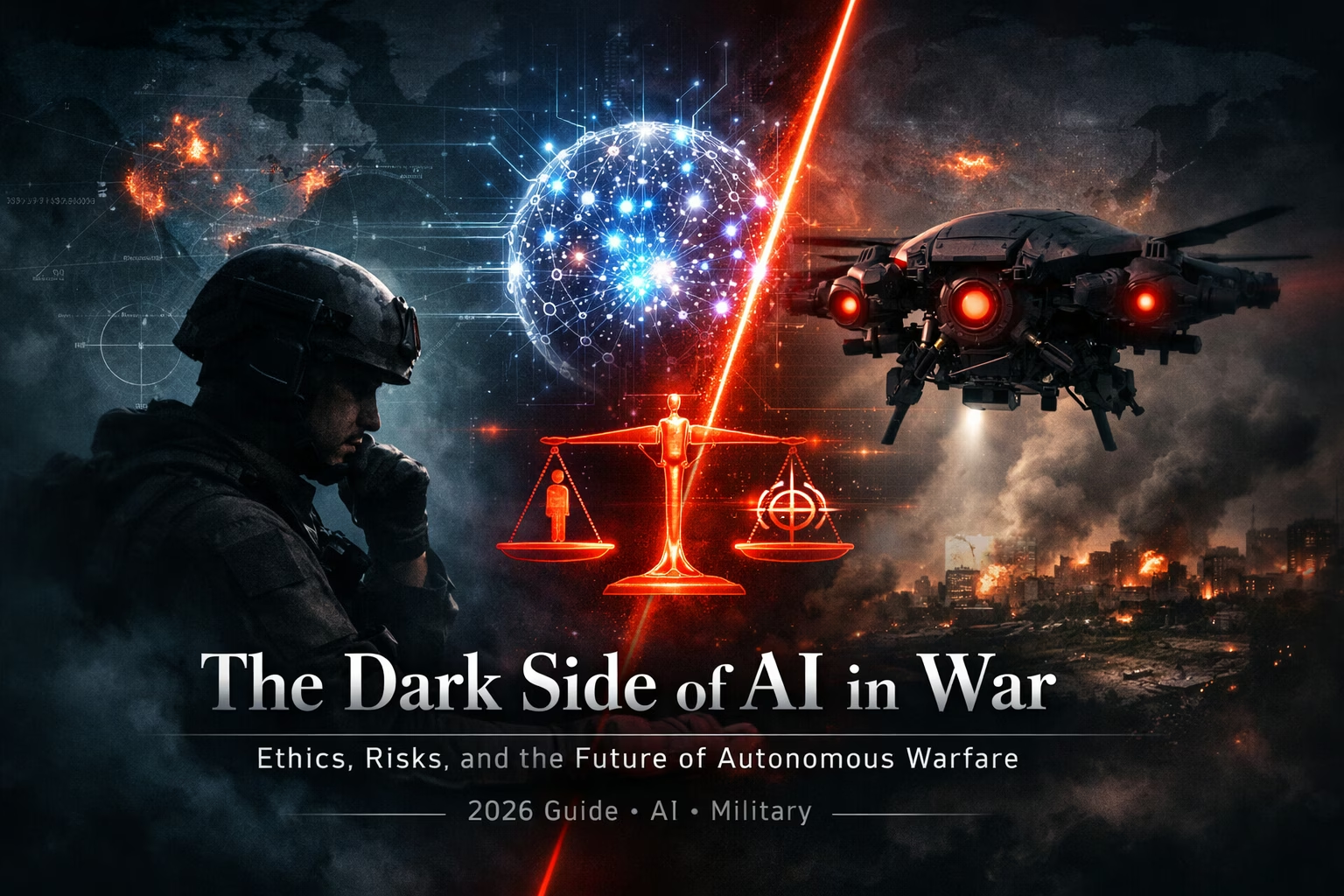
The Dark Side of AI in War: Ethics, Risks, and the Future of Autonomous Warfare (2026 Guide)

Machines are making life-or-death decisions on modern battlefields. Explore the ethics, dangers, and global security risks of AI in warfare — from autonomous drones to cyberweapons — and what it means for our future.
01 / IntroductionWhen Machines Go to War
Imagine a drone hovering silently at 30,000 feet, its camera locked onto a target. There's no pilot in a cockpit. No general on a radio. An artificial intelligence system analyzes the data, identifies the threat, and makes the call — all in less time than it takes you to blink.
This is not a Hollywood script. This is the emerging reality of AI in warfare, and it's unfolding faster than most people realize.
Modern war has always evolved with technology. From swords to gunpowder, from trenches to tanks, from nuclear missiles to stealth jets — each era brought new tools of destruction. But the integration of military artificial intelligence into combat systems is different. It's not just a new weapon. It's a new kind of decision-maker. One that doesn't feel fear, doesn't hesitate, and doesn't mourn.
In this guide, we'll explore what AI in warfare actually means, how it's being used right now, and — most importantly — the ethical risks, global dangers, and unanswered questions that come with it. Whether you're a developer, a student, or simply a curious human being living in an increasingly automated world, this is a conversation you need to be part of.
§
02 / FoundationsWhat Is AI in Warfare?
At its core, artificial intelligence is software that learns from data, recognizes patterns, and makes decisions — often without step-by-step human instructions. Think of it like teaching a dog new tricks, except the dog is a supercomputer, and the tricks involve analyzing satellite imagery or identifying targets at supersonic speed.
In a military context, AI refers to systems that can assist or replace human decision-making in defense and combat scenarios. This ranges from relatively benign applications — like AI software that predicts equipment failures before they happen — to deeply controversial ones, like autonomous weapons systems that can select and engage targets without a human pulling the trigger.
Key Definition
Autonomous Weapons Systems (AWS) are weapon platforms that use AI to independently detect, select, and engage targets. They are sometimes called "lethal autonomous weapons" or, in popular culture, "killer robots."
Countries like the United States, China, Russia, Israel, and South Korea are all actively developing or deploying AI in their military operations. The technology is already being used in drone navigation, battlefield surveillance, logistics optimization, cyber defense, and intelligence analysis.
The question isn't whether AI will play a role in future warfare. It already does. The question is: how much control should it have?
§
03 / TechnologiesTypes of AI Military Technologies
The umbrella of AI military applications covers a wide range of systems. Here are the four most significant categories — and what they actually do.
Autonomous Drones & Combat Systems
These are perhaps the most visible face of AI-powered weapons systems. Modern military drones can already fly pre-programmed routes, detect and track objects, and return to base without a human pilot. The next generation goes further: drones that swarm together, communicate with each other, and coordinate attacks without human oversight in real time. Think of a school of fish — but the fish are armed.
Surveillance & Facial Recognition
AI-powered surveillance systems can scan crowds, identify faces, track movement patterns, and flag "persons of interest" — all automatically. While this sounds useful in theory, it creates massive risks of misidentification, mass monitoring of civilians, and the erosion of privacy as a basic human right. Machine learning in defense has made surveillance faster and more scalable than ever before.
Cyber Warfare Tools
Cyber warfare technology powered by AI can scan networks for vulnerabilities in minutes, launch automated attacks, generate convincing disinformation at scale, and adapt to defenses in real time. A human hacker might attempt a few hundred password combinations per minute. An AI can try billions. This asymmetry makes AI a game-changer in digital warfare.
Decision-Making Algorithms
Perhaps the most unsettling category: AI systems that help — or outright make — strategic military decisions. These algorithms process vast intelligence feeds, satellite data, communication intercepts, and historical patterns to recommend or execute actions. When the algorithm's recommendation is "strike," the speed of AI can outpace any human review process.
§
04 / Core RisksThe Dark Side of AI in War
This is where the conversation gets serious. The same capabilities that make AI attractive to militaries are what make it genuinely terrifying. Let's break down the five biggest risks — one by one.
4.1 — Lack of Human Control
The most fundamental problem with autonomous weapons is the removal of human judgment from life-and-death decisions. A soldier can look a person in the eyes and hesitate. A drone with a targeting algorithm cannot.
International humanitarian law — the rules of war — requires that combatants distinguish between military targets and civilians, assess proportionality, and exercise judgment in complex situations. These are profoundly human skills. No AI system today can reliably replicate the kind of contextual, moral reasoning required in chaotic combat environments.
Critical Risk
When a machine makes a mistake in war, people die. There is no "undo" button. The faster AI systems operate — and they operate very fast — the less time there is for any human to intervene and prevent a catastrophic error.
4.2 — Bias in AI Algorithms
AI systems are only as fair as the data they're trained on. And in the real world, data is rarely fair. Facial recognition systems used in surveillance have repeatedly demonstrated higher error rates for people with darker skin tones. In a military targeting context, this bias isn't just an engineering flaw — it's a potential war crime.
If an AI weapon system trained on biased data misidentifies a civilian as a combatant, the algorithm doesn't bear the consequences. The civilian does.
4.3 — Risk of Mass Destruction
One of the most alarming properties of AI-powered weapons is scalability. A human army is limited by the number of soldiers, their stamina, and their logistics. An autonomous drone swarm has no such limits. Thousands of low-cost AI-guided weapons could be deployed simultaneously, overwhelming any conventional defense.
This lowers the threshold for catastrophic violence in a terrifying way. A conflict that might once have required massive military mobilization — giving diplomats time to intervene — could now escalate to mass destruction in hours.
4.4 — Cyber Attacks & AI Manipulation
What happens when an enemy hacks the AI? Adversarial attacks — subtle manipulations of the data an AI system perceives — can cause it to misidentify targets or malfunction entirely. A piece of tape on a stop sign can fool a self-driving car into misreading it. The same principle applies to weapons systems, with vastly higher stakes.
AI weapons systems are also vulnerable to spoofing (feeding them false data), jamming, and outright takeover. The more autonomous a system, the more catastrophic a successful cyberattack becomes. Cyber warfare technology and autonomous weapons are a dangerous combination.
4.5 — The Accountability Problem
Here's a scenario: an autonomous weapons system kills civilians. Who is responsible?
- The soldier who deployed it? They weren't in control.
- The officer who authorized its use? They didn't program it.
- The engineer who built it? They couldn't anticipate every battlefield scenario.
- The AI? It has no legal standing — you can't put an algorithm in prison.
This is the accountability gap, and it's one of the most troubling aspects of autonomous warfare. If no one can be held responsible for AI-inflicted harm, there is no deterrent against its misuse — and no justice for victims.
§
05 / EthicsThe Ethical Concerns of AI Warfare
"The question is not whether machines can think. The question is whether we should let them decide who lives."
— A question every policymaker must now confront
The ethical issues in technology don't get bigger than this. When we talk about AI war ethics, we're really asking something ancient and deeply human: what are the moral limits of violence, and who gets to enforce them?
Is It Moral to Let Machines Decide Human Lives?
War, for all its horror, has always been a human act — with human conscience at its center. Soldiers can surrender. Commanders can call off attacks. Combatants can recognize humanity in the enemy and choose mercy. Autonomous weapons have no such capacity. They execute objectives. That loss of human empathy in warfare is not a technical issue. It's a moral catastrophe waiting to happen.
International Law Hasn't Caught Up
The Geneva Conventions, the bedrock of international humanitarian law, were written in an era of human soldiers. They require "meaningful human control" over the use of force. Many legal scholars argue that fully autonomous weapons are inherently illegal under existing international law — yet no binding global treaty specifically bans them. The law is running decades behind the technology.
The AI Arms Race
Perhaps the most dangerous dynamic of all: the global race to develop military artificial intelligence is being driven not by a desire to use these weapons, but by fear of being left behind. The United States develops autonomous systems because China is developing them. China accelerates because the U.S. is ahead. Russia watches both and races to keep pace.
This mirrors the Cold War nuclear arms race — except AI weapons are cheaper, more accessible, and far easier to delegate to non-state actors. Global security and AI are now inseparable, and the trajectory is deeply concerning.
§
06 / Case StudiesReal-World Examples of AI in Conflict
These aren't hypotheticals. AI military applications are already shaping real conflicts and geopolitical tensions around the world.
01
AI-Guided Drone Strikes
Multiple militaries have deployed AI-assisted targeting systems in active conflict zones. These systems analyze visual and signals intelligence to recommend — and in some configurations, execute — strikes. The line between "AI-assisted" and "AI-directed" is blurring rapidly in real operational environments.
02
Automated Border Surveillance
Several nations have deployed AI surveillance towers along contested borders that automatically detect, classify, and track movement — flagging targets for human operators or, in some cases, triggering automated warnings or responses. These systems operate continuously, without fatigue, and at a scale no human team could match.
03
AI-Powered Cyber Operations
State-sponsored hacking groups increasingly use machine learning to automate the discovery of software vulnerabilities, craft more convincing phishing attacks, and adapt malware in real time to evade detection. The 2020s have seen a dramatic escalation in the sophistication and frequency of state-sponsored cyber warfare, with AI at the center of it.
04
Disinformation at Machine Scale
Generative AI has made it possible to produce millions of realistic-seeming social media posts, fake videos, and fabricated news articles at near-zero cost. In conflict zones, this capability is being weaponized to destabilize public trust, inflame sectarian tensions, and undermine democratic institutions — all without firing a single conventional shot.
§
07 / SecurityRisks for Global Security
The integration of AI into warfare doesn't just change how wars are fought. It changes who can fight them, how quickly they can start, and how hard they are to stop. The implications for global security and AI are profound.
⚡
Speed of Escalation
AI systems can respond and counter-respond in milliseconds. A conflict between AI-equipped adversaries could escalate to a crisis faster than any human diplomat could intervene.
🚪
Lower Barriers to War
Autonomous systems reduce the human cost of initiating conflict. If a government can go to war without risking its own soldiers' lives, the political barrier to starting one decreases significantly.
🕵️
Terrorist & Non-State Misuse
Advanced AI tools are becoming cheaper and more accessible. Terrorist organizations and criminal networks can leverage the same technology — drones, deepfakes, automated hacking — without a national defense budget.
🌐
Systemic Instability
When major powers engage in an AI arms race, smaller nations and unstable regions feel the pressure. The proliferation of autonomous weapons could trigger proxy wars and make existing conflicts far more deadly.
Warning
The dangers of artificial intelligence in warfare are not limited to direct combat. Economic warfare, infrastructure attacks, and information operations powered by AI pose existential risks to modern societies that depend on digital systems for water, power, healthcare, and communication.
§
08 / FutureThe Future of AI in Warfare
Where is all of this heading? The future of warfare technology is being written right now — in research labs, military procurement offices, and international negotiating chambers. Here's what the trajectory looks like.
Will AI Replace Soldiers?
Fully replacing human soldiers is still a distant prospect. But the role of human combatants is already shifting — toward supervision, strategy, and systems management rather than direct combat. The soldier of 2040 may spend more time managing autonomous platforms than carrying a rifle. This shift raises deep questions about accountability, military culture, and the very psychology of war.
The Rise of Fully Autonomous Weapons
The technical capability for fully autonomous lethal systems — weapons that can identify and kill targets without any human in the loop — exists today, or is very close to existing. The restraining factor is political and legal, not technical. How long those restraints hold is one of the most consequential open questions in international security.
Possible Regulations & Global Agreements
There is growing momentum for international regulation. The United Nations has convened multiple meetings on lethal autonomous weapons systems, and over 100 NGOs have called for a preemptive ban. However, the nations with the most advanced programs — the U.S., China, Russia — have resisted binding commitments. A comprehensive global treaty remains elusive, though not impossible.
The Role of Tech Companies
The private sector is deeply embedded in this story. Major technology companies supply cloud computing, AI software, and engineering talent to military programs. In 2018, thousands of Google employees signed a petition against the company's involvement in Project Maven, a Pentagon AI program — and Google ultimately declined to renew the contract. These moments of corporate conscience matter, and they set precedents for how the tech industry navigates its responsibility in AI in warfare.
§
09 / For YouWhat This Means for Developers & IT Professionals
If you're working in tech — or aspiring to — this isn't a distant political issue. It's your professional reality, and it comes with real responsibilities.
The Cybersecurity Opportunity
The rise of cyber warfare technology has created enormous demand for cybersecurity professionals. Protecting critical infrastructure, military networks, and civilian systems from AI-powered attacks is one of the fastest-growing career fields in technology. If you're building your skills in security, you're preparing for a career that genuinely matters.
The Ethical Responsibility of Developers
The engineers who build AI weapons systems are not neutral. The decisions made in code — what data to train on, what constraints to build in, what safeguards to include — have life-or-death consequences. The growing field of AI ethics is partly a response to this reality. Developers who understand both the technical and moral dimensions of their work are not just more thoughtful — they're more valuable.
Defense Tech Careers
Defense technology is a massive and growing sector. Machine learning in defense, autonomous systems engineering, secure communications, and AI safety research are all areas where technically skilled people can shape outcomes for the better — or worse. Knowing the ethical landscape of the field you're entering is essential.
Learning AI Responsibly
Understanding AI ethics and risks isn't just for policymakers and philosophers. Every developer who touches AI systems should understand bias, adversarial robustness, explainability, and the potential for misuse. The best defense against AI being used irresponsibly is a generation of builders who refuse to build irresponsibly.
§
FAQFrequently Asked Questions
Q1What is AI in warfare?
AI in warfare refers to the use of artificial intelligence technologies — including machine learning, computer vision, and autonomous systems — in military operations. This ranges from logistics optimization and intelligence analysis to AI-guided drones and autonomous weapons capable of selecting and engaging targets without direct human control.
Q2Are autonomous weapons legal under international law?
This is genuinely contested. No specific international treaty currently bans autonomous weapons outright. However, many legal scholars argue that fully autonomous weapons capable of selecting targets without human oversight violate existing international humanitarian law — particularly the requirements for distinction (between combatants and civilians), proportionality, and meaningful human control. The legal framework is actively under debate at the United Nations.
Q3What are the biggest risks of AI in war?
The major risks include: removal of human judgment from life-or-death decisions; algorithmic bias leading to misidentification of targets; scalability enabling mass-casualty attacks; vulnerability to hacking and adversarial manipulation; and a fundamental accountability gap — the absence of any clear legal or moral responsibility when AI systems cause harm.
Q4Can AI start a war on its own?
Not intentionally — AI systems don't have goals or desires. But they can absolutely trigger escalatory chains of events. An autonomous system that misidentifies an incoming threat and responds with a "defensive" strike could spark a conflict without any human intending it. The more autonomous military systems become, the greater the risk of accidental or algorithmic escalation.
Q5How can AI be controlled in military use?
Effective control requires multiple layers: technical safeguards (hard limits on what systems can do without human approval), legal frameworks (binding international treaties with verification mechanisms), institutional accountability (clear chains of responsibility for AI-assisted decisions), and cultural norms within militaries and the tech industry that treat "meaningful human control" as non-negotiable. None of these alone is sufficient — all are necessary.
10 / ConclusionWhere Do We Go From Here?
The risks of AI in war are not a distant hypothetical. They are unfolding now, in real conflicts, with real consequences. The technology is advancing at a pace that has consistently outrun our legal, ethical, and political frameworks.
That doesn't mean the outcome is predetermined. History shows that humanity has, at critical moments, chosen to limit its own destructive capacity — banning chemical weapons, constraining nuclear proliferation, restricting landmines. The same is possible with autonomous weapons, but it requires urgency, political will, and broad public understanding of what's at stake.
Technology is never neutral. The people who build it, deploy it, regulate it, and resist its misuse all shape what it becomes. If you've read this far, you're already part of that conversation.
The question isn't whether AI will change warfare. It already has. The question is whether we will be wise enough to control it before it controls us.