Digital Warfare Strategies Used by the USA (2026 Guide)

Explore the top digital warfare strategies used by the USA in 2026 — from cyber espionage and offensive attacks to AI-powered defense and information warfare. A complete beginner-friendly guide.
Introduction: The New Battlefield Has No Borders
Modern wars are no longer fought only with guns, tanks, and fighter jets. Today, some of the most powerful attacks happen silently — through a keyboard, a line of malicious code, or an algorithm running in a data center thousands of miles away. Welcome to the age of digital warfare.
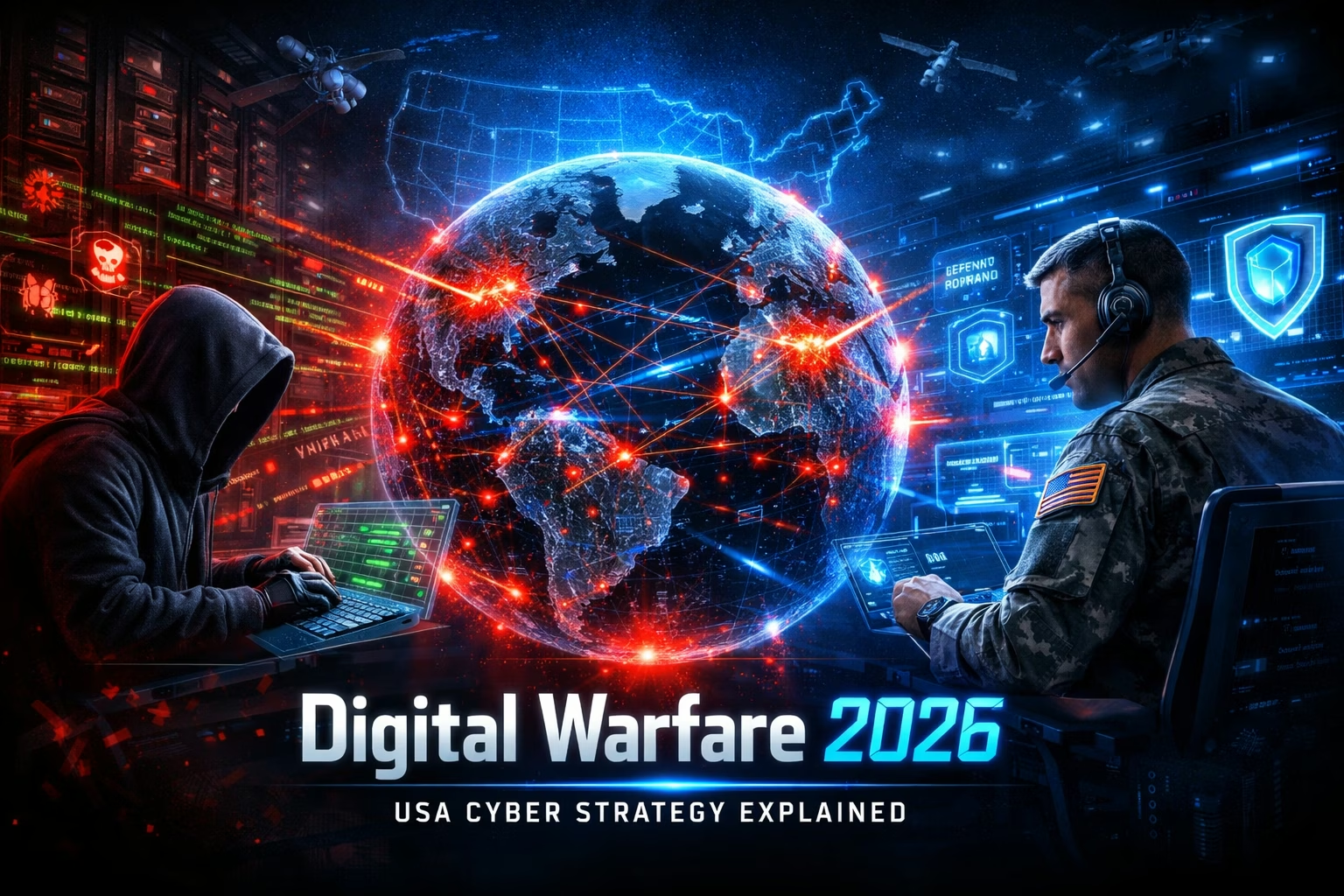
Digital warfare, often called cyber warfare, is the use of technology to attack, disrupt, spy on, or defend against enemies in the digital space. It targets everything from military networks and power grids to financial systems and public opinion. And in this new arena, the United States of America stands as one of the most capable, well-funded, and strategically advanced players in the world.
From the early days of internet-based intelligence gathering to today's AI-driven autonomous cyber operations, the USA has consistently been at the cutting edge of military cyber operations. Whether it's defending critical infrastructure, launching offensive cyber campaigns, or shaping global narratives through information warfare, America's digital strategy is as sophisticated as it is far-reaching.
In this guide, you'll get a comprehensive look at the digital warfare strategies used by the USA in 2026 — what they are, how they work, why they matter, and what the future holds. Whether you're a cybersecurity enthusiast, a student of military technology, or simply a curious reader, this article has something valuable for you.
What Is Digital Warfare?
At its core, digital warfare refers to the use of digital tools and cyberspace as a battlefield. Instead of physical weapons, combatants use malware, hacking tools, disinformation campaigns, and artificial intelligence to achieve strategic goals.
Think of it this way: traditional warfare aims to destroy physical assets — bridges, military bases, supply lines. Digital warfare aims to destroy or control information, infrastructure, and systems without a single bullet being fired.
The key differences between traditional and cyber warfare are significant:
- Traditional warfare is visible and physical; cyber warfare is often invisible and intangible.
- Traditional warfare requires large armies and heavy equipment; cyber warfare can be conducted by a small team of skilled operators.
- Traditional warfare has clear rules of engagement; the legal and ethical rules around cyber warfare are still evolving.
- Traditional warfare causes physical casualties; cyber warfare can cause massive economic and social disruption with minimal physical harm — though it can also enable physical attacks by disabling defense systems.
In today's hyper-connected world, the importance of digital warfare cannot be overstated. Almost every critical system — hospitals, power grids, financial networks, military communications — depends on digital infrastructure. Whoever controls the digital space holds enormous power over their adversaries.
The Evolution of US Digital Warfare
The United States didn't become a cyber superpower overnight. Its journey into digital warfare stretches back decades.
In the 1990s, as the internet began to reshape the world, the US military recognized early on that cyberspace would become a new domain of conflict. The first formalized efforts to develop offensive and defensive cyber capabilities began quietly within intelligence agencies like the NSA (National Security Agency).
By the early 2000s, following the September 11 attacks, the focus on digital security and cyber intelligence intensified dramatically. The wars in Afghanistan and Iraq brought to light how much modern militaries depend on networked systems — and how vulnerable those systems could be.
A major turning point came in 2009 when the United States Cyber Command (USCYBERCOM) was established. This unified command brought together cyber operations under a single military structure and signaled that the USA was treating cyberspace as a full military domain — on par with land, sea, air, and space.
United States Cyber Command operates under the Department of Defense and is responsible for directing, synchronizing, and coordinating cyberspace operations in defense of national interests. It works alongside the NSA and other intelligence agencies to execute both offensive and defensive cyber missions.
Another landmark moment came in 2018 when the US adopted a more aggressive "defend forward" doctrine — meaning American cyber forces would not wait to be attacked but would proactively operate in adversary networks to identify and disrupt threats before they reached home soil.
By 2026, US digital warfare capabilities have grown into a multi-layered, AI-enhanced ecosystem that spans military, intelligence, and civilian domains.
Core Digital Warfare Strategies Used by the USA
Cyber Espionage: Intelligence in the Digital Age
One of the oldest and most refined tools in America's digital warfare arsenal is cyber espionage. This involves secretly infiltrating the computer systems of foreign governments, military organizations, corporations, and individuals to gather intelligence.
The goals of cyber espionage include:
- Stealing sensitive government or military documents
- Monitoring the communications of foreign leaders and adversaries
- Tracking the movements of hostile groups and individuals
- Gaining economic intelligence about foreign industries and technologies
The NSA is the primary agency responsible for signals intelligence, and its capabilities for digital surveillance are legendary. Revelations over the years have shown just how vast these operations can be — intercepting communications, monitoring internet traffic, and gaining access to foreign servers.
Cyber espionage provides the US government with critical intelligence that shapes diplomatic decisions, military planning, and economic policy. It's the digital equivalent of having spies everywhere at once — but far more scalable and harder to detect.
Offensive Cyber Attacks: Striking Without Firing a Shot
The USA doesn't just play defense. Offensive cyber attacks are a core part of America's digital warfare strategy — and they can be extraordinarily powerful.
Offensive operations include:
- Deploying malware to disable enemy military systems
- Disrupting communication networks during conflict
- Attacking critical infrastructure like power grids or water systems in adversary nations
- Disabling air defense systems before traditional military strikes
One of the most famous examples of an offensive cyber operation attributed to the USA is the Stuxnet worm — a sophisticated piece of malware reportedly developed jointly by the US and Israel to sabotage Iran's nuclear program in the early 2010s. It targeted industrial control systems in Iranian uranium enrichment facilities and caused physical damage to centrifuges without a single conventional weapon being used.
By 2026, offensive cyber capabilities have become even more sophisticated. The USA can now deploy highly targeted cyber weapons that cause minimal collateral damage while achieving precise strategic objectives. These operations often remain classified, but their effects are felt across the globe.
Defensive Cyber Security: Protecting America's Digital Backbone
While offensive operations grab the headlines, defensive cyber security is arguably the most important pillar of America's digital warfare strategy. The USA has massive amounts of critical infrastructure to protect — and adversaries are constantly probing for weaknesses.
US cyber defense strategies include:
- Securing military networks and classified communications
- Protecting the power grid, water systems, and transportation networks
- Defending financial systems and banking infrastructure
- Securing government databases containing sensitive citizen and personnel data
The Cybersecurity and Infrastructure Security Agency (CISA) plays a central role in coordinating national cyber defense efforts. It works with private companies, state governments, and federal agencies to identify vulnerabilities and respond to incidents.
The "defend forward" strategy also plays a role here. By disrupting adversary operations before they reach American systems, US cyber forces create a defensive buffer in the digital world — much like maintaining a forward military presence to prevent conflicts from reaching home soil.
Zero-trust architecture — a security model that assumes threats may exist inside and outside a network — has become a standard framework across US government and military systems by 2026. Every user, device, and system must be continuously verified, minimizing the risk of insider threats or lateral movement by intruders.
Information Warfare: The Battle for Minds
Not all digital warfare is about hacking systems. Information warfare — the strategic use of information to influence, deceive, or destabilize adversaries — is one of the most powerful and controversial tools in the modern playbook.
The USA engages in information warfare through:
- Psychological operations (PSYOPS) aimed at influencing enemy soldiers and civilian populations
- Countering disinformation campaigns launched by foreign powers
- Broadcasting alternative narratives in conflict zones
- Monitoring and responding to foreign propaganda efforts on social media
Information warfare is a double-edged sword. While the USA works to counter foreign disinformation — particularly from countries like Russia and China — it also uses similar tools to shape perceptions and gain strategic advantages. The battlefield here is the human mind, and in the age of social media, it's a battleground where millions of engagements happen every single day.
By 2026, AI-powered tools have made information warfare far more sophisticated. Automated systems can now monitor millions of social media posts in real time, detect coordinated influence operations, and generate counter-narratives at scale — all without human intervention.
AI and Automation in Warfare: The Next Frontier
Perhaps the most transformative development in US digital warfare over recent years is the integration of artificial intelligence and automation into military cyber operations.
AI is being used across the full spectrum of digital warfare:
- Threat detection: AI systems scan network traffic at massive scale to identify anomalies and potential intrusions faster than any human analyst
- Autonomous cyber weapons: Malware and attack tools that can adapt their behavior in real time based on the target environment
- Decision support: AI systems that help commanders make faster, better-informed decisions during cyber operations
- Predictive intelligence: Machine learning models that analyze patterns in data to predict adversary behavior before attacks occur
The USA has invested billions of dollars in AI and machine learning for military applications. The Pentagon's AI adoption strategy — driven by initiatives like the Joint Artificial Intelligence Center (JAIC) and its successor bodies — aims to embed AI into every aspect of defense operations.
Autonomous systems and drones, guided by AI, are also increasingly being used in combination with cyber operations — disabling enemy air defenses digitally before physical strikes, for example. The boundaries between cyber warfare and traditional military operations are blurring rapidly.
Real-World Examples of US Digital Warfare
While many US cyber operations remain classified, several high-profile cases have become part of the public record:
Stuxnet (circa 2010): As mentioned earlier, this pioneering cyber weapon — reportedly a joint US-Israeli operation — targeted Iranian nuclear facilities and is widely considered the first major offensive cyber weapon deployed in a real-world conflict scenario.
Operation against ISIS: US Cyber Command conducted open operations against the Islamic State, disrupting their communications, propaganda networks, and financial systems. Officials have publicly discussed these efforts as a key part of the counter-ISIS campaign.
Election security operations: In the run-up to multiple US election cycles, USCYBERCOM conducted operations to counter foreign interference, including engaging directly in adversary networks to prevent attacks on American electoral infrastructure.
Response to SolarWinds: When a massive supply-chain cyber attack — attributed to Russian intelligence — compromised US government systems in 2020, it prompted a significant overhaul of American cyber defense posture and led to expanded offensive authorities for US cyber forces.
These examples illustrate how digital warfare has moved from theory to practiced reality — with the USA at the forefront of both offensive capability and strategic doctrine.
Technologies Powering US Digital Warfare
The US digital warfare machine is powered by a remarkable array of cutting-edge technologies:
Artificial Intelligence and Machine Learning form the backbone of modern cyber operations — from threat detection to autonomous attack systems. AI allows the USA to operate at a speed and scale that no human-only operation could match.
Big Data Analytics enables the processing of enormous volumes of intelligence data — communications intercepts, network logs, satellite imagery — to identify patterns, threats, and opportunities.
Cloud Computing provides the scalable infrastructure needed to store, process, and share vast amounts of sensitive military and intelligence data securely across distributed teams and locations.
Satellite and Space-Based Surveillance Systems extend America's digital reach into every corner of the globe, providing communications intercept capabilities, GPS infrastructure, and real-time monitoring of adversary activities.
Quantum Computing, still emerging but advancing rapidly, promises to revolutionize both encryption and code-breaking — with the potential to render current encryption standards obsolete and create virtually unbreakable communications for those who develop it first.
5G and Next-Gen Networks create both new opportunities and new vulnerabilities, enabling faster military communications while also expanding the attack surface that adversaries can exploit.
Impact on Global Security
America's digital warfare capabilities have profound implications for global security — not all of them straightforward.
On the positive side, US cyber dominance has deterred some adversaries from conducting full-scale attacks on American or allied infrastructure. The knowledge that the USA can respond with devastating cyber counterstrikes — or has already pre-positioned forces within adversary networks — creates a form of cyber deterrence.
However, the aggressive posture also creates risks. Every offensive capability the USA develops or deploys can be studied, reverse-engineered, and turned against it or its allies. The proliferation of cyber warfare tools has lowered the barrier to entry for smaller nations and non-state actors.
There are also serious questions about escalation. A cyber attack that disables a power grid, for example, could cause civilian casualties — and may be treated by the target nation as an act of war justifying a kinetic military response. The rules of engagement in cyberspace remain murky, increasing the risk of miscalculation.
US digital warfare activities have also strained diplomatic relationships, particularly when espionage operations targeting allies — as revealed in various leaks over the years — have come to light. Balancing the need for intelligence with the demands of alliance politics is a constant challenge.
The Future of Digital Warfare in the USA
Looking ahead to 2030 and beyond, the trajectory of US digital warfare points toward several major developments:
Quantum supremacy will reshape the encryption landscape entirely. Whoever achieves functional quantum computing at scale first will have an enormous intelligence advantage — and the USA is racing against China and others to get there.
AI autonomy will continue to expand. Future cyber weapons may operate entirely without human direction — identifying targets, launching attacks, and adapting to defenses in real time. This raises profound ethical questions about accountability and control.
Space as a cyber domain will become increasingly important. Satellites underpin GPS, communications, and intelligence gathering — making them prime targets and prime assets in future digital conflicts.
Biometric and cognitive warfare may emerge as new frontiers, with adversaries potentially using AI-generated deepfakes, personalized disinformation, or even neurotechnology to influence individuals and populations.
Public-private integration will deepen. Since most critical infrastructure is privately owned, the partnership between the US government and major technology companies will become even more essential to national cyber defense.
The USA will need to continue investing heavily in cyber talent, technology, and doctrine to maintain its edge in an increasingly competitive global cyber landscape.
How Individuals Can Stay Safe: Practical Cybersecurity Tips
While national cyber warfare plays out at the geopolitical level, individual Americans can take practical steps to protect themselves in an increasingly dangerous digital world:
- Use strong, unique passwords for every account, and use a reputable password manager to keep track of them.
- Enable multi-factor authentication (MFA) on every account that offers it — especially email, banking, and social media.
- Be vigilant about phishing — never click links in unsolicited emails or text messages, and always verify the sender's identity before sharing any personal information.
- Keep software updated — most successful cyber attacks exploit known vulnerabilities in outdated software. Regular updates close those gaps.
- Use a VPN when connecting to public Wi-Fi networks to encrypt your internet traffic and protect your data from eavesdroppers.
- Back up your data regularly — both to the cloud and to a physical external drive. In the event of a ransomware attack, having clean backups can save you from a devastating loss.
- Stay informed about current cyber threats. CISA's website regularly publishes alerts about active threats targeting American consumers and businesses.
Cyber security is not just a concern for governments and corporations — in a connected world, every individual is a potential target and a potential vulnerability.
Conclusion: The Digital Battlefield Is Here to Stay
Digital warfare is not a distant concept or a science fiction scenario — it is the defining strategic reality of our time. The United States has invested enormous resources, talent, and institutional energy into becoming the world's foremost cyber power, and by 2026, that investment has produced capabilities that are genuinely awe-inspiring in their scope and sophistication.
From the silent intelligence-gathering of cyber espionage to the disruptive power of offensive cyber attacks, from the relentless work of cyber defense to the mind-bending possibilities of AI-driven autonomous warfare, America's digital strategy is comprehensive, adaptive, and constantly evolving.
But with great power comes great responsibility — and great risk. The decisions made today about how to use, limit, and govern digital warfare capabilities will shape the security landscape for generations to come. In a world where a single line of code can disrupt a nation's power supply, the stakes could not be higher.
The keyboard, it turns out, can be mightier than the sword.
Frequently Asked Questions (FAQs)
1. What is digital warfare and how is it different from traditional warfare? Digital warfare, or cyber warfare, uses technology and cyberspace to attack, disrupt, or defend against adversaries. Unlike traditional warfare, which involves physical weapons and visible destruction, digital warfare operates in the invisible realm of networks and data. It can cause massive disruption — disabling power grids, stealing secrets, or crashing financial systems — without any physical confrontation.
2. What is the role of United States Cyber Command in digital warfare? United States Cyber Command (USCYBERCOM) is the military body responsible for organizing, directing, and executing cyber operations in defense of US national interests. It coordinates offensive and defensive cyber missions, works alongside intelligence agencies like the NSA, and operates under a "defend forward" doctrine that involves proactively engaging adversaries in their own networks before they can attack US systems.
3. What are some real-world examples of US cyber warfare operations? The most widely known example is the Stuxnet operation, a sophisticated cyberweapon reportedly developed jointly by the US and Israel to sabotage Iran's nuclear program around 2010. US Cyber Command has also conducted publicly acknowledged operations against ISIS, disrupting their communications and propaganda infrastructure. Additionally, the USA conducted operations to protect electoral infrastructure from foreign interference in multiple election cycles.
4. How does AI change the nature of cyber warfare? Artificial intelligence dramatically accelerates and scales cyber warfare operations. AI systems can detect threats in real time, automate attacks, adapt malware to circumvent defenses, and analyze vast intelligence datasets far faster than human analysts. As AI becomes more autonomous, future cyber weapons may be able to operate entirely without human direction — raising serious ethical and strategic questions about accountability and escalation control.
5. How can ordinary Americans protect themselves from cyber threats? The most effective steps individuals can take include using strong, unique passwords with a password manager, enabling multi-factor authentication on all important accounts, staying alert to phishing attempts, keeping all devices and software updated, using a VPN on public networks, and regularly backing up important data. Staying informed through resources like CISA's cybersecurity alerts also helps individuals stay ahead of emerging threats.