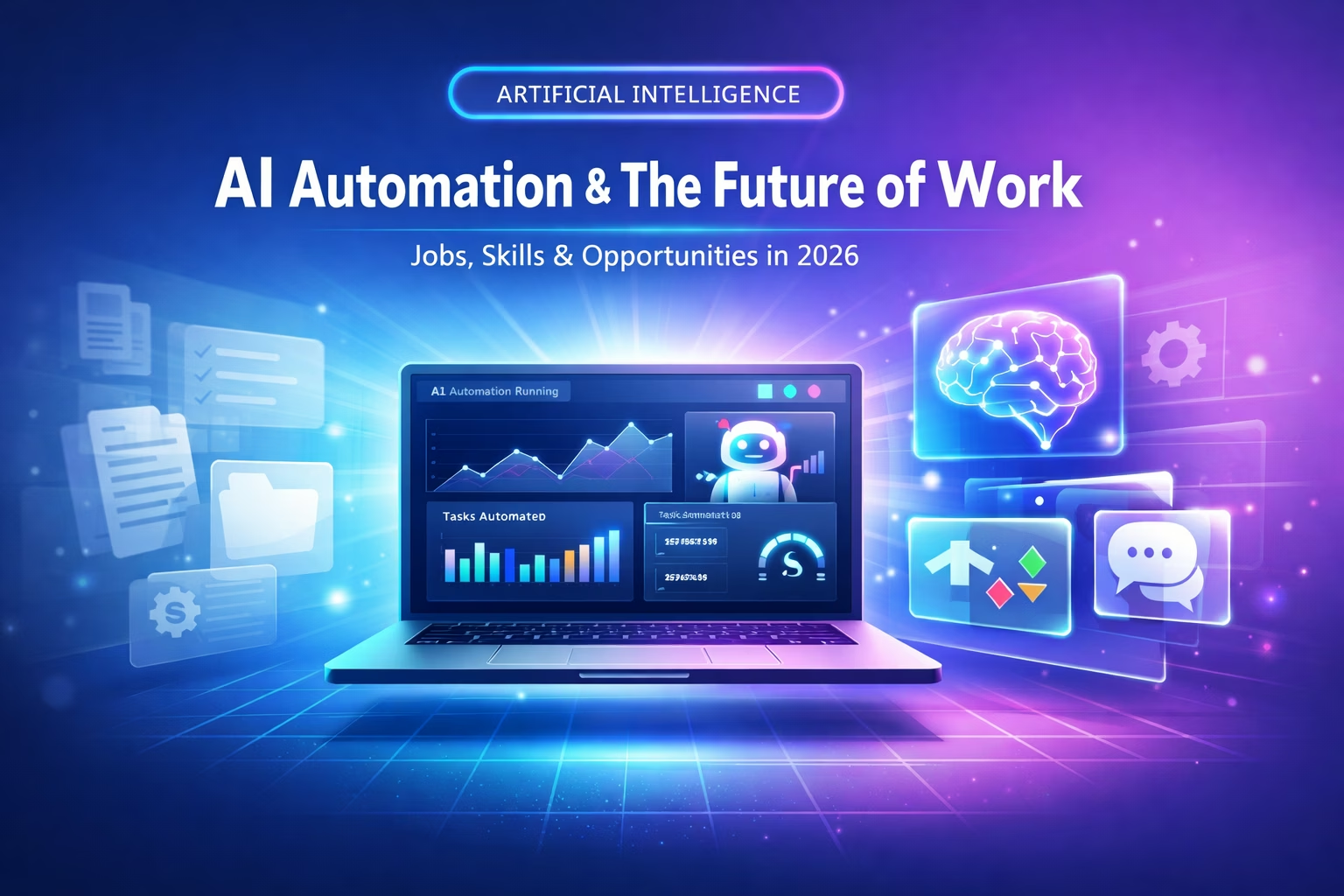
How AI Automation is Changing the Global Workforce: The Future of Jobs 2026

AI automation is reshaping the global workforce faster than most people realize. Discover which jobs are at risk, which skills will survive, and how to future-proof your career in an AI-driven world — with actionable insights for 2026 and beyond.
Introduction: The Shift Has Already Begun
Not long ago, the idea of a machine writing code, diagnosing illness, or managing customer relationships felt like science fiction. Today, it's Tuesday morning at most tech companies.
AI automation is no longer a distant prediction — it's an active force reshaping the global workforce right now. Millions of jobs are being redefined, entire industries are reorganizing around intelligent systems, and workers everywhere are asking the same urgent question:
Will AI replace your job — or create the opportunity you've been waiting for?
The honest answer is: it depends on what you do next.
This isn't a doom-and-gloom article, and it isn't blind optimism either. It's a clear-eyed look at how AI automation is transforming the global workforce, which roles are most vulnerable, which skills will carry you forward, and how to position yourself on the right side of this shift.
What is AI Automation?
Before diving into impact, let's get clarity on terms — because "automation" and "AI" are often used interchangeably when they're actually quite different.
Traditional automation follows fixed rules. A machine on an assembly line performs the same action thousands of times without deviation. It does exactly what it's programmed to do — nothing more.
AI automation is different. It learns, adapts, and improves over time. It can recognize patterns, make decisions, process natural language, generate content, and handle tasks that previously required human judgment.
Real-world examples of AI automation in action:
- A chatbot that resolves customer complaints without human involvement
- Software that reviews legal contracts and flags risks in minutes
- Algorithms that approve or deny loan applications based on thousands of data points
- AI tools that write, edit, and optimize marketing content
- Diagnostic systems that analyze medical images with high precision
The leap from rule-based automation to AI-driven automation is significant. It means that knowledge work — not just manual labor — is now within the scope of what machines can do.
The Evolution of the Global Workforce
To understand where we're going, it helps to see how far we've come.
The Industrial Revolution mechanized physical labor. Farmers became factory workers. Craftsmanship gave way to mass production. Millions of jobs disappeared — and millions of new ones were created.
The Digital Revolution moved work from physical to knowledge-based. Computers replaced paper ledgers. The internet created entirely new industries — e-commerce, social media, digital marketing, software development — that didn't exist a generation earlier.
The AI Revolution is doing something different from both. It's not just automating physical tasks or digitizing processes. It's automating cognition — the ability to analyze, decide, create, and communicate.
That's why this moment feels different. And why the workforce transformation happening right now is more profound than anything that came before it.
How AI Automation is Transforming Jobs
The impact of AI on jobs is not a single story. It's three distinct stories happening simultaneously.
Jobs Being Replaced by AI
Some roles are genuinely at high risk. These tend to be positions built around repetitive, rule-based tasks — work that follows predictable patterns and doesn't require emotional intelligence or complex judgment.
Jobs facing significant displacement pressure:
- Data entry clerks and administrative processors
- Basic customer service representatives
- Routine bookkeeping and payroll processing
- Assembly line quality control inspectors
- Basic content moderation roles
- Junior-level report generation and data summarization
The common thread is predictability. If your job can be described as a series of repeatable steps, AI can learn those steps — and execute them faster and cheaper.
Jobs Being Created by AI
Here's what most people miss in this conversation: AI is also generating entirely new categories of work that didn't exist before.
Emerging roles directly created by AI growth:
- AI prompt engineers and model trainers
- Machine learning operations (MLOps) specialists
- AI ethics and bias auditors
- Conversational AI designers
- Synthetic data specialists
- AI-assisted healthcare coordinators
- Automation workflow consultants
Beyond these technical roles, AI is creating demand for human oversight, quality assurance, and strategic direction across nearly every industry. Machines can execute — but they still need humans to set direction, evaluate outcomes, and course-correct.
Jobs Being Transformed (Not Replaced)
This is the largest and most important category — and it gets the least attention.
The truth is, most jobs won't vanish. They'll evolve. AI becomes a tool that professionals use to work faster, smarter, and at greater scale.
- Doctors use AI diagnostics but still make the final call and care for patients
- Lawyers use AI contract review but still provide strategy and counsel
- Designers use AI image generation as a starting point but apply taste and judgment
- Developers use AI code assistants but architect systems and solve complex problems
- Writers use AI drafting tools but bring original voice, insight, and research
The professionals who thrive will be those who treat AI as a powerful collaborator rather than a threat.
Industries Most Affected by AI
Technology is both the driver and the subject of this transformation. Software developers are using AI assistants to write and debug code faster than ever — but they're also building the AI systems that affect every other industry.
Healthcare is experiencing a fundamental shift. AI is improving diagnostic accuracy, personalizing treatment plans, accelerating drug discovery, and automating administrative workloads that consume a significant portion of healthcare workers' time.
Finance has embraced AI for fraud detection, algorithmic trading, credit risk assessment, and customer-facing financial advice. Back-office operations that once required large teams are increasingly automated.
Customer Service has been dramatically reshaped by conversational AI. Chatbots now handle a growing share of customer interactions across banking, retail, telecoms, and software — with escalation to human agents reserved for complex or sensitive cases.
Manufacturing continues its automation journey, but AI adds a new layer — predictive maintenance, quality control through computer vision, adaptive production scheduling, and supply chain optimization that responds to real-time conditions.
Impact on Freelancers and Remote Workers
For freelancers and remote workers, AI automation is a double-edged sword.
On one side, AI tools have dramatically expanded what a solo professional can produce. A single freelance marketer with the right AI stack can output what previously required a small team. Developers ship faster. Designers iterate quicker. Writers research more efficiently.
The productivity gains are real — and they're significant.
On the other side, competition has intensified. Clients who once hired five people for a project may now hire two with AI assistance. Entry-level freelance work — basic copywriting, simple design, data research — is under serious price pressure as AI handles more of the base-level work.
The opportunity for freelancers lies in moving up the value chain. Positioning around strategy, creative direction, complex problem-solving, and client relationships creates defensible value that AI tools can't replicate alone.
Remote work itself is also being reshaped by automation — AI scheduling tools, meeting summarizers, async communication assistants, and project management automation are changing how distributed teams operate day to day.
Benefits of AI Automation for Businesses
From a business perspective, the case for AI automation is compelling. It's not difficult to understand why adoption is accelerating.
- Cost reduction — Automating repetitive tasks reduces labor costs and minimizes human error, particularly in high-volume operational areas
- Efficiency at scale — AI systems can handle workloads that would require hundreds of human hours, completing them in minutes without fatigue
- Faster decision-making — AI processes vast datasets and surfaces insights faster than any human analyst, enabling quicker, more informed strategic decisions
- 24/7 availability — Automated systems don't take breaks, observe holidays, or get sick — critical for customer-facing operations in global markets
- Consistency — AI delivers the same quality output repeatedly, eliminating the variability that comes with human performance across different conditions
For small and medium businesses, AI automation is particularly transformative — it levels the playing field by giving smaller operations access to capabilities that were previously only affordable for large enterprises.
Risks and Challenges of AI Automation
The benefits are real. So are the risks. A balanced view requires engaging honestly with both.
Job displacement is the most visible concern. While new roles are being created, the transition isn't seamless. Workers displaced from declining roles don't automatically slot into emerging ones — retraining takes time, resources, and access that aren't equally available to everyone.
Skill gaps are widening. The demand for AI literacy, data fluency, and technical skills is growing faster than educational systems are producing graduates with those capabilities.
Ethical concerns are multiplying. AI systems trained on biased data reproduce and sometimes amplify those biases. Hiring algorithms, credit scoring systems, and law enforcement tools have all demonstrated problematic patterns that require human oversight and correction.
Over-reliance on AI creates new vulnerabilities. Organizations that automate critical processes without maintaining human understanding of how those processes work become fragile. When AI systems fail — and they do fail — the absence of human expertise to step in becomes a serious problem.
Privacy and data security risks grow as AI systems require and process ever-larger volumes of personal data to function effectively.
Navigating these challenges requires thoughtful policy, organizational responsibility, and individual awareness — not just technological capability.
Skills That Will Survive AI Automation
Here's a practical question worth sitting with: what can humans do that AI genuinely cannot?
Technical skills with enduring value:
- AI and machine learning development — someone has to build, train, and maintain these systems
- Cloud architecture and infrastructure management
- Cybersecurity — especially as AI both creates and combats new threat vectors
- Complex software engineering and system design
- Data science and advanced analytics
Human skills that AI cannot replicate:
- Creative thinking — original ideas, cultural intuition, artistic vision
- Emotional intelligence — empathy, nuanced communication, relationship building
- Ethical judgment — navigating complex moral trade-offs that require values, not just data
- Leadership and vision — inspiring people, managing uncertainty, making decisions without complete information
- Complex problem-solving — tackling genuinely novel challenges that don't fit existing patterns
- Physical dexterity in unstructured environments — skilled trades, hands-on healthcare, complex repairs
The most resilient career positions combine technical fluency with deeply human capabilities. Neither alone is as strong as both together.
How to Future-Proof Your Career
Awareness without action is just anxiety. Here's how to move forward:
Learn AI tools relevant to your field. You don't need to become an AI engineer to benefit from AI literacy. Understanding how to use AI assistants, automation platforms, and data tools in your specific domain makes you more productive and more valuable.
Upskill continuously — and deliberately. The half-life of specific technical skills is shrinking. Build a habit of regular learning: online courses, certifications, communities of practice. Treat skill development as ongoing maintenance, not a one-time event.
Build a visible personal brand. In a world where AI can produce generic work at scale, individual perspective and reputation become differentiating assets. Publish your thinking, share your expertise, build a portfolio that demonstrates your specific capabilities and approach.
Develop T-shaped expertise. Broad awareness across adjacent areas, combined with deep expertise in one domain, creates professionals who can connect dots and contribute at multiple levels — something AI systems struggle to do across genuinely different contexts.
Embrace adaptability as a core skill. The professionals who will navigate this transition most successfully aren't necessarily those with the most technical knowledge today — they're those who are comfortable with change and committed to continuous growth.
Future of Work: 2026–2030 Predictions
Looking at the trajectory of AI automation and global workforce trends, several patterns are becoming clear:
AI-human collaboration will become the standard model. Rather than AI replacing workers wholesale, the dominant pattern will be AI augmenting human capabilities — with the most effective workers being those who leverage AI most skillfully.
Hybrid jobs will multiply. Roles that combine domain expertise with AI fluency will command premium value. The healthcare professional who understands AI diagnostics, the lawyer who can work with AI contract tools, the marketer who can direct and evaluate AI-generated content — these hybrid profiles will be in high demand.
Repetitive middle-skill work faces the most pressure. Entry-level knowledge work — the kind of roles that once served as training grounds for developing expertise — will be increasingly automated. This creates a skills ladder gap that societies will need to address thoughtfully.
New governance frameworks will emerge. AI regulation, data rights, algorithmic accountability, and workforce transition policy will become major areas of political and legal activity globally as the impacts of automation become more visible and broadly felt.
The geography of work will continue shifting. Remote work automation tools will make global talent competition more intense, while simultaneously enabling workers in more locations to participate in the digital economy.
Final Thoughts
AI automation isn't a threat to be feared or a revolution to be worshipped. It's a powerful set of tools and forces that are reshaping the global workforce in real time — with consequences that are simultaneously challenging and full of possibility.
The workers, freelancers, and businesses that approach this moment with clear eyes, a commitment to continuous learning, and a willingness to evolve alongside these changes will find that AI creates more opportunity than it closes.
The ones who wait for certainty — or assume things will stay as they are — face a harder road.
The future of work is not AI or humans. It's AI and humans, figuring out how to work together. The question is whether you're building the skills and mindset to be part of that collaboration.
Start now. The window is open — but it won't stay open indefinitely.
FAQ
Will AI replace all jobs? No. AI will displace certain categories of repetitive, rule-based work, but it will simultaneously create new roles and transform existing ones. The net impact on total employment is still debated by economists, but the consensus is that adaptation — not elimination — describes most workers' futures.
Which jobs are safest from AI automation? Roles requiring strong emotional intelligence, complex physical dexterity in unstructured environments, original creative thinking, ethical judgment, and high-stakes interpersonal communication are most resilient. Skilled trades, counseling, creative direction, complex caregiving, and strategic leadership all fall into this category.
How can I prepare for an AI-driven future? Build AI literacy relevant to your field, develop human skills that complement rather than compete with AI, upskill consistently, and position yourself around high-value, judgment-intensive work. Visibility and personal brand also matter more in a world where AI handles generic output.
Is AI good or bad for employment? Both — and the honest answer is that it depends significantly on policy choices, access to education and retraining, and how quickly affected workers can transition into emerging roles. AI creates genuine opportunity, but the transition costs are real and not evenly distributed.
What skills will be most valuable in 2030? AI fluency combined with deeply human capabilities — creative problem-solving, emotional intelligence, communication, ethical reasoning, and adaptability. Technical skills in AI development, cybersecurity, and cloud infrastructure will also remain in strong demand.
Can freelancers compete in an AI-dominated market? Yes — but the value proposition must evolve. Freelancers who compete on speed and volume for commodity work face growing pressure. Those who position around strategy, expertise, creative direction, and client relationships will find AI makes them more productive and more competitive, not less relevant.
How fast is AI changing the job market? Faster than most people expect, but slower than the most dramatic headlines suggest. The transformation is uneven across industries and geographies. Some sectors are already deeply affected; others are in early stages of change. Building adaptability now provides a buffer regardless of your specific field's pace of change.