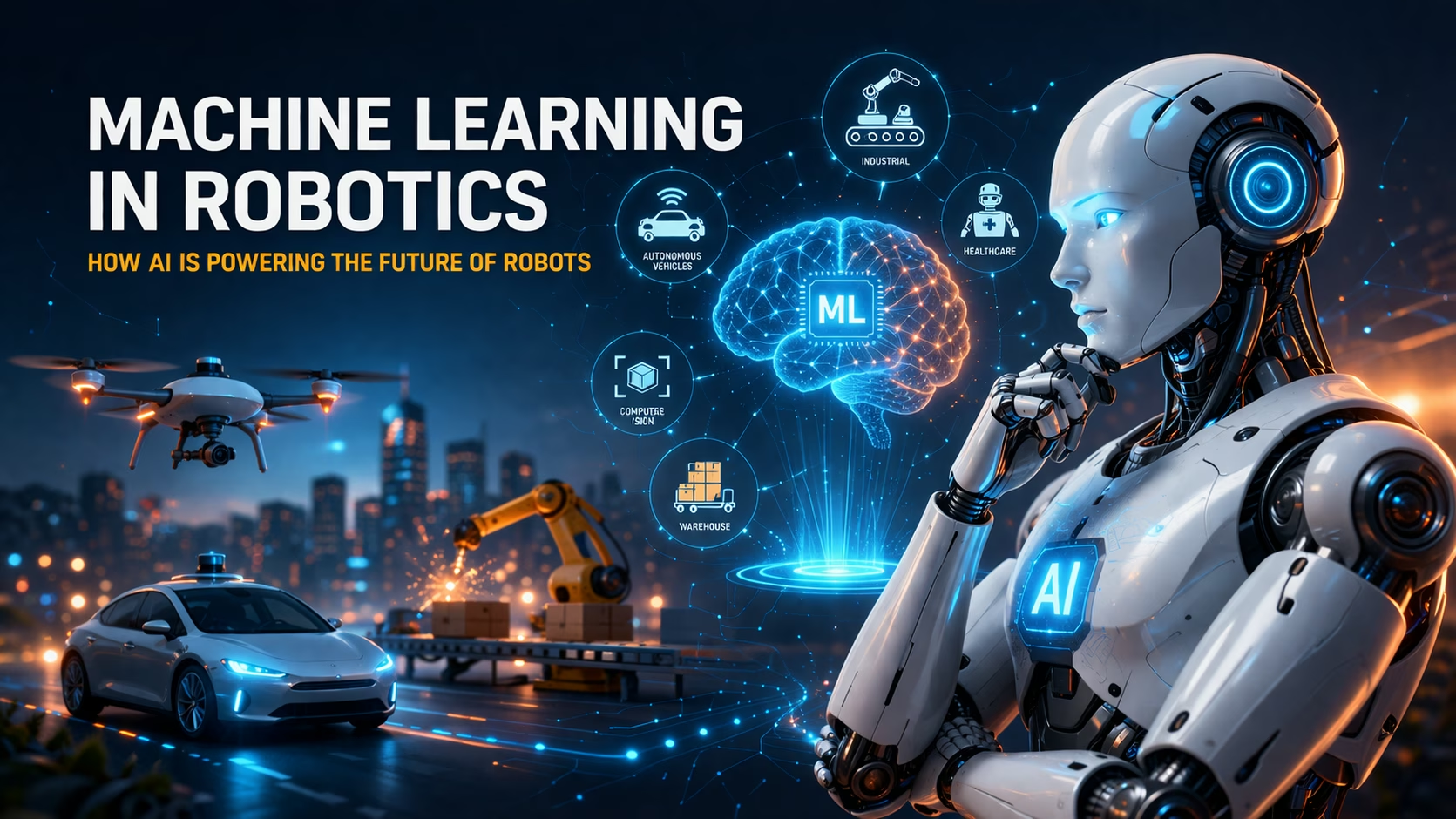
How AI is Revolutionizing Robotics in 2026: The Era of Physical AI

Discover how Agentic AI, VLA models, and NVIDIA Omniverse are closing the sim-to-real gap, transforming robots from rigid machines into intelligent, embodied entities in 2026.
2026 isn't just another year for robotics; it marks a profound paradigm shift driven by artificial intelligence. We are moving beyond mere automation to an era of "Physical AI," where robots are no longer just programmed machines but intelligent entities capable of learning, adapting, and interacting seamlessly with the real world. This revolution is redefining industries, enhancing human capabilities, and setting the stage for an unprecedented future.
The Shift from Automation to "Embodied Intelligence"
For decades, industrial robots operated with predictable precision within controlled environments. Their tasks were hard-coded, their movements repetitive, and their adaptability minimal. The advent of AI has shattered these limitations, transforming robots into truly "embodied intelligent systems."
What is Physical AI?
Physical AI refers to the convergence of advanced artificial intelligence with robotic hardware, enabling machines to perceive, reason, and act within dynamic physical environments. Unlike traditional AI that primarily operates in the digital realm, Physical AI directly influences the physical world. This means robots can now interpret complex sensory data, make autonomous decisions, and perform intricate tasks that once required human dexterity and cognitive flexibility. Think of it as giving a robot a brain and a body that truly works together.
The Role of Vision-Language-Action (VLA) Models
At the heart of this transformation are Vision-Language-Action (VLA) models. These sophisticated AI frameworks allow robots to understand and execute tasks based on natural language instructions, visual cues, and contextual awareness. Imagine telling a robot, "Pick up the blue wrench from the workbench and hand it to me," and it not only understands "blue wrench" visually but also comprehends the action "pick up" and "hand it." VLA models like Google DeepMind's RT-2 Octo π0 are pivotal in bridging the gap between human intent and robotic execution, making human-robot interaction intuitive and efficient.
Top 5 AI Robotics Trends for 2026
The landscape of robotics in 2026 is defined by several groundbreaking trends, each propelled by advancements in AI:
1. Agentic AI and Generative AI in Robotics
This year, Agentic AI is moving beyond theoretical discussions into practical robotic deployment. Agentic AI refers to intelligent systems capable of setting goals, planning complex sequences of actions, executing them, and autonomously course-correcting based on real-time feedback. This enables robots to tackle unstructured problems without explicit human instruction for every step.
Simultaneously, Generative AI in robotics is revolutionizing design, simulation, and operational efficiency. Instead of humans designing every component or motion path, generative AI can autonomously create optimal robot designs, generate synthetic data for training, and even devise novel manipulation strategies, drastically accelerating development cycles.
2. Closing the Sim-to-Real Gap with Synthetic Data
One of the biggest hurdles in robotics development has historically been the "sim-to-real gap" – the challenge of transferring learned behaviors from simulated environments to the real world. In 2026, synthetic data generation is the game-changer. High-fidelity simulation platforms like NVIDIA Omniverse allow AI models to be trained on vast amounts of photorealistic synthetic data, dramatically reducing the need for expensive and time-consuming real-world data collection. This accelerated training allows robots to quickly adapt to new tasks and environments, making deployments faster and more reliable. This has led to breakthroughs like those seen with NVIDIA Isaac Sim, pushing robots from prototype to production with unprecedented speed.
3. Humanoid Robots on the Manufacturing Floor
While humanoid robots have long been a subject of fascination, 2026 marks their serious emergence beyond research labs. Companies like Tesla with Optimus, Figure with Figure 01, and Boston Dynamics with Atlas are making significant strides in human-like dexterity and mobility. These AI-powered humanoid robots are now demonstrating capabilities that enable them to perform tasks in environments originally designed for humans, addressing labor shortages and boosting productivity in manufacturing, logistics, and even service industries. Their ability to use human tools and navigate complex spaces makes them ideal for flexible automation.
4. IT/OT Convergence and Edge Computing
The integration of Information Technology (IT) with Operational Technology (OT) is a critical trend for 2026. IT/OT convergence allows for seamless data flow between factory floor machines (OT) and enterprise IT systems, enabling advanced analytics, predictive maintenance, and real-time decision-making.
Furthermore, Edge Computing is empowering robots to process data locally, reducing latency and improving responsiveness. This is crucial for autonomous systems operating in dynamic environments where split-second decisions are vital. AI robotics chips optimized for edge processing, often featuring Neural Processing Units (NPUs), are making this possible, moving intelligence closer to the point of action.
5. Collaborative Robots (Cobots) and Safety
Collaborative robots, or cobots, are becoming increasingly sophisticated thanks to AI. They are designed to work alongside humans without safety cages, offering unparalleled flexibility in manufacturing and assembly. AI enhances their ability to perceive human presence, predict movements, and adapt their actions to ensure safety. This is underpinned by advancements in AI robotics safety protocols and adherence to ISO safety standards for robotics, fostering trust and efficiency in human-robot collaboration.
Real-World Applications of AI Robotics
The impact of these AI-driven advancements is already being felt across various sectors:
AI in Industrial and Manufacturing Robotics
In manufacturing, AI is enabling robots to perform complex assembly, quality inspection with computer vision, and adaptive material handling. From personalized product lines to highly efficient smart factories, AI in industrial robotics is driving unprecedented levels of productivity and precision. Industrial robot arms equipped with AI can now handle delicate components, learn new tasks from demonstration, and optimize their own workflows.
Medical and Surgical Robots
Medical robots and surgical robots are being revolutionized by AI. These systems can assist surgeons with unparalleled accuracy, perform minimally invasive procedures, and even analyze patient data to guide diagnostics. AI enhances their ability to interpret complex anatomical structures, adapt to physiological variations, and reduce human error, leading to improved patient outcomes.
Warehouse Automation and AMRs
The e-commerce boom has accelerated the need for sophisticated warehouse automation. AI is at the core of this, powering autonomous mobile robots (AMRs) that navigate dynamic warehouse environments, optimize inventory placement, and fulfill orders with remarkable speed and efficiency. AI in warehouse robotics minimizes human intervention, reduces operational costs, and handles the increasing demands of global logistics.
The Technology Stack Powering 2026 Robotics
The rapid evolution of AI in robotics is heavily reliant on underlying technological advancements:
NVIDIA Omniverse and Digital Twins
Digital twins – virtual replicas of physical systems – are invaluable for designing, testing, and optimizing robots. Platforms like NVIDIA Omniverse provide the framework for creating highly accurate, physically simulated digital twins, allowing engineers to iterate on robot designs and train AI models in a risk-free virtual environment before deploying them to the real world. This accelerates development and ensures robust performance.
Edge AI and Next-Gen Chips
The demand for real-time processing and autonomous decision-making means that much of AI's computational power is moving to the "edge" – directly onto the robot itself. Edge AI is powered by specialized AI robotics hardware and AI robotics chips that offer high performance with low power consumption. This enables robots to operate independently in remote or challenging environments without constant reliance on cloud connectivity.
Frequently Asked Questions (FAQ)
What is the difference between AI and robotics?
Artificial Intelligence (AI) is the science of making machines intelligent—capable of reasoning, learning, and perceiving. Robotics is the engineering discipline that deals with the design, construction, operation, and application of robots. In 2026, AI is the "brain" that empowers robots (the "body") to perform complex, adaptive, and autonomous tasks, moving beyond simple programmed movements.
How is generative AI used in robotics?
Generative AI is used in robotics for several key functions:
-
Synthetic Data Generation: Creating vast amounts of diverse training data for AI models, bridging the sim-to-real gap.
-
Robot Design: Generating novel and optimized designs for robot morphology and components.
-
Task Planning: Devising efficient and adaptive motion plans for complex manipulation tasks.
-
Content Creation: Generating instructional materials or simulations for human operators.
What are the challenges of AI in robotics?
Despite rapid advancements, challenges remain, including:
-
Safety and Ethics: Ensuring safe human-robot interaction and addressing ethical concerns around autonomous decision-making.
-
Robustness: Making AI systems reliable enough to handle unforeseen circumstances in unpredictable real-world environments.
-
Scalability: Developing cost-effective and easily deployable solutions for widespread adoption across various industries.
-
Energy Efficiency: Powering complex AI computations on mobile platforms.
-
Cybersecurity: Protecting AI-powered robotic systems from malicious attacks.