Next Big Technologies After AI: Future Innovations That Will Shape 2030 and Beyond

Discover the next big technologies after AI, including quantum computing, brain-computer interfaces, and robotics that will shape the future by 2030.
Artificial Intelligence (AI) has already transformed the modern world. From automating business operations to powering recommendation systems and self-driving cars, AI is no longer a futuristic idea—it’s reality. But here’s the bigger question:
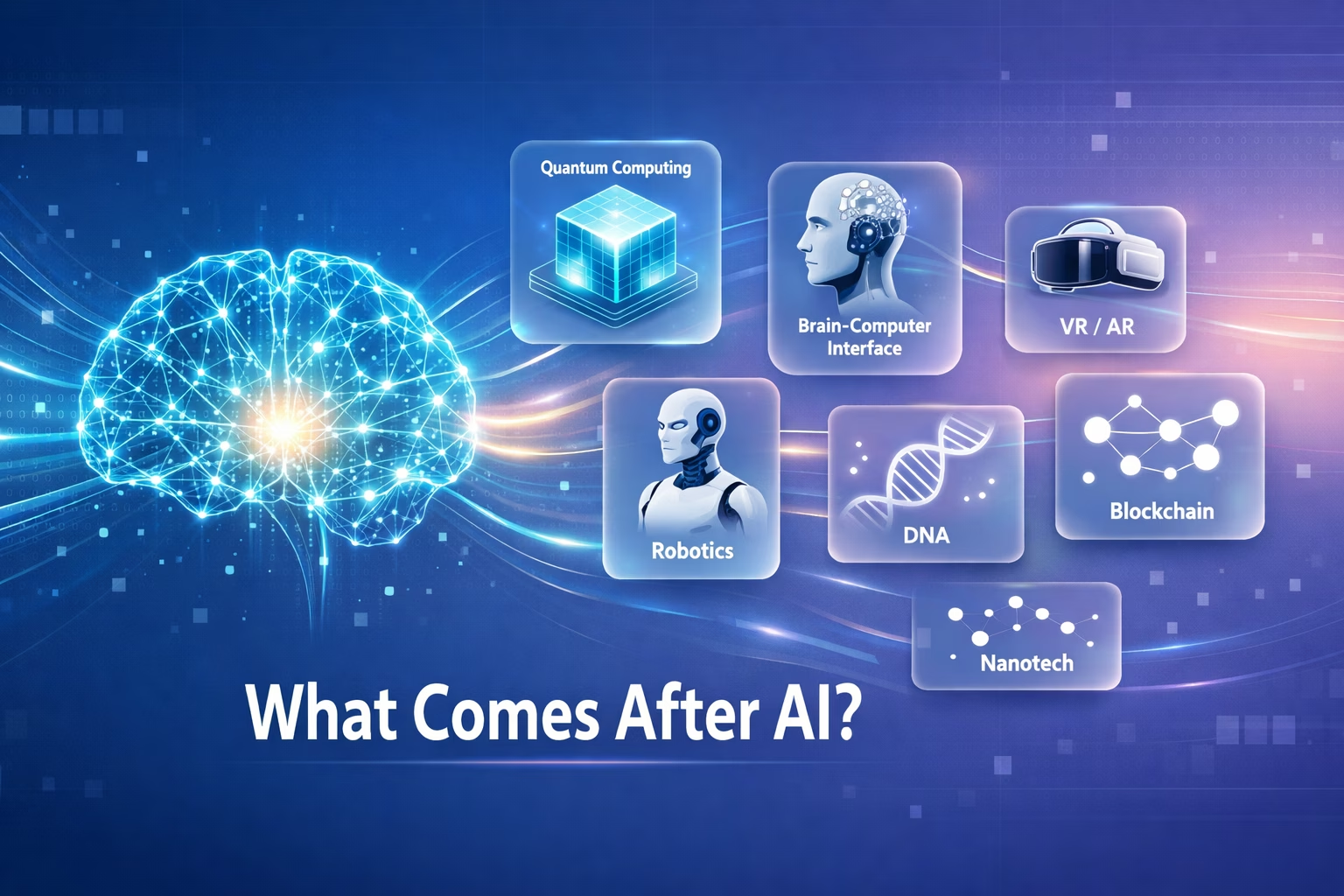
What comes after AI?
As powerful as AI is, it is only the beginning of a much larger technological revolution. The next wave of innovation will not replace AI but build on top of it, creating systems that are faster, smarter, and more integrated into human life than ever before.
By 2030 and beyond, multiple emerging technologies will rise alongside and beyond AI, reshaping industries, economies, and even human capabilities. In this article, we’ll explore the next big technologies after AI, their real-world applications, and how they will impact your future.
Why AI Is Just the Beginning
AI excels at processing data, recognizing patterns, and automating decisions. However, it still has limitations:
- It depends heavily on data
- It cannot fully replicate human consciousness
- It struggles with complex simulations at scale
- It lacks physical embodiment without robotics
This is where the next generation of technologies comes in—filling the gaps that AI cannot address alone.
The future is not about one dominant technology. Instead, it’s about a convergence of multiple powerful systems working together.
🔥 Top Technologies That Will Dominate After AI
1. Quantum Computing: Beyond Classical Limits
Quantum computing is widely considered the strongest candidate for the next big leap after AI.
Unlike traditional computers, quantum systems use qubits, allowing them to process massive datasets simultaneously through principles like superposition and entanglement.
Why It Matters
- Solves problems impossible for AI alone
- Accelerates drug discovery
- Optimizes global logistics systems
- Breaks and rebuilds cybersecurity systems
Future Impact
Quantum computing will revolutionize industries like finance, healthcare, and climate science. It will also enable AI to become exponentially more powerful.
2. Brain-Computer Interfaces (BCIs): Merging Humans and Machines
Brain-computer interfaces allow direct communication between the human brain and machines.
What This Means
- Control devices with thoughts
- Restore movement for paralyzed patients
- Enhance memory and cognitive ability
Future Vision
Imagine typing messages, controlling apps, or even communicating without speaking—just by thinking.
This technology could redefine human interaction with machines.
3. Neuromorphic Computing: Machines That Think Like Humans
Neuromorphic computing is designed to mimic the structure and function of the human brain.
Key Advantages
- Lower energy consumption
- Real-time learning
- More human-like decision-making
Why It’s Important
AI today is powerful but inefficient compared to the human brain. Neuromorphic systems aim to close that gap.
4. Synthetic Biology & CRISPR: Programming Life
Synthetic biology treats DNA like code, allowing scientists to design and modify living organisms.
Applications
- Gene editing using CRISPR
- Personalized medicine
- Lab-grown organs
- Bio-engineered food
Future Impact
This could eliminate diseases, extend human lifespan, and redefine healthcare entirely.
5. Spatial Computing & Extended Reality (XR)
Spatial computing combines augmented reality (AR), virtual reality (VR), and mixed reality (MR).
What It Enables
- Fully immersive digital environments
- Virtual workplaces
- Interactive learning experiences
Future Use Cases
- Remote work in 3D environments
- Virtual training simulations
- Digital twins of real-world systems
6. Web3 & Decentralization
The next evolution of the internet focuses on decentralization, ownership, and transparency.
Core Concepts
- Blockchain technology
- Decentralized finance (DeFi)
- User-owned data
Why It Matters
It shifts control from big corporations to individuals, enabling a more open digital ecosystem.
7. Autonomous Systems & Advanced Robotics
AI-powered robotics will evolve into fully autonomous systems capable of operating without human input.
Examples
- Self-driving vehicles
- Automated supply chains
- Smart factories
Impact
This will redefine industries, reduce labor costs, and increase efficiency.
8. Human Augmentation
Human augmentation enhances physical and cognitive abilities through technology.
Includes
- Wearable tech
- Neural implants
- Exoskeletons
Future Potential
Humans may become stronger, faster, and more intelligent with technological assistance.
9. Programmable Matter & Nanotechnology
Imagine materials that can change shape or function on demand.
Applications
- Self-healing materials
- Shape-shifting devices
- Advanced manufacturing
Why It’s Revolutionary
It could transform everything from construction to medicine.
10. Decentralized Physical Infrastructure (DePIN)
DePIN uses blockchain to decentralize real-world infrastructure.
Examples
- Decentralized internet networks
- Community-powered energy systems
Impact
This reduces reliance on centralized systems and increases resilience.
🌍 Industries That Will Boom After AI
Several industries are poised for massive growth:
Healthcare
- AI + biotech = personalized medicine
Finance
- Quantum computing = faster, smarter trading
Education
- XR = immersive learning
Manufacturing
- Robotics + automation
Space Technology
- Private space exploration
💡 How to Prepare for the Post-AI Era
To stay ahead, you must adapt:
Learn Future Skills
- AI + quantum basics
- Programming
- Data analysis
Stay Updated
- Follow tech trends
- Read research papers
Invest Smartly
- Emerging tech startups
- Innovation-driven industries
Build Digital Assets
- Blogs
- Online businesses
- Personal brand
⚠️ Challenges & Ethical Concerns
With great power comes responsibility.
Key Issues
- Job displacement
- Privacy concerns
- Ethical use of biotech
- AI and human control
Balancing innovation with ethics will be critical.
🔮 The Future: A Multi-Technology World
The future is not about replacing AI—it’s about expanding beyond it.
The next decade will be defined by:
- AI + Quantum Computing
- AI + Biology
- AI + Human Intelligence
This convergence will create a world that is smarter, faster, and more connected than ever before.
📌 Conclusion
The era after AI is already beginning. Technologies like quantum computing, brain-computer interfaces, and synthetic biology are pushing the boundaries of what’s possible.
The question is no longer “What comes after AI?”
The real question is:
👉 “Are you ready for what comes next?”
Those who understand and adapt to these emerging technologies will shape the future—while others struggle to keep up.
❓ FAQs (Optimized for Featured Snippets)
What is the next big technology after AI?
Quantum computing, brain-computer interfaces, and synthetic biology are among the top contenders.
Will AI be replaced?
No, AI will evolve and integrate with other technologies rather than being replaced.
Which industry will grow after AI?
Healthcare, robotics, finance, and biotechnology will see massive growth.
What skills should I learn for the future?
Focus on AI, programming, data science, and emerging technologies.
Is quantum computing the future?
Yes, it is expected to revolutionize computing and work alongside AI.