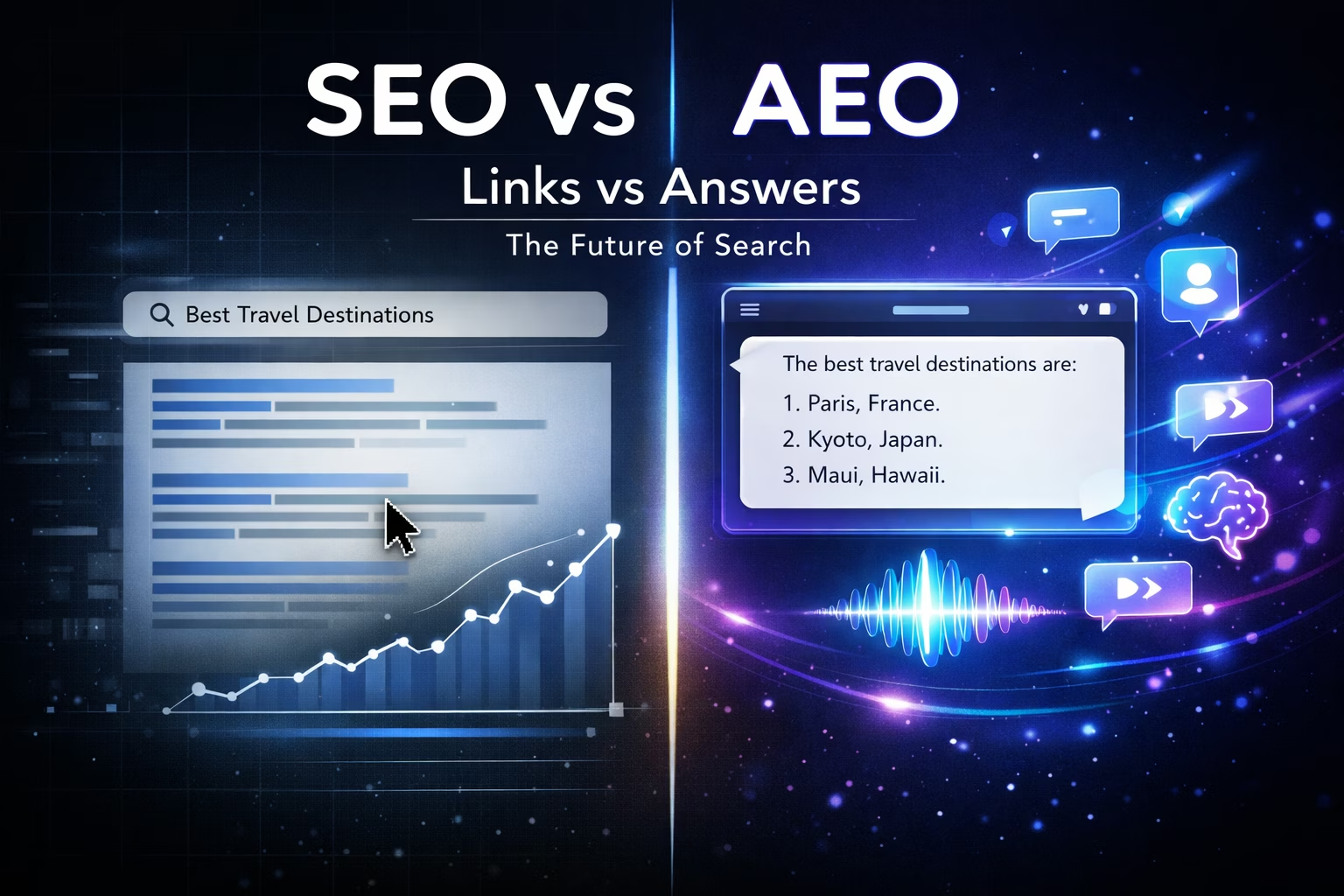
SEO vs AEO – What's the Future of Search

Search is no longer just about ranking — it's about answering. Discover the key differences between SEO and AEO, how AI search engines are changing everything in 2026, and the exact steps to optimize your website for both Google and AI platforms.
Introduction: The Way People Search Has Completely Changed
Think about the last time you Googled something. Did you scroll through 10 blue links — or did you just read the answer that appeared right at the top?
That's the shift happening right now, and it's bigger than anything we've seen since Google launched.
In 2026, search is no longer just about ranking. It's about answering. Users today are asking full questions to ChatGPT, talking to Siri, and getting direct responses without ever clicking a single website. This is where the battle between SEO vs AEO becomes critically important for every business owner, marketer, and entrepreneur.
If you're still only focused on traditional SEO, you're already falling behind. This guide will break down the SEO vs AEO difference, explain the future of search, and give you a step-by-step roadmap to dominate both in 2026.
What is SEO? (And Why You Already Know This — But Not Enough)
Search Engine Optimization (SEO) is the practice of optimizing your website so it ranks higher on search engines like Google and Bing. When someone types "best running shoes" or "digital marketing agency near me," SEO determines whose website appears first.
SEO works through three main pillars:
- On-Page SEO — using the right keywords, writing quality content, optimizing titles and meta descriptions
- Technical SEO — making sure your website loads fast, is mobile-friendly, and is easy for Google to crawl
- Off-Page SEO — earning backlinks from trusted websites to build your domain authority
Traditional SEO has been the backbone of digital marketing for over two decades. It's driven billions in business revenue and helped millions of websites get discovered online.
But here's the problem: SEO was built for a world where users click. That world is changing fast.
What is AEO (Answer Engine Optimization)?
Answer Engine Optimization (AEO) is the process of optimizing your content so that AI-powered tools, voice assistants, and search engines select your content as the direct answer to a user's question.
Instead of trying to rank #1 in a list of results, AEO aims to make your content the answer — the one paragraph, sentence, or data point that ChatGPT reads aloud, that Google features in a snippet, or that Alexa speaks when someone asks a question.
AEO focuses on:
- Featured snippets — the highlighted box at the top of Google results
- Voice search results — what Siri, Google Assistant, and Alexa actually say out loud
- AI-generated answers — what ChatGPT, Gemini, and other AI tools pull from when answering user queries
- Zero-click searches — when users get their answer directly on the search page without needing to visit any website
AEO is not a replacement for SEO. It's the next layer that every modern digital strategy needs.
SEO vs AEO – Key Differences Explained
The comparison table above gives you the full breakdown at a glance. Let's dig into the most important differences:
Focus — Ranking vs Answering SEO is about climbing the results page. AEO is about being the answer that gets spoken, quoted, or displayed — often before any results are even listed.
Goal — Traffic vs Instant Answers Traditional SEO success means getting users to click through to your website. AEO success means your brand's information is delivered directly to the user, building trust and authority even without a click.
Platform — Google vs AI Tools SEO lives primarily on Google and Bing. AEO expands into ChatGPT, Claude, Perplexity, Google's AI Overviews, Siri, Alexa, and every other AI-powered search interface.
Content Style — Keywords vs Questions SEO content is structured around keywords and search volume. AEO content is structured around questions — specifically the exact questions real users are asking.
How Search is Changing in 2026
The search landscape in 2026 looks nothing like it did five years ago. Here's what's driving the transformation:
The Rise of AI Search Engines Tools like ChatGPT Search, Google AI Overviews (formerly SGE), Perplexity AI, and Microsoft Copilot are handling millions of queries daily. These platforms don't show you a list of links — they generate a direct, conversational response, often without the user ever visiting a website.
Voice Search is Mainstream Over 50% of internet users now use voice search regularly. When someone asks their phone "what's the best time to post on Instagram?", they get one answer — not ten links. If your content isn't optimized for AEO, that answer will never be yours.
Zero-Click Searches are Dominating Studies suggest that more than 60% of searches now end without a single click on any website. Google answers the question before the user even has a reason to go further. This is both a challenge and an opportunity — and AEO is the key to capturing it.
Chat-Based Search is the New Normal Users increasingly treat search like a conversation. They type full sentences, follow up with more questions, and expect intelligent, contextual answers. This behavior rewards content that is structured clearly, written conversationally, and built to answer — not just to rank.
Why SEO Alone is Not Enough Anymore
SEO is still incredibly valuable — let's be clear about that. But relying only on SEO in 2026 is like running a great brick-and-mortar store but having no online presence.
Here's why traditional SEO is no longer sufficient on its own:
- AI Overviews are stealing clicks — Google now answers many queries at the top of the page, pushing organic results further down and reducing click-through rates significantly.
- User behavior has changed — People want answers immediately. They're asking AI tools, not browsing through pages of results.
- Competition is fierce — With millions of pages competing for the same keywords, ranking alone doesn't guarantee visibility anymore.
- Voice search has no "second position" — When Alexa or Siri answers a question, there's only one answer. If it's not yours, you simply don't exist in that moment.
The businesses that thrive in 2026 will be the ones combining strong SEO with a smart AEO strategy.
Benefits of AEO for Businesses
Investing in Answer Engine Optimization gives your business a powerful edge. Here's what you gain:
1. Massive Visibility Across All Platforms Your content gets surfaced not just on Google, but across AI tools, voice assistants, and emerging search platforms. You're everywhere your audience is asking questions.
2. Stronger Brand Authority When AI tools consistently cite your content as the trusted answer, your brand builds credibility at scale. Users begin to associate your name with expertise — even if they've never visited your website.
3. Higher Trust and Conversion Rates People who discover your brand through a helpful, accurate AI-cited answer are already primed to trust you. The conversion journey becomes shorter and more powerful.
4. Competitive Advantage Right Now Most businesses are still focused purely on traditional SEO. Getting into AEO now means you're establishing authority before the competition catches up — and in digital marketing, early movers always win.
How to Optimize for SEO + AEO: Step-by-Step Strategy
The good news? You don't have to choose between SEO and AEO. The best strategy combines both. Here's how:
Step 1 — Build Question-Based Content Research the exact questions your target audience is asking. Use tools like Google's "People Also Ask" section, AnswerThePublic, or simply type a question into ChatGPT and see what it asks in return. Create dedicated content — blog posts, FAQs, landing page sections — that answers these questions clearly and directly.
Step 2 — Optimize for Featured Snippets Featured snippets are Google's way of showing AEO results. To win them, structure your content so the answer appears in the first 40–60 words after a question-based heading. Use clear, simple language. Avoid unnecessary filler sentences before getting to the point.
Step 3 — Implement Structured Data (Schema Markup) Schema markup is code that tells search engines exactly what your content means — is it a product, a review, an FAQ, a how-to guide? Using FAQ schema, HowTo schema, and Article schema significantly increases your chances of appearing in featured snippets and AI-generated answers. Platforms like Google's Structured Data Markup Helper make this straightforward even for non-technical users.
Step 4 — Improve Page Speed and Core Web Vitals Google and AI search tools prefer fast, reliable websites. Use tools like Google PageSpeed Insights to identify improvements. Compress images, minimize unnecessary scripts, and ensure your site loads in under 3 seconds on mobile.
Step 5 — Write Conversationally and Clearly AI engines are trained to pull content that sounds natural and reads like a genuine, helpful human wrote it. Avoid jargon. Use short sentences. Break down complex ideas into digestible pieces. If an 8th-grader can understand it, AI search engines will love it.
Step 6 — Optimize for Voice Search Voice queries are longer and more conversational than typed searches. Instead of targeting "digital marketing agency," target "what does a digital marketing agency do?" or "how can a digital marketing agency help my business?" Include these natural-language phrases throughout your content.
Step 7 — Build Topical Authority Instead of writing one page on a topic, build a cluster of deeply interconnected content. Cover the main topic and all related subtopics comprehensively. AI search engines recognize and reward websites that demonstrate genuine expertise across an entire subject area.
Real-World Examples: AEO in Action
Google Featured Snippets Search "how long does it take to rank on Google?" and you'll see a paragraph from one specific website displayed at the very top — before any other results. That website used AEO principles: a clear question as a heading, a direct answer in the opening lines, and properly formatted content. That's AEO winning in real time.
ChatGPT Answers Ask ChatGPT "what is the best social media platform for B2B marketing?" and it will cite information that comes from authoritative, well-structured content online. Websites that have comprehensive, clearly written answers on this topic are the ones ChatGPT references — not the ones that simply stuffed keywords into their pages.
Voice Assistants Ask Google Assistant "what time does the stock market open?" and it reads out one direct answer from one source. The website that provides that answer has effectively dominated that query for every voice user — without a single click ever being needed.
The Future of Search
The trajectory is clear. Here's where search is heading:
AI-First Search Engines — Google, Microsoft, and new AI players are building search experiences where AI generates the primary result. Traditional blue links are becoming secondary.
Hyper-Personalized Results — Search engines are becoming better at understanding individual user preferences, location, history, and intent. Content that speaks directly to specific audiences will outperform generic, broadly-targeted pages.
Predictive Search — AI tools are moving toward anticipating what users need before they even finish asking. Businesses that create comprehensive, structured content around entire topics — not just individual keywords — will own this space.
Multimodal Search — Searching with images, voice, and video is becoming standard. Optimizing text content alone will no longer be enough. Businesses need to consider how their brand appears across all input types.
Human-Like AI Assistants as Gatekeepers — The AI assistant is becoming the first point of contact between a user and information. If your content isn't structured to be discovered, cited, and used by these assistants, you are effectively invisible to a growing percentage of your audience.
Common Mistakes to Avoid
Ignoring AEO Entirely This is the most costly mistake businesses are making right now. Assuming that traditional SEO is sufficient is leaving enormous visibility — and revenue — on the table.
Keyword Stuffing Cramming keywords into content might have worked in 2015. Today, it actively hurts your rankings and makes AI engines less likely to trust or cite your content.
Neglecting Mobile Optimization More than 70% of searches happen on mobile devices. A website that isn't perfectly optimized for mobile is losing rankings, losing featured snippet eligibility, and losing credibility with AI tools.
Poor Content Structure Content that lacks clear headings, short paragraphs, and direct answers is invisible to AEO. AI engines scan for structure. If your page looks like a wall of text, it will be skipped.
Ignoring Page Speed Slow websites don't get featured. Google's Core Web Vitals are now a direct ranking factor, and AI tools also factor in page quality signals when selecting sources to cite.
Ready to Dominate Both SEO and AEO? Let LetDigitalFly Help.
Understanding SEO vs AEO is one thing. Executing a strategy that wins on both fronts is another — and that's exactly where LetDigitalFly comes in.
We provide advanced SEO + AEO strategies built specifically to help businesses rank on Google and get cited by AI search platforms like ChatGPT, Google AI Overviews, and voice assistants. Whether you're a startup looking to get discovered or an established brand wanting to future-proof your digital presence, we have the tools and expertise to make it happen.
Here's what we offer:
- Full website SEO audit (technical, on-page, and off-page)
- AEO content strategy — question-based content, schema markup, featured snippet optimization
- Voice search optimization
- AI search visibility strategy for platforms like ChatGPT and Perplexity
- Monthly reporting with real, measurable results
👉 Get your free SEO + AEO audit today. Contact the LetDigitalFly team and let's build a search strategy that doesn't just rank — it answers.
Conclusion: The Future Belongs to Those Who Answer
The message is clear: SEO vs AEO is not a battle — it's a partnership.
SEO gives you the foundation — the rankings, the traffic, the domain authority. AEO gives you the future — the featured snippets, the AI citations, the voice results, the zero-click visibility. Together, they create a digital presence that dominates search in every form it takes in 2026 and beyond.
Search is evolving at a pace we've never seen before. The businesses that adapt now, build question-based content, implement structured data, and optimize for AI search engines will own their industries online for years to come.
Don't wait for your competitors to figure this out first. Start your SEO and AEO strategy for 2026 today — and make sure that when anyone, anywhere, asks a question your business can answer, your brand is the one that responds.
Frequently Asked Questions (FAQ)
Q1: What is AEO in SEO? AEO stands for Answer Engine Optimization. It is the practice of structuring your content so that AI-powered tools, voice assistants, and search engines like Google select your content as the direct, featured answer to a user's query. While SEO focuses on ranking in search results, AEO focuses on being the answer.
Q2: Is AEO replacing SEO? No — AEO is not replacing SEO. Think of AEO as the next evolution of digital search strategy. Traditional SEO still matters enormously for driving organic traffic. AEO adds a new layer on top, ensuring your content also gets surfaced by AI tools, voice assistants, and featured snippets. In 2026, you need both.
Q3: How do I rank in AI search engines like ChatGPT? To rank in AI search results, focus on creating clear, authoritative, question-based content. Use structured data and schema markup. Build topical authority by covering your niche comprehensively. Write in natural, conversational language. AI tools like ChatGPT prefer well-structured, trustworthy sources with clear, direct answers.
Q4: What is a zero-click search? A zero-click search is when a user finds their answer directly on the search results page — from a featured snippet, Google's AI Overview, a knowledge panel, or similar — without clicking on any website. Over 60% of searches are now zero-click. AEO helps your brand be the source of that zero-click answer, which builds brand visibility even without generating website traffic.
Q5: How do I optimize my content for ChatGPT? To optimize for ChatGPT and similar AI tools: write comprehensive, accurate content on topics in your niche; structure answers clearly with proper headings and short paragraphs; use FAQ sections; earn mentions and citations from reputable websites; keep your content regularly updated; and use schema markup so search engines can better understand your content.
Q6: Is SEO still relevant in 2026? Absolutely. SEO remains one of the most powerful and cost-effective digital marketing strategies available. However, its role is evolving. In 2026, successful SEO must be combined with AEO practices to ensure visibility across both traditional search engines and the growing ecosystem of AI-powered search tools.
Q7: How long does it take to see results from AEO? AEO results can appear faster than traditional SEO. Well-structured content with schema markup can earn featured snippet placement within days or weeks of publication. However, building consistent authority in AI search results — like being regularly cited by ChatGPT or Google AI Overviews — typically takes 3–6 months of consistent, high-quality content production.