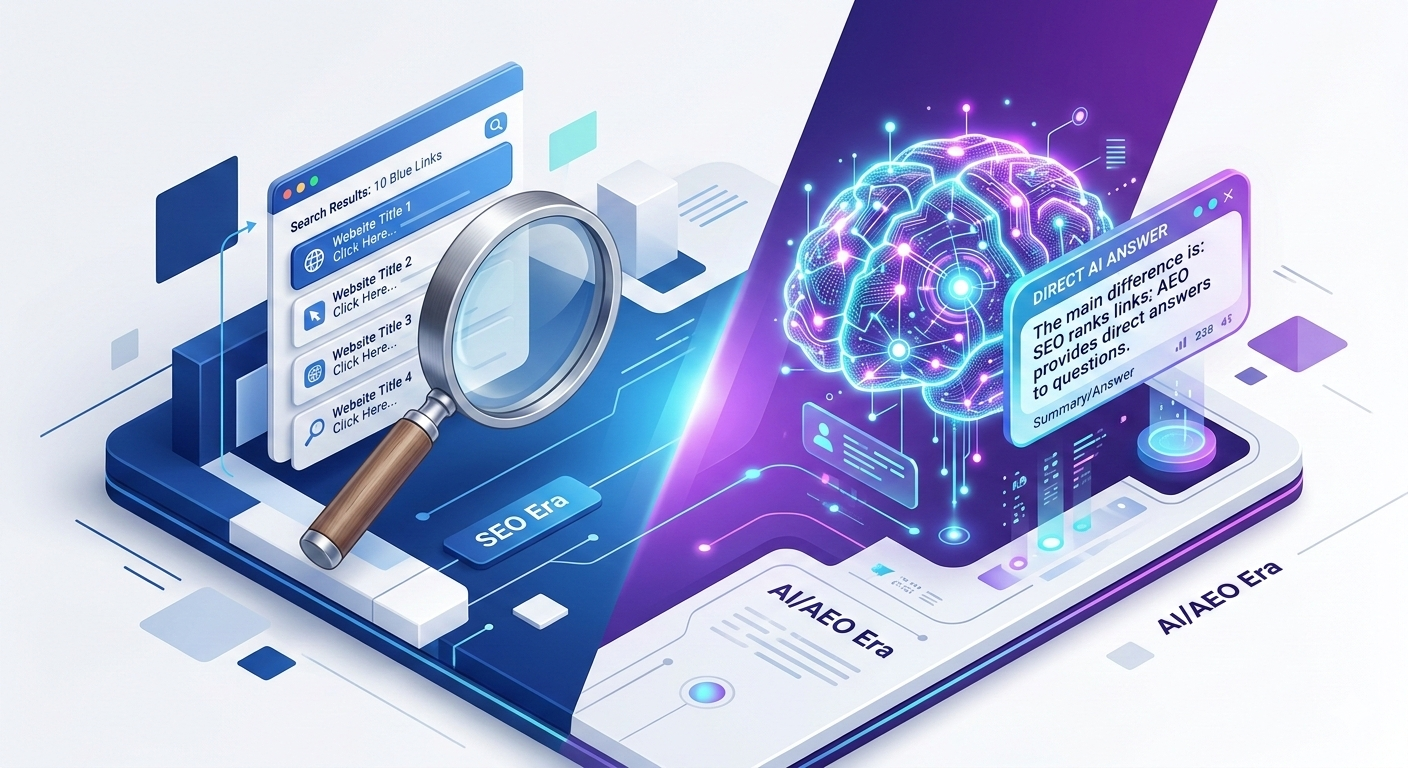
AEO vs. SEO: Is Your Website Ready for AI Search Engines?

Search is changing from "links" to "answers." This guide explains how to transition from traditional SEO to Answer Engine Optimization (AEO) to stay visible in the AI era.
The internet is changing faster than ever before. For twenty years, we lived in the world of SEO (Search Engine Optimization). If you wanted to know something, you went to Google, typed in a word, and clicked on a blue link.
But today, things are different. We have ChatGPT, Google Gemini, and Perplexity. Instead of clicking links, we are asking questions and getting instant answers. This new world is called AEO (Answer Engine Optimization).
If you own a website or write a blog, you need to ask yourself: Is my website ready for the AI revolution? ---
Chapter 1: Understanding the Basics
To win the game, you first need to know the players. Let’s break down these two big terms into simple ideas.
What is SEO?
Think of SEO like a library catalog. When you go to a library and look for a book about "Space," the librarian shows you a shelf full of books. You have to pick one, open it, and find the information yourself.
In SEO, you use "keywords" so that Google knows what your page is about. If someone searches for "best running shoes," SEO helps your website show up in those search results. The goal is to get people to click on your link.
What is AEO?
Think of AEO like a smart friend. Instead of showing you a shelf of books, your friend just tells you the answer: "The best running shoes for beginners are Nike or Adidas because they have good cushions."
AEO focuses on providing the direct answer that AI engines can read aloud or display in a chat box. The goal isn't just a click; it’s being the source of the answer.
Chapter 2: Why AI is Changing the Rules
Why should we care about AEO? Because the way humans use the internet has shifted.
-
Voice Search: People use Siri or Alexa. They don't type "Weather London." They ask, "Hey Siri, do I need an umbrella today?"
-
Conversational AI: Tools like ChatGPT give a single, clear answer. If your website isn't the one providing that answer, you lose that visitor.
-
Speed: We live in a fast world. People don't want to browse five websites; they want the truth in five seconds.
Chapter 3: The Big Differences (AEO vs. SEO)
While they work together, they have different "vibes."
| Feature | SEO Strategy | AEO Strategy |
| User Intent | Finding a website. | Finding an answer. |
| Content Type | Long-form articles and blogs. | Clear, concise facts and FAQs. |
| Key Metric | Clicks and Traffic. | Brand Mentions and Citations. |
| Technology | Crawlers and Keywords. | Natural Language Processing (NLP). |
Chapter 4: How to Write for Humans (And Make Google Happy)
Google’s latest updates all say the same thing: "Write for people, not for robots." Here is how you do that while staying SEO-optimized.
1. Use the "Inverted Pyramid" Style
In the old days, people would write a long introduction before giving the answer. Now, you should give the answer first.
-
Top: The direct answer (The "Meat").
-
Middle: Supporting details and data.
-
Bottom: Background info and history.
2. Talk Like a Person
Don't use big, scary words like "utilize" when "use" works just fine. If a 10-year-old can't understand your article, an AI engine might struggle to summarize it too. Use short sentences. Use "you" and "we."
3. Use Headings Correctly
Google and AI use headings (H2, H3) like a map. If your headings are clear, the AI knows exactly where the answer is.
-
Bad Heading: "Information regarding the optimization process."
-
Good Heading: "How to optimize your site for AI."
Chapter 5: 7 Steps to Make Your Website AI-Ready
If you want to stay ahead of the curve, follow this checklist:
Step 1: Create an FAQ Section
AI engines love Frequently Asked Questions. Why? Because they are already formatted as "Question" and "Answer."
-
Tip: Look at the "People Also Ask" section on Google for ideas on what questions to answer.
Step 2: Use Structured Data (Schema Markup)
This sounds technical, but it’s just a "translator" for your website. It tells Google: "This is a price," "This is a review," or "This is a recipe." Sites with Schema are much more likely to be picked up by AI engines.
Step 3: Focus on Brand Authority
AI engines only recommend sources they trust. To build trust:
-
Have a clear "About Us" page.
-
Link to high-quality, famous websites.
-
Get other websites to link back to you (Backlinks).
Step 4: Optimize for "Long-Tail" Keywords
Instead of trying to rank for "Shoes," try to rank for "What are the most comfortable shoes for standing all day?" These conversational phrases are exactly what people ask AI.
Step 5: Improve Website Speed
If your site takes 10 seconds to load, Google won't like it, and AI won't bother with it. Use small images and fast hosting.
Step 6: Be Concise
AI engines have a "token limit." They like answers that are 40 to 60 words long. Try to summarize your main points into short, punchy paragraphs.
Step 7: Update Old Content
Go back to your old blogs. Add a "Key Takeaways" box at the top. This makes it very easy for an AI to "scrape" your page for the best info.
Chapter 6: The "Humanize" Factor
One of the biggest mistakes people make today is using AI to write their entire article without checking it. Google can often tell when a "robot" wrote something. To make your article feel Real and Human:
-
Share Personal Stories: An AI doesn't have a life. It hasn't "tried" a product. If you say, "When I tried this, I noticed...", it adds human value.
-
Use Emotion: Use words that show excitement, caution, or humor.
-
Give Opinions: AI is usually neutral. Humans have opinions. Don't be afraid to say what you think is "the best" or "the worst."
Chapter 7: Will SEO Die?
A lot of people are scared that AEO will kill SEO. The answer is No.
People will still need to visit websites for deep learning, shopping, and entertainment. AEO is just the "front door." It gives the user a taste of the answer, and if they want to learn more, they click through to your website.
Think of AEO as your digital business card. It introduces you. SEO is your office, where the real work happens. You need both to be successful.
Chapter 8: Conclusion (The Future of the Web)
The future of the internet is helpful. Whether it is a search engine or an answer engine, the goal is to help the user find what they need.
If you focus on:
-
Clarity (Simple language)
-
Structure (Good headings and Schema)
-
Trust (Honest facts)
...then your website will not only survive the AI revolution—it will thrive in it. Don't be afraid of AI. See it as a new way to reach people who are looking for exactly what you have to offer.
🔹 Explore more powerful file conversion and online utilities at AllFileTools –
🔹 For technical support, digital solutions, and expert services, visit LetDigitalFly IT Services –
🔹 Discover additional career and productivity resources at Resume Slip Builder –