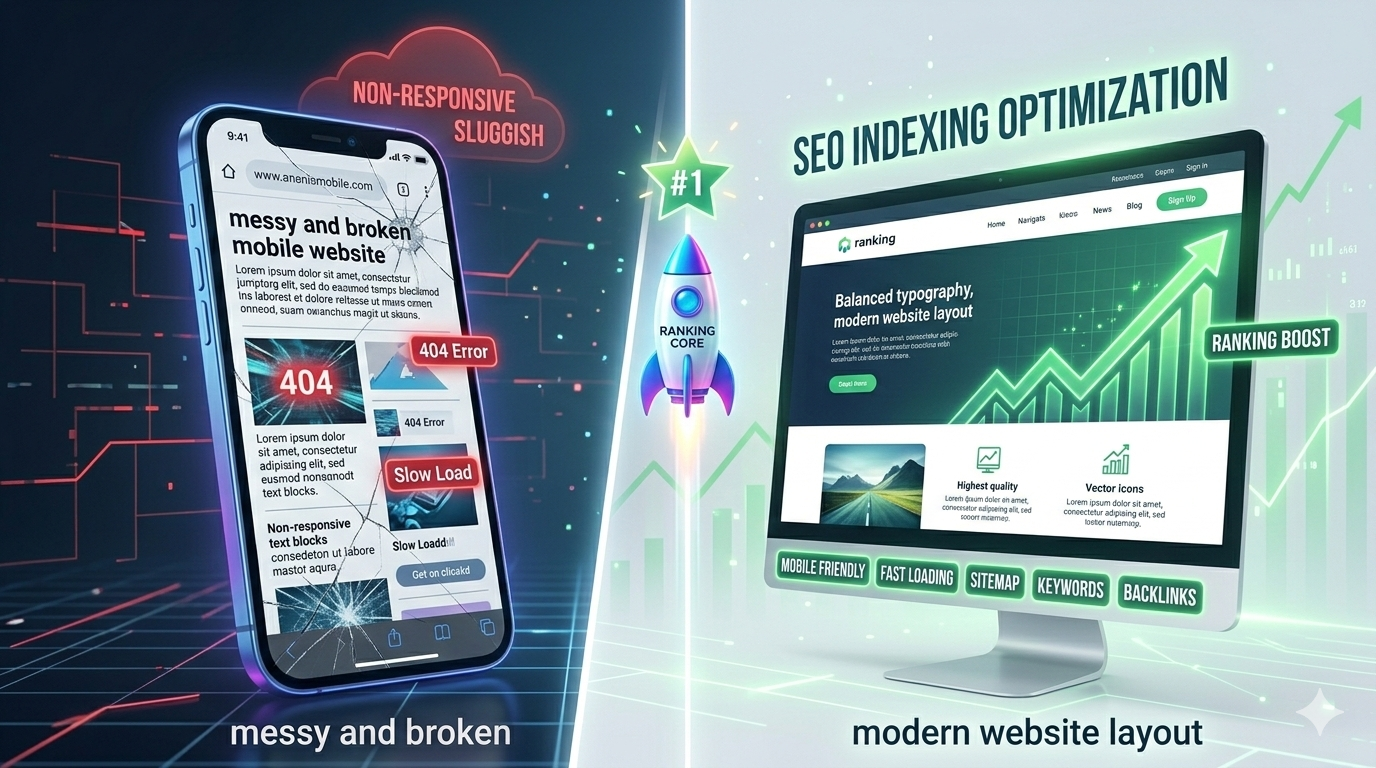
Complete SEO & Website Optimization Guide (2026 Beginner to Advanced)

Master SEO optimization and website optimization in 2026. Learn on-page SEO, technical SEO, Core Web Vitals, and proven SEO strategies to improve website ranking and drive organic traffic growth. Includes actionable SEO checklist.
1. Introduction
The digital battlefield of 2026 is louder than ever. Every day, over 7 million blog posts are published, and billions of searches happen on Google. If your website is not optimized, you are invisible.
Search engine optimization 2026 is no longer just about adding keywords. It is about delivering speed, trust, and a flawless user experience. Whether you are a blogger in New York or a startup in Texas, mastering SEO optimization and website optimization is the only way to drive organic traffic growth and stay ahead of competitors.
In this guide, you will learn exactly how to improve website ranking, fix hidden technical issues, and implement the SEO strategies 2026 that actually work.
2. What is SEO? (Beginner Friendly)
SEO (Search Engine Optimization) is the practice of making your website attractive to search engines like Google. Think of Google as a librarian. SEO helps you put your book on the front desk.
Types of SEO
-
On-page SEO: Optimizing content, titles, and images inside your website.
-
Off-page SEO: Building backlinks and social signals from other websites.
-
Technical SEO: Improving server, structure, and code so Google can crawl your site easily.
All three types work together to boost your Google ranking factors.
3. What is Website Optimization?
Website optimization is the process of improving every element of your site—speed, design, content, and user flow—to achieve higher conversions and better rankings.
Why is this important for SEO? Because Google now measures user experience SEO directly. A fast, easy-to-navigate website keeps visitors happy. Happy visitors stay longer, click more pages, and send positive signals to Google.
Website performance optimization directly impacts your bottom line. A 1-second delay in load time can reduce conversions by 20%.
4. How Search Engines Work (Simple Explanation)
To rank, you must first understand the Google pipeline:
-
Crawling: Google bots (spiders) find new and updated pages by following links.
-
Indexing: Google analyzes the content and stores it in a massive database.
-
Ranking: When a user searches, Google pulls the most relevant, authoritative results from its index.
If you block crawlers or have a slow server, you break this chain. That is why technical SEO is non-negotiable.
5. On-Page SEO (Detailed Guide)
On-page SEO is the foundation of any SEO optimization strategy. Here is your step-by-step playbook for 2026.
Step 1: Keyword Research Guide
Before writing anything, find what your audience actually searches for. Use tools like Ahrefs, SEMrush, or Google Keyword Planner. Look for:
-
Long-tail keywords (e.g., “best running shoes for flat feet”)
-
Search intent (informational, commercial, transactional)
Step 2: Title Tags & Meta Descriptions
Your title tag is the first thing searchers see. Include your primary keyword near the beginning.
-
Example: “Complete SEO Optimization Guide 2026: Rank #1 on Google”
Meta descriptions do not directly affect rankings, but they improve click-through rate (CTR) . Write compelling, action-oriented descriptions under 160 characters.
Step 3: Header Tags (H1, H2, H3)
Use a single H1 for your main title. Use H2 for main sections and H3 for sub-sections. This creates a logical hierarchy that Google loves.
Step 4: Internal Linking
Link to your own relevant articles. This spreads “link equity” and keeps users on your site longer. For example, if you mention website speed optimization, link to your detailed speed guide.
Step 5: Image Optimization (Alt Text)
Images slow down pages if not optimized. Compress images and always add descriptive alt text (e.g., “red Nike running shoes on track”). Alt text helps visually impaired users and improves image search rankings.
Step 6: Content Optimization
Write for humans first, but help Google understand your topic. Use related LSI keywords naturally. Aim for comprehensive coverage (1500+ words for pillar pages). Update old content regularly.
6. Technical SEO (Advanced Section)
Technical SEO is where most small businesses fail. It is not difficult, but it requires attention to detail.
Website Speed Optimization
Google confirmed that page speed is a ranking factor. Use Core Web Vitals to measure real-world user experience.
Core Web Vitals
Three metrics that Google tracks:
-
Largest Contentful Paint (LCP): Loading performance (under 2.5 seconds).
-
First Input Delay (FID): Interactivity (under 100 milliseconds).
-
Cumulative Layout Shift (CLS): Visual stability (less than 0.1).
Mobile-First Indexing
Google now uses the mobile version of your site for ranking. If your site is not mobile-friendly, you will lose rankings. Use Google’s Mobile-Friendly Test tool.
XML Sitemap
An XML sitemap lists all important pages on your site. Submit it to Google Search Console so crawlers find your content faster.
Robots.txt
This file tells crawlers which pages to ignore (e.g., admin pages, thank-you pages). Do not block important content accidentally.
Fix Crawl Errors
In Google Search Console, go to “Coverage” reports. Fix 404 errors, server errors, and redirected pages.
7. Website Speed Optimization (IMPORTANT)
Speed is the backbone of website performance optimization. Here are 5 actionable fixes you can implement today:
-
Image Compression: Use tools like TinyPNG or ShortPixel. Reduce image file sizes by 70% without losing quality.
-
Lazy Loading: Images and videos load only when the user scrolls to them. This cuts initial load time drastically.
-
CDN Usage: A Content Delivery Network (Cloudflare, BunnyCDN) stores copies of your site on global servers. Visitors get data from the nearest location.
-
Minify CSS/JS: Remove unnecessary spaces, comments, and code. Plugins like Autoptimize (WordPress) do this automatically.
-
Enable Browser Caching: Store static files on the visitor’s device so they don’t download again on repeat visits.
Real-world example: A travel blog reduced load time from 5 seconds to 1.8 seconds using lazy loading and a CDN. Their organic traffic growth increased 34% in 60 days.
8. User Experience (UX) & SEO
Google’s “Page Experience” update made user experience SEO official. Here is what matters:
-
Bounce Rate: If users leave after one page, Google assumes your content is irrelevant.
-
Time on Site: Longer visits signal quality content.
-
Mobile Responsiveness: Buttons must be tappable. Text must be readable without zooming.
-
Clean UI/UX Design: No pop-up spam, clear navigation, and fast access to key information.
A good UX keeps visitors engaged. Engaged visitors convert into customers.
9. SEO Strategies for 2026
The game has changed. Here are the SEO strategies 2026 you must adopt:
AI in SEO
Google’s Search Generative Experience (SGE) uses AI to answer queries directly. To win, create authoritative, experience-driven content that AI cannot easily replicate. Use AI tools (like Frase or SurferSEO) for content briefs, but add human case studies and original data.
Voice Search Optimization
Over 50% of searches are voice-based. People speak conversationally. Optimize for question phrases:
-
“What is the best Italian restaurant near me?”
-
“How to fix a leaking faucet”
Use FAQ schemas to appear in voice answers.
Zero-Click Searches
Many searches end on the results page (featured snippets, knowledge panels). To capture traffic, target “how-to” and “what is” queries. Provide clear, concise answers in paragraph or list format.
E-E-A-T (Experience, Expertise, Authority, Trust)
Google evaluates your content creator’s credibility. Show real experience:
-
Author bios with credentials.
-
Case studies and original research.
-
Customer reviews and trust badges.
YMYL (Your Money Your Life) niches like health and finance require the highest E-E-A-T.
10. Common SEO Mistakes to Avoid
Even experienced website owners make these errors. Avoid them now:
-
Keyword stuffing: Repeating “SEO optimization” 50 times unnaturally will trigger a penalty.
-
Slow website: A 3-second load time loses 50% of mobile users.
-
Ignoring mobile users: If your site is desktop-only, you are invisible in 2026.
-
Poor content quality: Thin content (under 300 words) rarely ranks.
-
Broken backlinks: Links to 404 pages waste authority.
-
No internal linking: Google cannot discover your deep pages.
-
Ignoring Core Web Vitals: Poor scores directly reduce rankings.
11. SEO Checklist (Actionable)
Use this SEO checklist every time you publish or audit a page:
-
Primary keyword in title tag and H1
-
Meta description under 160 characters with keyword
-
At least one H2 and two H3 tags
-
Images compressed + alt text added
-
Internal links to 2–3 related posts
-
Mobile responsive test passed
-
Core Web Vitals pass (green in PageSpeed Insights)
-
XML sitemap submitted to Google Search Console
-
No broken links (use Broken Link Checker)
-
Content length ≥ 1200 words (for competitive topics)
-
Unique, updated within last 6 months
-
Schema markup (FAQ, HowTo, or Article) added
12. Tools for SEO & Optimization
You do not need to spend thousands. Here are the best SEO tools 2026 for beginners to advanced users:
-
Google Search Console: Free. Track rankings, clicks, and fix crawl errors.
-
Google Analytics 4 (GA4): Free. Understand user behavior and traffic sources.
-
PageSpeed Insights: Free. Measure website speed optimization and Core Web Vitals.
-
Ahrefs Webmaster Tools: Free tier. Analyze backlinks and keywords.
-
SEMrush: Paid, but powerful for competitor research.
-
Screaming Frog SEO Spider: Free for up to 500 URLs. Finds broken links and duplicate content.
-
Rank Math or Yoast SEO: WordPress plugins that simplify on-page SEO.
-
Cloudflare: Free CDN and security.
13. Conclusion
You now have a complete roadmap for search engine optimization 2026. To recap:
-
On-page SEO ensures your content is relevant.
-
Technical SEO helps Google crawl and index you.
-
Website speed optimization keeps users and Google happy.
-
UX & Core Web Vitals are official ranking factors.
-
SEO strategies 2026 focus on AI, voice search, and E-E-A-T.
Do not try to fix everything in one day. Start with the SEO checklist above. Run your site through Google PageSpeed Insights. Fix the lowest-hanging fruit first (image compression, lazy loading, internal links).
If you feel overwhelmed or want professional help to improve website ranking quickly, our team offers full SEO optimization and website optimization services. We audit, fix, and grow organic traffic.
Ready to dominate Google in 2026? Click here to request a free website audit.
FAQs (Frequently Asked Questions)
1. What is the difference between SEO and website optimization?
SEO optimization focuses on ranking higher in search engines through keywords, backlinks, and content. Website optimization is broader—it includes speed, UX, conversion rate, and overall performance. Both work together to grow organic traffic.
2. How long does it take to see results from SEO in 2026?
Typically 4 to 6 months for new websites. If you fix technical SEO and Core Web Vitals, you may see improvements in 6–8 weeks. Established websites with high authority can rank new content in days.
3. Is website speed really a ranking factor?
Yes. Google confirmed that website speed optimization is a ranking factor for both desktop and mobile. Slow websites are penalized, especially after the Page Experience update.
4. Can I do SEO myself without hiring an expert?
Absolutely. Beginners can implement on-page SEO and basic website optimization using free tools like Google Search Console and PageSpeed Insights. For advanced technical SEO (JavaScript rendering, structured data, server configuration), an expert may be faster.
5. What are Core Web Vitals, and how do I fix them?
Core Web Vitals are three speed-and-stability metrics (LCP, FID, CLS). Fix them by:
-
Improving server response time (LCP)
-
Removing unused JavaScript (FID)
-
Setting width/height on images (CLS)
Use PageSpeed Insights for specific recommendations.
6. Does mobile-first indexing affect my existing rankings?
Yes. If your mobile site has less content or broken features than your desktop site, you will lose rankings. Ensure both versions have identical content and structured data.
7. What is the most important SEO strategy for 2026?
E-E-A-T (Experience, Expertise, Authority, Trust) combined with user experience SEO. Google now prioritizes content from real experts that also delivers fast, seamless interaction.