Swift vs. Objective-C in 2026: What to Use for Your Next App

Is Objective-C finally dead? Explore the 2026 showdown between Swift 6 and Objective-C. Learn how Apple Intelligence, visionOS 26, and strict concurrency safety dictate your choice for new iOS projects.
In the fast-evolving landscape of Apple platform development, choosing the right programming language is more critical than ever. As we look to 2026, the perennial debate of Swift vs. Objective-C continues, but with new dimensions shaped by Swift 6's strict concurrency, the rise of Apple Intelligence, and the expanding visionOS ecosystem. For iOS architects and business leaders, the decision impacts everything from development costs and maintenance to app performance and future-proofing.
This guide provides a definitive comparison for 2026, dissecting the technical advancements, economic realities, and strategic considerations that will inform your next app development journey.
The 2026 State of Play: Is Objective-C Finally Dead?
For years, developers have speculated about the demise of Objective-C. While it’s certainly no longer the primary choice for new Apple projects, calling it "dead" is an oversimplification. In 2026, Objective-C remains a cornerstone for legacy codebases, enterprise applications with deep historical roots, and specific scenarios requiring intricate C/C++ interoperability.
However, the trend is undeniable. The talent pool for Objective-C developers is shrinking, and maintaining older codebases incurs higher costs and introduces greater risks. Apple's relentless innovation, particularly with Swift 6 and its emphasis on modern concurrency, pushes Objective-C further into niche territories. The language isn't gone, but its future lies predominantly in maintenance and specific bridging scenarios, rather than spearheading the next generation of Apple platforms.
Swift 6: The Game Changer for Safety and Concurrency
Swift has consistently evolved, but Swift 6, anticipated to be widely adopted by 2026, marks a pivotal moment. Its focus on strict concurrency fundamentally changes how developers write safe, performant, and reliable multi-threaded code. This is not just an incremental update; it’s a paradigm shift that addresses some of the most persistent and hard-to-debug issues in software development.
Solving Data Races: Why Swift 6 Wins
One of the most significant advancements in Swift 6 is its robust approach to data race safety. Data races, where multiple threads access the same memory location without proper synchronization, are notorious for causing crashes, unpredictable behavior, and security vulnerabilities. Objective-C, with its dynamic runtime and manual memory management (though assisted by ARC), requires developers to implement thread safety meticulously, often leading to subtle bugs.
Swift 6, through its actor model, Sendable protocols, and compile-time checks, makes data races significantly harder to introduce. By enforcing explicit isolation and ownership rules, the compiler can now identify and prevent many concurrency issues before your code even runs. This drastically reduces debugging time, improves code stability, and lowers the overall cost of maintenance for complex, multi-threaded applications.
Embedded Swift and the Future of Apple IoT
The expansion of Swift beyond traditional iOS/macOS apps is another key trend for 2026. Embedded Swift enables developers to write code for low-power, resource-constrained devices, pushing the language into the realm of IoT, wearables, and even custom hardware. This opens up possibilities for building highly integrated Apple ecosystem experiences, from Matter-compatible smart home accessories to advanced health devices powered by watchOS.
While Objective-C could theoretically interface with C for embedded systems, Swift's modern toolchain, memory safety features, and growing ecosystem for bare-metal development make it a far more attractive and efficient choice for this emerging space. Developers can leverage the familiarity of Swift while optimizing for performance and footprint in ways previously challenging outside of C/C++.
Objective-C’s Last Stand: When It’s Still the Right Choice
Despite Swift's advantages, there are specific scenarios where Objective-C remains a pragmatic, or even necessary, choice in 2026.
Deep C++ Interoperability and Legacy Performance
Objective-C was designed to be a superset of C, making its interoperability with C and C++ seamless. For projects that rely heavily on existing C++ libraries, high-performance computing modules written in C, or deep system-level access, Objective-C provides a more direct and often less complex bridging mechanism than Swift. Projects in areas like game development, scientific computing, or real-time audio processing might find Objective-C's direct ties to C/C++ advantageous for integrating highly optimized, pre-existing codebases.
Maintaining Legacy Codebases
The most common reason to stick with Objective-C in 2026 is the sheer volume of existing code. Migrating a massive, mature application entirely from Objective-C to Swift can be a monumental task, often outweighing the benefits for projects that are stable and not undergoing significant feature development. For these scenarios, a hybrid approach, where new features are written in Swift and gracefully integrated with existing Objective-C code using bridging headers, is the most sensible path.
Head-to-Head: Feature Comparison Table (Performance, Safety, AI)
Let's break down how Swift and Objective-C stack up against key development metrics in 2026:
| Feature/Aspect | Swift (2026 with Swift 6) | Objective-C (2026 Context) |
| Concurrency Safety | Compile-time enforced (Actors, Sendable, strict checks) | Manual, runtime-based (Grand Central Dispatch, locks) |
| Memory Management | Automatic Reference Counting (ARC) with Value Types | ARC (objects) + manual for C/C++ structs |
| AI/ML Integration | Native Foundation Models framework, on-device AI optimized | Requires bridging to Swift/C++ ML libraries |
| Performance | Generally faster, modern compiler optimizations | Good, but often slower due to dynamic dispatch; C-level speed possible |
| Code Readability | Concise, modern, less boilerplate | Verbose, "bracket syntax," older conventions |
| Safety | Type-safe, null-safe (Optionals), compile-time checks | Less type-safe, more prone to runtime errors/nil pointers |
| Interoperability | Excellent with C/Objective-C; improving with C++ | Seamless with C/C++; good with Swift (bridging) |
| Community/Ecosystem | Vibrant, rapidly growing, open-source focus | Mature, but diminishing for new development; legacy support |
| Future-Proofing | Apple's primary language, continuous innovation | Limited new feature development; focus on compatibility |
| Talent Pool | Large and growing | Shrinking, specialized for legacy |
The Economics of 2026: Talent Pools and Technical Debt
The choice between Swift and Objective-C extends far beyond technical merits; it has significant economic implications for your project.
Cost of Development and Maintenance
Swift's modern syntax, robust safety features, and active community translate to faster development cycles and lower maintenance costs for new projects. Less time spent on debugging concurrency issues or memory leaks means more resources for innovation. Objective-C, particularly for new features, often incurs higher costs due due to its verbosity, the need for more specialized developers, and the increased likelihood of subtle runtime errors in complex scenarios.
Talent Acquisition and Retention
By 2026, the pool of proficient Objective-C developers actively seeking new projects will be considerably smaller and more expensive to attract. Most new graduates and experienced developers are focusing on Swift. Choosing Swift for your next app means easier talent acquisition, a wider selection of skilled engineers, and better developer retention due to alignment with modern industry trends and Apple's strategic direction.
Future-Proofing and Scalability
Investing in Swift now means your application is better positioned for future Apple platform innovations. Swift is the language of choice for visionOS, Apple Intelligence, and future hardware integrations like embedded Swift. Building in Objective-C today means accumulating more technical debt that will eventually need to be addressed, potentially through costly migrations. Swift offers a more scalable and adaptable foundation for long-term growth.
Migration Strategy: Moving from Objective-C to Swift 6
For organizations with significant Objective-C investments, a complete rewrite is rarely feasible. A phased migration strategy is the most practical approach:
-
Identify Core Modules: Prioritize critical, high-churn, or high-risk Objective-C modules for conversion.
-
Hybrid Development: Utilize Objective-C bridging headers to allow Swift and Objective-C files to coexist and communicate within the same project.
-
Refactor Incrementally: Convert existing Objective-C classes to Swift one by one, focusing on areas that benefit most from Swift's safety and concurrency features (e.g., networking layers, data models, UI components).
-
Leverage New Tools: Adopt Swift Package Manager for new dependencies and ensure your CI/CD pipelines support both languages.
-
Train Your Team: Invest in training for your existing Objective-C developers to transition them to Swift 6.
Final Verdict: What Should You Use for Your Next App?
In 2026, the recommendation is overwhelmingly clear:
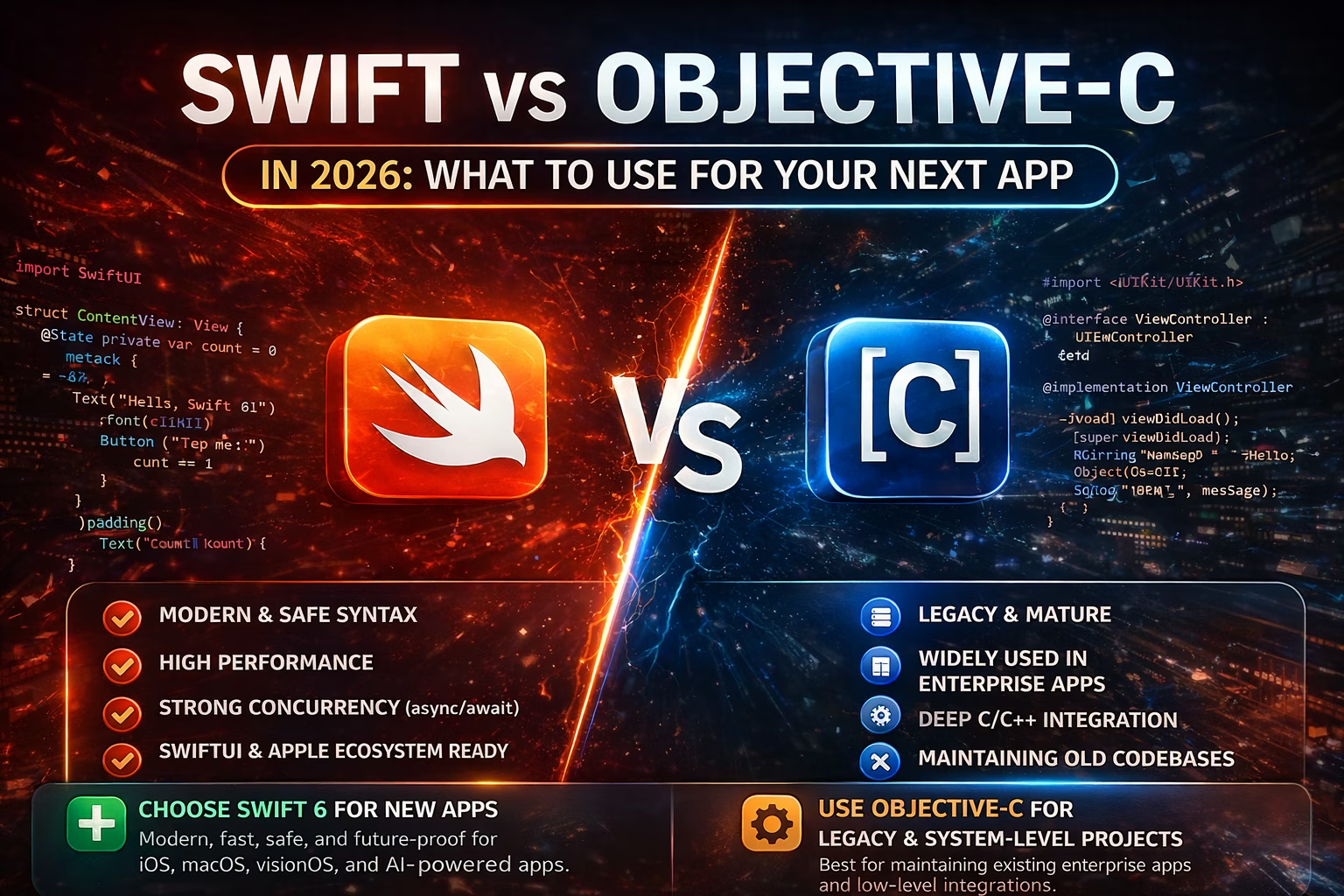
For all new Apple platform applications, including iOS, macOS, watchOS, tvOS, and especially visionOS projects leveraging Apple Intelligence or embedded Swift, choose Swift 6.
Swift offers superior safety, concurrency, performance, developer experience, and future-proofing. It aligns with Apple's strategic vision and provides access to a vibrant, growing developer ecosystem.
Consider Objective-C only for:
-
Extending or maintaining existing Objective-C legacy applications.
-
Projects with extremely deep and unavoidable dependencies on complex C/C++ libraries where bridging from Swift proves overly cumbersome.
Even in legacy scenarios, a hybrid approach is often recommended, gradually introducing Swift for new features and ultimately paving the way for a more modern and sustainable codebase. The future of Apple development is undoubtedly Swift.