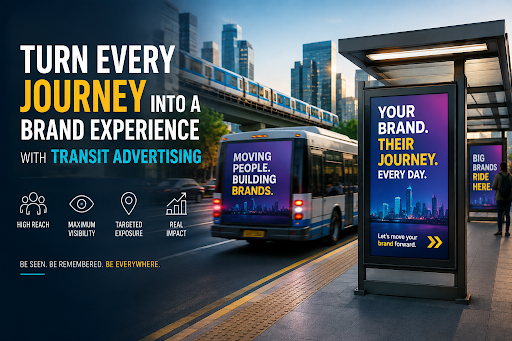
Turn Every Journey into a Brand Experience with Transit Advertising

Learn how transit advertising builds brand awareness through repeated exposure, strategic route selection, simple messaging, and integrated marketing campaigns.
Every day, millions of people commute to work, school, shopping centers, and entertainment venues. Whether they travel by bus, train, taxi, or rideshare, these daily journeys create countless opportunities for businesses to connect with potential customers. Understanding how transit advertising works can help marketers recognize why it remains one of the most effective forms of out-of-home advertising for building consistent brand awareness.
Unlike many digital campaigns that disappear after a few seconds, transit advertising keeps a brand visible throughout an entire journey. Commuters repeatedly encounter the same message, whether on a moving vehicle, at a station, or while waiting at a stop. This repeated exposure builds familiarity, which plays a significant role in consumer trust and purchase decisions.
Businesses of all sizes can benefit from this advertising format. From local restaurants and healthcare providers to national retail brands and technology companies, transit campaigns provide an opportunity to reach large audiences across multiple neighborhoods without depending solely on online platforms.
Understanding Why Transit Advertising Creates Strong Brand Experiences
Transit advertising is more than simply placing a logo on a bus. It transforms ordinary travel into a memorable interaction between people and brands. Because public transportation naturally moves through busy commercial districts, residential areas, and business centers, advertisements gain exposure from both passengers and pedestrians.
The effectiveness of transit advertising comes from several important advantages:
- Continuous visibility throughout the day
- Exposure to diverse demographic groups
- High message repetition
- Large geographic coverage
- Strong support for local brand recognition
Imagine a new fitness center opening in a city. Instead of relying exclusively on digital ads that users may scroll past, branded buses traveling through nearby neighborhoods repeatedly introduce the business to residents. Over several weeks, people begin recognizing the name before they even consider joining a gym. When the need arises, the brand is already familiar.
This combination of repetition and broad reach makes transit advertising particularly valuable for businesses seeking long-term brand recall instead of immediate clicks.
Building an Effective Transit Advertising Strategy
A successful campaign requires thoughtful planning rather than simply selecting available advertising space.
Define Your Primary Objective
Begin by identifying what success looks like.
Common objectives include:
- Increasing local brand awareness
- Promoting a product launch
- Driving foot traffic
- Supporting seasonal campaigns
- Reinforcing an existing marketing initiative
Each objective influences creative design, messaging, and campaign duration.
Know Your Audience
Transit routes often serve different communities.
For example:
- Business districts attract professionals.
- University routes reach students.
- Tourist destinations attract travelers.
- Residential areas reach families and homeowners.
Matching your campaign with audience movement improves overall campaign performance.
Keep the Message Simple
Transit advertisements are viewed briefly. Most people only have a few seconds to absorb the information.
An effective design typically includes:
- One clear headline
- Minimal supporting text
- Strong brand identity
- Easy-to-read typography
- A memorable visual concept
Trying to communicate too many ideas usually reduces effectiveness.
Coordinate with Other Marketing Channels
Transit advertising performs best when integrated into a broader marketing strategy.
For example, a healthcare provider launching a vaccination campaign might combine:
- Bus shelter advertising
- Social media awareness
- Search advertising
- Local community outreach
- Email newsletters
Consistent messaging across channels reinforces brand recognition.
Common Challenges Businesses Should Avoid
Even experienced marketers sometimes reduce campaign effectiveness by overlooking several important principles.
Overloading the Advertisement
Large paragraphs, multiple offers, or excessive graphics overwhelm viewers.
Instead, communicate one primary message that people can understand almost instantly.
Ignoring Route Selection
Not every transit route serves the same audience.
A luxury real estate campaign may perform better near business districts than university campuses. Choosing locations strategically often matters more than campaign size.
Measuring Only Immediate Sales
Transit advertising frequently influences awareness before purchases occur.
Someone who notices a brand today may search for it weeks later when they actually need the product or service.
Evaluating only direct conversions may underestimate the campaign's true value.
Inconsistent Branding
Changing colors, messaging, or visual identity across campaigns creates confusion.
Maintaining consistent branding helps audiences recognize your business regardless of where they encounter it.
Expert Recommendations for Better Results
Years of successful out-of-home campaigns demonstrate several best practices that consistently improve performance.
First, focus on storytelling instead of simply displaying products. A memorable message often creates stronger emotional connections than a list of features.
Second, design specifically for movement. Since buses and trains are constantly in motion, advertisements should remain readable from different distances and viewing angles.
Third, maintain campaigns long enough to build familiarity. Transit advertising becomes more effective through repeated exposure over several weeks or months.
Fourth, regularly review campaign performance alongside other marketing metrics. Website traffic, branded search volume, store visits, and customer surveys can provide valuable insights into overall effectiveness.
Finally, adapt creative materials for different transit formats. A full vehicle wrap, station poster, and digital transit display each require unique design considerations while maintaining a consistent brand identity.
Businesses can also strengthen campaign performance by evaluating how well their online presence supports offline awareness. Someone who discovers a brand during their commute will often visit its website before making a purchase decision. Tools such as AudEsto can help businesses assess website quality through white-label SEO audits and downloadable reports, ensuring that the digital experience aligns with the credibility established through transit advertising.
Conclusion
Transit advertising remains one of the most reliable ways to create lasting brand awareness because it reaches people during their everyday routines. Instead of competing for attention in crowded digital feeds, brands become part of the environments people experience daily.
The most successful campaigns prioritize audience understanding, concise messaging, strategic route selection, and consistent branding. When combined with a strong online presence and integrated marketing strategy, transit advertising turns ordinary journeys into memorable brand experiences that continue influencing purchasing decisions long after commuters reach their destinations.