How to Use an Asesor IA to Build a Smarter AI Strategy

Discover how an asesor IA can help businesses identify AI opportunities, automate repetitive tasks, choose suitable tools, and build a smarter AI strategy.
Artificial intelligence is no longer something businesses can simply watch from the sidelines. From automating repetitive work to improving customer experiences, AI is changing how companies operate. But choosing the right tools and knowing where to start can be difficult.
This is where an asesor IA, or AI advisor, can help. Instead of adopting AI just because it is trending, businesses can use expert guidance to identify real opportunities, avoid unnecessary tools, and create a strategy that supports their goals. The right approach turns AI from an exciting idea into something practical and useful.
What Is an Asesor IA?
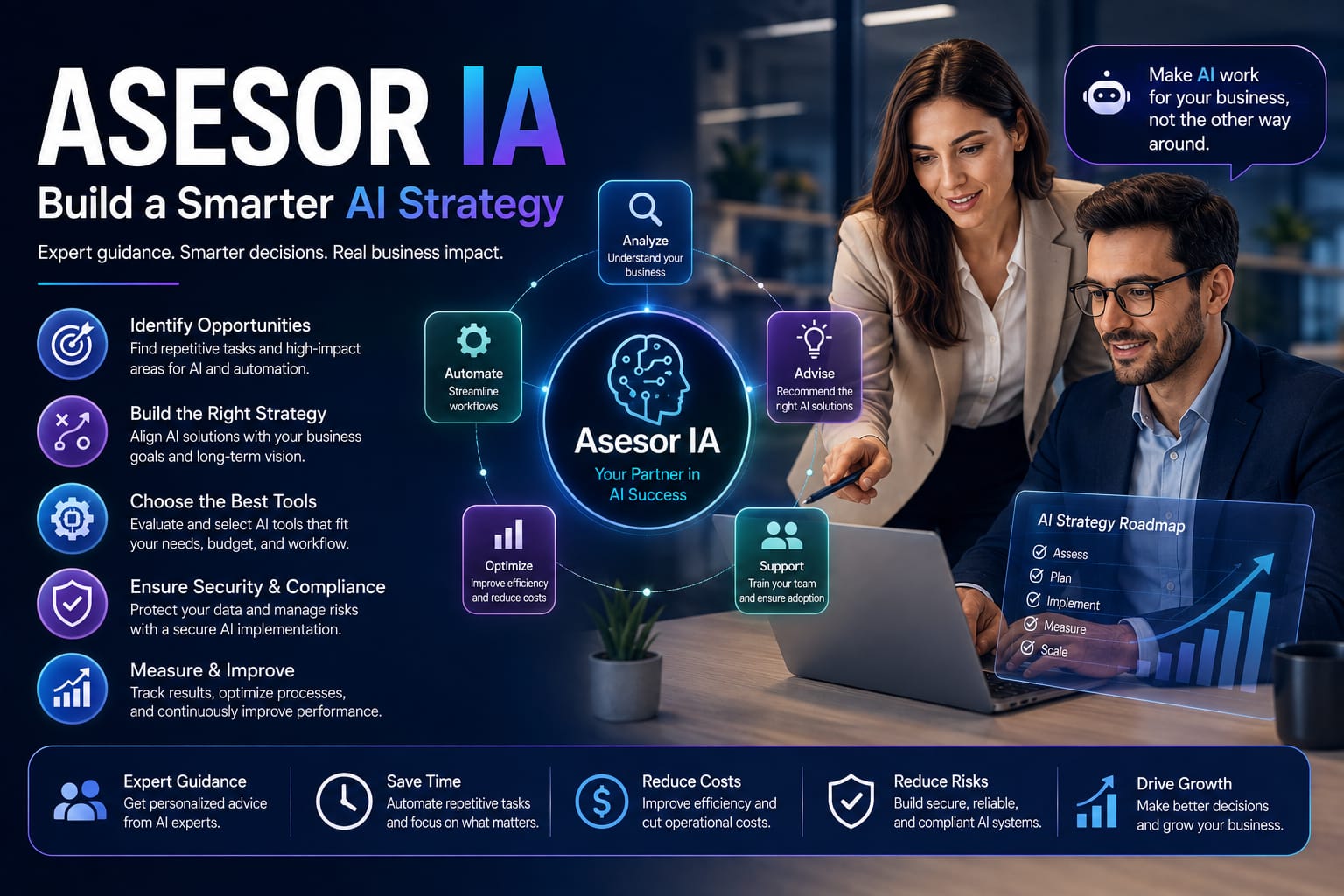
An asesor IA is an AI advisor who helps businesses understand how artificial intelligence can be applied to their specific needs. Their role can involve identifying automation opportunities, evaluating AI tools, improving workflows, and developing a practical AI adoption strategy.
The exact services can vary. Some advisors focus on automation, while others may specialize in AI implementation, data, customer service, or business strategy.
The important point is that an AI advisor should connect technology with a real business need. Instead of recommending AI tools simply because they are popular, the advisor should consider the company's objectives, existing systems, budget, employees, and customers.
Why Do Businesses Need an AI Strategy?
Buying several AI tools does not automatically create an effective AI strategy.
Without a clear plan, businesses may end up paying for tools they rarely use, creating disconnected workflows, or automating processes that were never efficient in the first place. Employees may also become confused when new technologies are introduced without proper training or communication.
A structured strategy provides direction. It helps a business decide:
- Which problems should AI solve?
- Which tasks are suitable for automation?
- What technology is already available?
- What data is needed?
- What risks need to be managed?
- How will success be measured?
An asesor IA can help organize these questions into a practical roadmap.
How Can an Asesor IA Help Build a Smarter AI Strategy?
A useful AI strategy should be connected to business priorities rather than technology alone. An AI advisor can support this process through several important steps.
1. Identify Repetitive Business Tasks
The first step is finding work that consumes time without requiring significant human judgment.
Examples include:
- Data entry
- Basic customer inquiries
- Appointment scheduling
- Report generation
- Document processing
- Internal information searches
- Routine email responses
These processes may provide opportunities for automation. However, not every repetitive task should automatically be automated. An advisor can help determine whether automation would actually create measurable value.
2. Connect AI Opportunities With Business Goals
AI should have a purpose beyond simply being introduced into the company.
For example, a business might want to reduce customer response times. Another company may want to reduce administrative workload. A growing organization could be more interested in improving internal productivity.
An asesor IA can map potential AI applications to these objectives. This makes the strategy easier to evaluate because every proposed solution has a clear reason for existing.
3. Evaluate Existing Tools and Technology
Businesses often already have software that includes AI-powered features. Before purchasing something new, it makes sense to understand what is already available.
An AI advisor can review the existing technology stack and identify potential integrations or gaps. This can prevent unnecessary spending and reduce the complexity of adding another platform.
For example, a company may already have a customer relationship management system, communication platform, or accounting software that can connect with automation tools.
4. Choose AI Tools Based on Business Needs
There is no universal AI tool that works perfectly for every organization.
An advisor can help compare potential solutions according to factors such as functionality, integration, scalability, security, cost, and ease of use.
This is especially important for smaller businesses. A sophisticated platform may offer dozens of features, but if a company only needs two of them, a simpler solution could be more practical.
The goal should be finding technology that fits the workflow—not forcing the workflow to fit the technology.
What Should an AI Strategy Include?
A strong AI strategy should provide more than a list of recommended tools. It should explain how AI will be introduced, managed, and measured.
Clear Business Objectives
Start with measurable goals. Instead of saying, “We want to use AI,” define what the business wants to improve.
For example, the goal could be reducing the time spent on a specific administrative process or improving the speed of customer support.
A Prioritized AI Roadmap
Not every AI project needs to happen at once.
An asesor IA can help prioritize projects based on factors such as potential business value, implementation difficulty, available resources, and risk.
Starting with a smaller project can also make it easier to learn what works before expanding AI across the organization.
Data and Security Considerations
AI systems often depend on data, which makes privacy and security important parts of the strategy.
Businesses should understand what information an AI system will access, where that information is processed, who can access it, and how sensitive information is protected.
An AI strategy should also consider relevant regulations and internal data policies rather than treating security as an afterthought.
Employee Training and Adoption
Technology only creates value when people can use it effectively.
Employees may need training to understand new AI tools, review AI-generated outputs, recognize mistakes, and use automation responsibly.
Clear communication can also reduce uncertainty. Employees should understand how the technology supports their work and where human judgment remains necessary.
How to Measure the Results of an AI Strategy
A strategy should have measurable outcomes.
Before implementing an AI solution, establish a baseline. For example, determine how much time employees currently spend completing a particular process.
After implementation, compare the new results with the original baseline.
Useful measurements may include:
- Time saved
- Processing speed
- Operating costs
- Customer response time
- Error rates
- Employee productivity
- Customer satisfaction
These measurements help businesses determine whether an AI initiative is delivering meaningful results or simply adding another layer of technology.
Common Mistakes to Avoid When Adopting AI
AI adoption can become expensive and complicated when businesses focus on technology before understanding the problem.
One common mistake is trying to automate everything at once. A better approach is to start with a clearly defined workflow and expand after the results are understood.
Another mistake is relying completely on AI-generated outputs without human review. AI systems can produce inaccurate or inappropriate results, so businesses need processes for verification and accountability.
Ignoring employees is another problem. If the people expected to use a new system do not understand it or see its value, adoption can suffer.
Finally, businesses should avoid choosing tools based only on popularity. A solution that works well for one company may not be appropriate for another.
When Should You Work With an Asesor IA?
An AI advisor can be particularly useful when a business knows it wants to adopt AI but is unsure where to begin.
You may benefit from professional guidance if your business:
- Has many repetitive processes
- Uses several disconnected software systems
- Wants to introduce AI but lacks an internal strategy
- Needs help evaluating AI tools
- Wants to automate workflows
- Is concerned about implementation risks
- Needs a roadmap for gradual AI adoption
For organizations with an internal technology team, an advisor can also provide an outside perspective and help evaluate specific AI opportunities.
Build an AI Strategy That Grows With Your Business
A smarter AI strategy does not mean using the most AI tools possible. It means choosing the right applications for the right problems and introducing them in a controlled, measurable way.
An asesor IA can help businesses move from uncertainty to a clearer plan by identifying opportunities, evaluating technology, considering risks, and connecting AI initiatives with measurable business goals.
The best place to begin is often simple: choose one repetitive process, define the problem, establish a measurable goal, and test a suitable AI solution. Learn from the results before expanding.
AI adoption is an ongoing process, not a one-time technology purchase. With a thoughtful strategy and the right guidance, businesses can use AI to improve workflows while keeping people, security, and long-term business objectives at the center
Final Thoughts
Building a smarter AI strategy is not about adopting every new AI tool. It is about understanding your business problems, identifying where AI can create real value, and choosing solutions that support your long-term goals.
An asesor IA can help make this process more practical by identifying automation opportunities, evaluating suitable technologies, considering security and implementation needs, and creating a clear roadmap. Instead of making large changes all at once, businesses can start with one meaningful problem, measure the results, and gradually expand what works.
The key is to treat AI as a business strategy rather than simply a technology trend. With the right planning, human oversight, and measurable goals, AI can become a practical part of everyday business operations and help teams work more efficiently.