How to Use Drovenio AI for Business to Save Time and Reduce Manual Work

Learn how AI automation can help businesses reduce repetitive tasks, save valuable time, and improve everyday workflows with practical strategies.
Running a business can sometimes feel like spending more time managing small tasks than doing meaningful work. Copying information between systems, preparing routine reports, sorting requests, and answering the same questions repeatedly can quietly consume hours every week.
That is where AI automation becomes useful. It can help businesses understand which repetitive processes are worth improving and where technology can reduce unnecessary manual effort. If you have searched for Drovenio AI for Business, it is important to understand what Droven.io actually provides and how its information about AI and automation can help you make better technology decisions.
Droven.io describes itself as a technology and AI editorial platform that explains artificial intelligence, automation, machine learning, cloud computing, cybersecurity, and related topics in accessible language. It is not presented as a software product or automation agency.
What Is Drovenio AI for Business?
The phrase Drovenio AI for Business can be understood as a business-focused approach to learning about AI, automation, and emerging technology through Droven.io's educational content.
This distinction is important because some online pages describe Droven.io as though it were a standalone AI automation platform. However, its own website presents it as an editorial resource rather than a tool that businesses can log into and use to build automated workflows.
For a business owner, that makes Droven.io more useful as a knowledge and research resource. You can use information about AI and automation to identify repetitive processes, understand possible solutions, and make more informed decisions before investing in an actual automation tool.
The real value starts with understanding the problem.
Why Businesses Lose Time to Manual Work
Manual work is not always bad. Some tasks genuinely require human judgment, creativity, or communication.
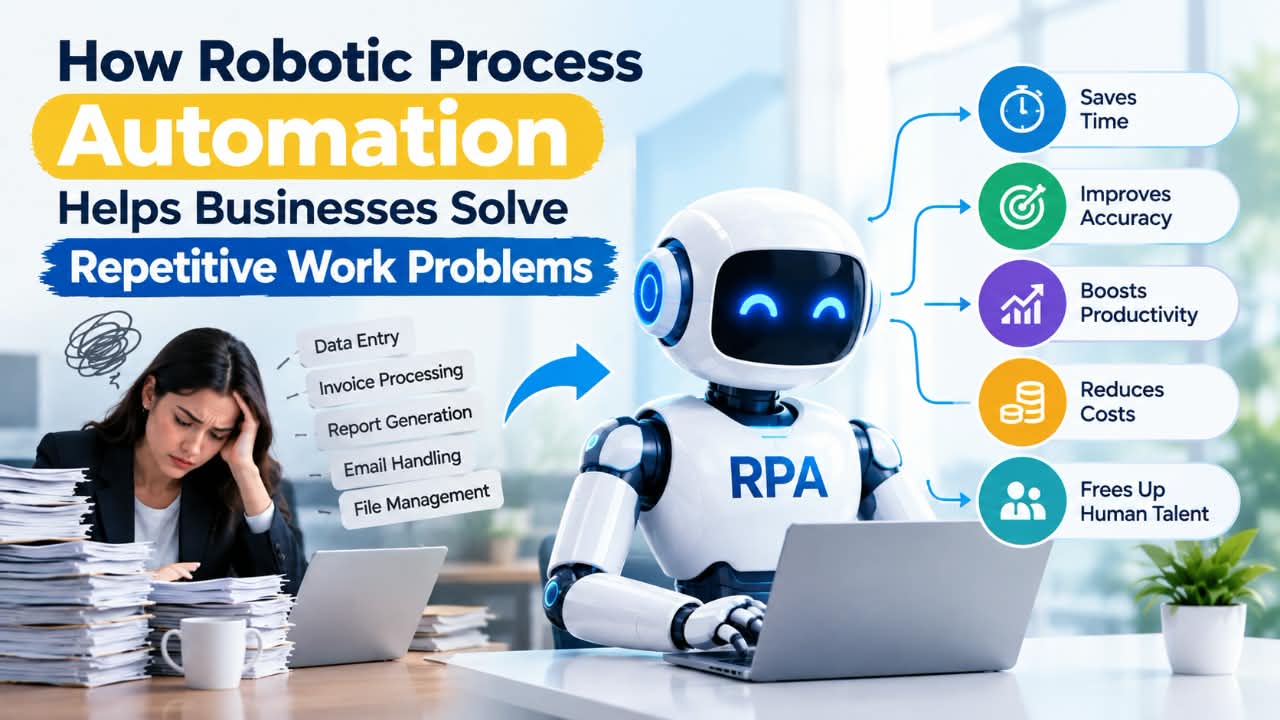
The problem occurs when employees repeatedly perform simple digital actions that could be streamlined.
Consider a typical workflow. A customer submits an inquiry, an employee reads it, copies information into a spreadsheet, enters the same information into a CRM, sends a notification, and prepares a follow-up message.
None of these steps may seem particularly difficult. But when hundreds of inquiries arrive every month, the accumulated workload becomes significant.
Other examples include:
- Repetitive data entry
- Sorting incoming emails
- Preparing routine reports
- Moving information between applications
- Organizing documents
- Scheduling internal notifications
- Summarizing large amounts of information
- Responding to common customer questions
This is where AI automation can become part of a broader workflow improvement strategy.
How AI Automation Can Reduce Repetitive Work
AI automation combines artificial intelligence with automated processes. Traditional automation usually follows clearly defined rules, while AI can help a system interpret information, classify content, generate text, or identify patterns.
For example, a basic automated workflow might move a form submission into a spreadsheet. An AI-assisted workflow could also examine the submission, determine its category, summarize the request, and help route it to the appropriate team.
That does not mean every business task should be handed over to AI.
A better approach is to separate the workflow into tasks that require human judgment and tasks that are repetitive enough to streamline.
This creates a practical balance:
AI handles appropriate repetitive work → automation moves information → employees review important decisions.
That approach can save time without removing people from processes where their judgment matters.
How to Identify Tasks Worth Automating
Before choosing an AI tool, look at your existing workflow.
Start by making a list of tasks employees perform repeatedly during the week. Then ask a few simple questions:
- How often does this task happen?
- How much time does it take?
- Does it follow a predictable process?
- Does it involve copying or organizing information?
- Does the task frequently cause errors?
- Does it require human judgment?
- What would happen if part of the process were automated?
The answers can reveal opportunities that are easy to overlook.
For instance, a task that takes only five minutes might not seem worth automating. But if five employees perform it 20 times every day, the total time becomes much larger.
The goal is not to automate everything. It is to find the work where automation can create measurable value.
Using Droven.io to Understand Business AI
Droven.io covers topics including AI, automation, machine learning, cloud computing, and cybersecurity. Its stated purpose is to explain these technologies in accessible language and help readers understand them before making technology decisions.
For a business, that information can be useful during the research stage.
Suppose your team wants to automate customer support. Instead of immediately purchasing a tool, you can first learn about AI-assisted customer service, workflow automation, RPA, data requirements, and human oversight.
Then you can compare actual software solutions based on your requirements.
This approach reduces the risk of choosing technology simply because it sounds impressive.
Where Businesses Can Apply AI Automation
AI automation can support many different areas of a company. The right application depends on the business process and the type of information involved.
Customer Support
Businesses often receive similar questions repeatedly. AI-assisted systems can help classify inquiries, summarize conversations, suggest responses, and route requests.
Human support staff can remain responsible for sensitive or complicated cases.
Marketing
Marketing teams handle research, customer feedback, campaign information, content workflows, and reporting.
AI can assist with organizing information and reducing repetitive preparation work. Employees can then spend more time on strategy and creative decisions.
Sales
Sales teams frequently manage leads, customer information, follow-ups, and meeting notes.
AI-supported workflows can help summarize conversations, organize information, and prepare routine follow-up material.
Administrative Operations
Administrative processes are often filled with repetitive digital tasks.
Document organization, information extraction, notifications, reporting, and data movement can sometimes be streamlined through automation.
The important question is always the same: Does the process have enough repetitive work to justify automation?
AI Automation vs. Traditional Automation
Understanding the difference between AI automation and traditional automation can help businesses choose the right approach.
Traditional automation generally follows predefined rules.
For example:
If a form is submitted → add the information to a database → notify the assigned employee.
AI can add another layer of interpretation.
For example:
A customer message arrives → AI identifies the request → extracts relevant information → categorizes it → suggests the next action → automation routes it to the appropriate workflow.
Traditional automation is often sufficient when the rules are predictable. AI becomes more useful when the process involves unstructured information such as natural-language messages, documents, or large amounts of text.
Using AI where ordinary automation would work can create unnecessary complexity.
How to Reduce Manual Work Without Creating New Problems
Automation should make work easier, not create another system employees have to manage.
One practical approach is to start small.
Choose one repetitive workflow with a clear beginning and end. Document the existing process, identify unnecessary steps, and determine which parts could be automated.
Then establish a measurable goal.
For example, instead of saying:
«“We want to use AI to improve productivity.”»
Set a clearer objective:
«“We want to reduce the time spent processing routine customer inquiries.”»
The second goal can be measured.
You can compare processing time before and after implementation, monitor error rates, and collect feedback from employees.
That evidence tells you whether the automation is actually helping.
Common Mistakes to Avoid
AI automation can be useful, but businesses should avoid treating it as a magic solution.
Automating a Bad Process
If a workflow is unnecessarily complicated, automating it may simply make the complicated process faster.
Improve the workflow first.
Automating Tasks That Need Human Judgment
Some activities involve negotiation, sensitive customer information, complex decisions, or creative thinking. These should not automatically be handed to an automated system.
Ignoring Data Quality
AI systems depend on the information they receive. Poor-quality or inconsistent data can produce unreliable results.
Choosing Technology Before Defining the Problem
This is one of the most common mistakes.
Start with the business problem, then identify the technology needed to address it.
Measuring Only Cost
Saving money is useful, but it is not the only measurement. Response time, accuracy, employee workload, customer experience, and processing capacity can also matter.
How to Build a Practical AI Automation Strategy
A simple five-step process can make AI adoption easier.
1. Identify repetitive work.
Find tasks that consume significant time without requiring much human judgment.
2. Map the workflow.
Write down what happens from the beginning of the process to the end.
3. Find the automation opportunity.
Determine which steps can be automated and which should remain under human control.
4. Test one workflow.
Start with a manageable process instead of changing the entire business at once.
5. Measure the result.
Compare time, accuracy, workload, and other relevant metrics before and after implementation.
This approach keeps AI automation focused on outcomes rather than technology for its own sake.
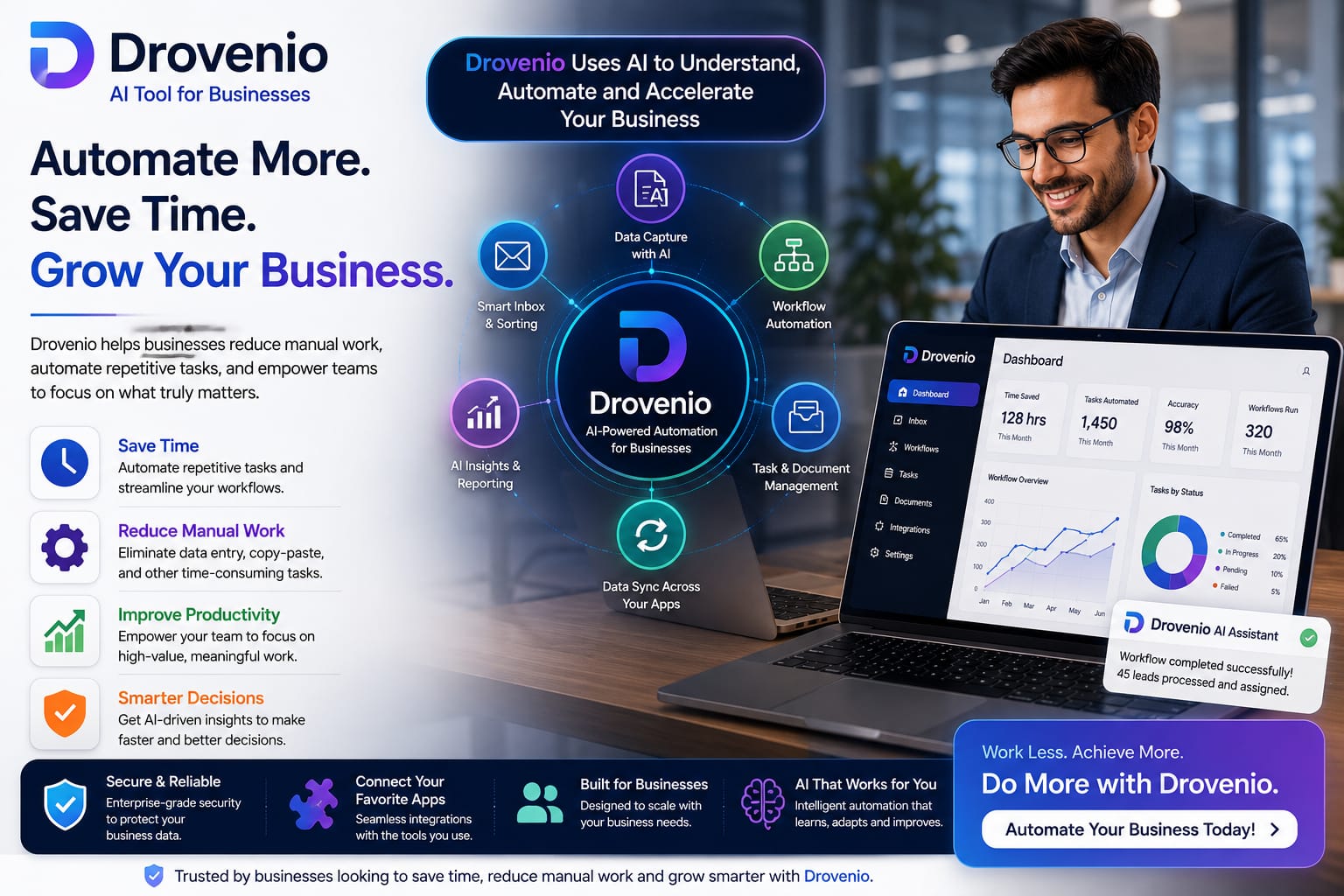
Is Drovenio AI for Business an Automation Tool?
This is an important point for anyone searching for the keyword.
Based on Droven.io's own public description, it is an editorial and knowledge platform, not a conventional business automation application. Its content focuses on helping readers understand AI, automation, emerging technology, and related subjects.
Therefore, businesses should not assume that searching for “Drovenio AI for Business” means they are looking at a software platform with its own automation dashboard, pricing plans, or workflow builder.
Instead, Droven.io can be approached as a source of information for understanding the technologies behind modern business automation.
If you need an actual automation system, you should separately evaluate a suitable software provider based on its documented capabilities, security practices, integrations, support, and pricing
Conclusion
AI automation can make everyday business work faster and more manageable, but the biggest gains usually come from solving small, repetitive problems first. Start by identifying one task that regularly consumes employee time, map the steps involved, and determine where automation could make the process simpler.
If you are exploring Drovenio AI for Business, use the available information to build your understanding of AI, automation, and emerging business technologies. Then move from research to action by identifying the workflows in your own business that need improvement.
Before implementing any solution, define a measurable goal. You might want to reduce processing time, minimize manual data entry, improve response speed, or free employees to focus on higher-value work. Test one workflow, track the results, and expand only when the results support it.
Ready to reduce manual work? Start with one repetitive business task today. Identify the time it consumes, explore an appropriate AI automation approach, and test a small workflow that can deliver a measurable improvement.