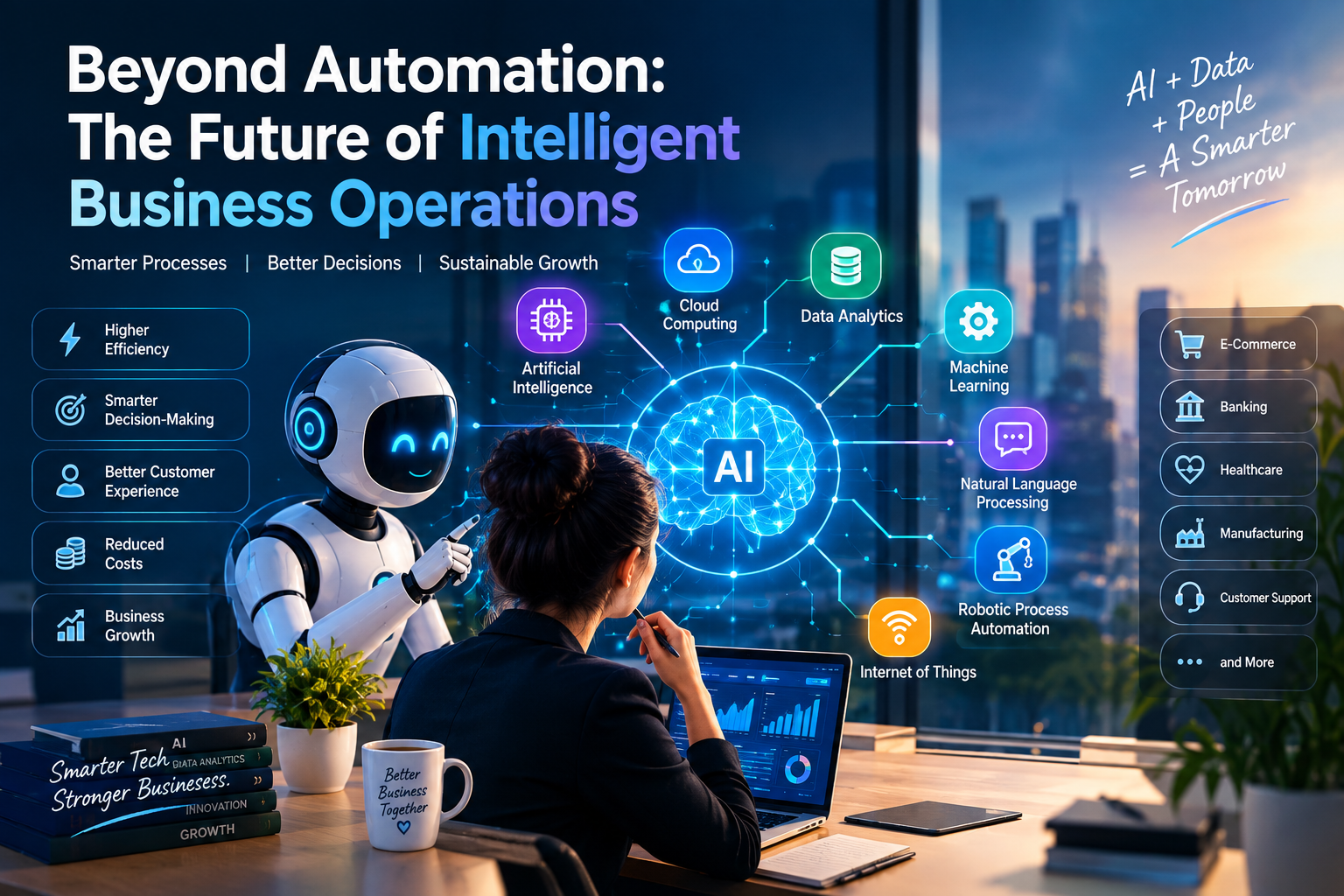
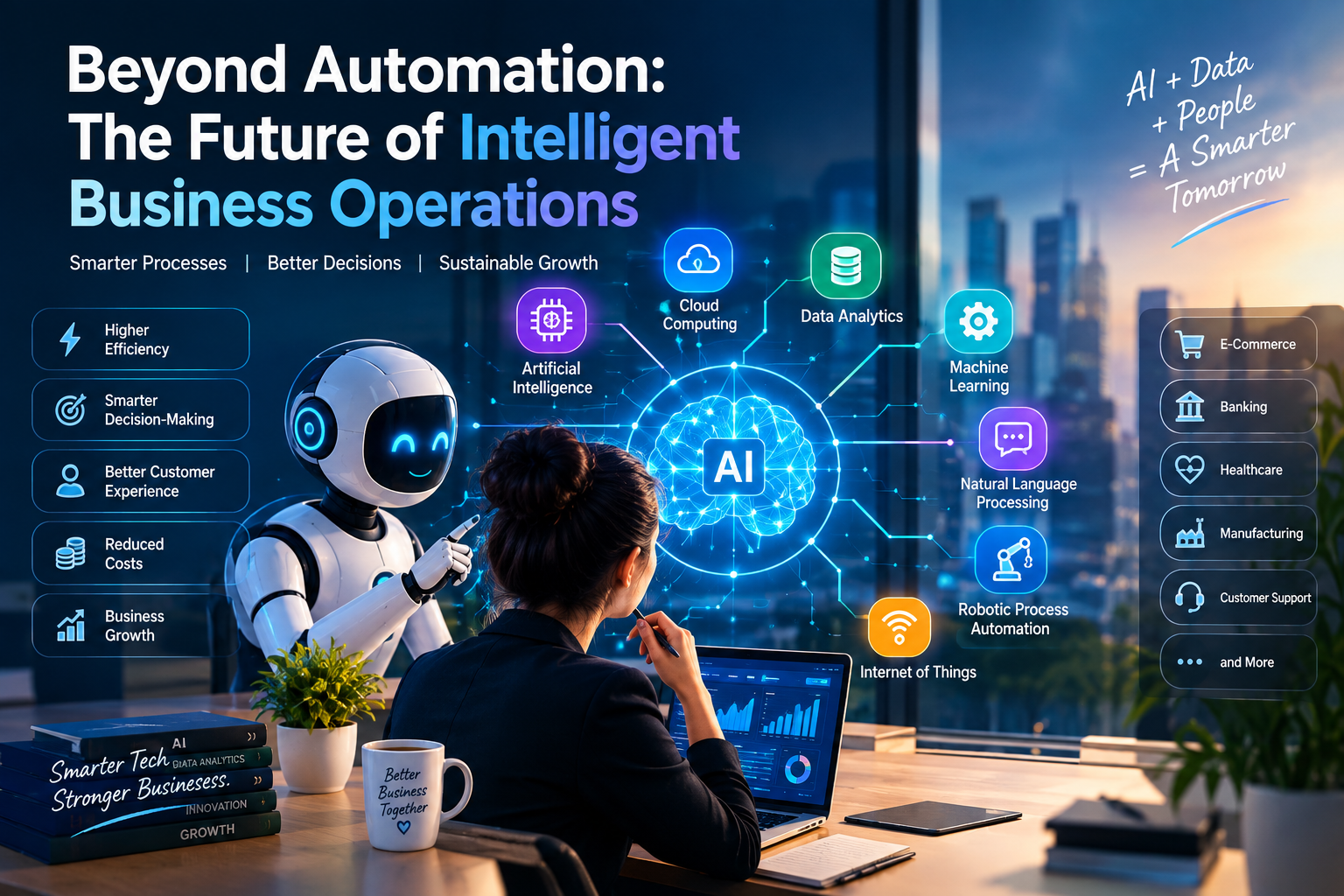
Beyond Automation: The Future of Intelligent Business Operations
Discover how intelligent business operations go beyond traditional automation by combining AI, data analytics, and human expertise for smarter growth.
What Are Intelligent Business Operations?
Intelligent business operations refer to the use of advanced digital technologies to make business processes more efficient, adaptive, and data-driven. While traditional automation follows predefined rules, intelligent operations can analyze information, recognize patterns, make recommendations, and support complex decisions.
For example, a traditional automated system may send an email whenever a customer completes a purchase. An intelligent business system can analyze the customer's purchase history, preferences, behavior, and previous interactions before determining what message or offer should be provided.
This shift changes the role of technology from simply performing repetitive tasks to actively supporting business decision-making.
From Traditional Automation to Intelligent Operations
Traditional automation has played an important role in improving business efficiency. It can reduce repetitive manual work, standardize processes, and save employees valuable time.
However, traditional automation usually depends on fixed rules. If a situation changes, the system may require human intervention or manual reconfiguration.
Intelligent business operations take automation a step further. They combine automation with technologies such as artificial intelligence, machine learning, natural language processing, predictive analytics, and real-time data processing.
The difference can be understood simply:
Traditional Automation:
"If this happens, perform this action."
Intelligent Operations:
"Analyze what is happening, understand the available information, determine the appropriate action, and continuously improve based on new data."
This makes intelligent operations more suitable for modern businesses operating in rapidly changing environments.
Key Technologies Behind Intelligent Business Operations
Several technologies work together to create intelligent business operations.
1. Artificial Intelligence
Artificial intelligence enables systems to analyze information, recognize patterns, generate insights, and support decision-making.
Businesses can use AI for customer service, document processing, forecasting, fraud detection, recommendation systems, and many other activities.
2. Machine Learning
Machine learning allows systems to learn from historical and real-time data. Instead of relying entirely on manually programmed rules, machine-learning models can identify patterns and improve their predictions as more data becomes available.
3. Data Analytics
Data analytics transforms raw business data into meaningful information. Companies can analyze sales, customers, operations, finance, and other business areas to identify trends and make informed decisions.
4. Robotic Process Automation
Robotic Process Automation (RPA) can handle repetitive, rule-based digital tasks such as entering information, processing documents, transferring data between applications, and generating reports.
When RPA is combined with AI, organizations can automate more complex workflows.
5. Natural Language Processing
Natural Language Processing (NLP) allows computers to understand and process human language. It can support chatbots, virtual assistants, document analysis, customer-service systems, and automated communication.
6. Cloud Computing
Cloud platforms provide businesses with scalable computing resources, storage, applications, and data-access capabilities. Cloud technology can help organizations deploy intelligent systems without building all infrastructure from scratch.
Major Benefits of Intelligent Business Operations
Improved Operational Efficiency
Intelligent systems can reduce unnecessary manual work and streamline workflows. Employees can spend less time on repetitive administrative activities and more time on tasks that require creativity, communication, and strategic thinking.
Faster Decision-Making
Businesses generate enormous amounts of data every day. Intelligent analytics can process large datasets and provide useful insights much faster than traditional manual analysis.
This helps managers make decisions based on current information rather than outdated reports.
Better Customer Experiences
Intelligent operations can help businesses understand customer behavior and provide more personalized experiences.
For example, an intelligent customer-service platform can analyze previous interactions and recommend relevant information to a customer-service representative.
Reduced Operational Costs
Automation and intelligent process optimization can reduce unnecessary manual effort, errors, and resource usage. Over time, this can contribute to lower operational costs.
Increased Accuracy
Manual data entry and repetitive processes can lead to human errors. Intelligent systems can help reduce errors by automatically processing information and applying consistent rules.
Predictive Business Insights
Instead of only analyzing what happened in the past, businesses can use predictive analytics to identify possible future trends.
For example, a retailer can analyze historical sales, seasonal patterns, and customer behavior to estimate future demand.
Greater Business Agility
Modern markets can change quickly. Intelligent operations allow organizations to monitor changing conditions and adjust processes more efficiently.
This flexibility can help businesses respond to new customer expectations, market trends, and operational challenges.
Examples of Intelligent Business Operations
Intelligent Customer Service
Businesses can use AI-powered customer-service platforms to classify inquiries, suggest responses, identify common issues, and route complex requests to human employees.
The goal is not necessarily to remove humans from customer service but to help employees handle customer needs more efficiently.
Smart Supply Chain Management
Supply chains involve many variables, including inventory, transportation, suppliers, demand, and delivery schedules.
Intelligent systems can analyze these variables and help businesses forecast demand, identify potential delays, and improve inventory planning.
Intelligent Financial Operations
Financial departments can use intelligent technologies to analyze transactions, automate reporting, identify unusual activity, and support financial forecasting.
Human Resources
HR departments can use intelligent systems for tasks such as employee data management, workforce analytics, scheduling, and administrative workflows.
Human judgment remains important, particularly for sensitive employment decisions.
Intelligent Marketing
Marketing teams can analyze customer behavior, campaign performance, and market trends to identify which strategies are generating better engagement.
AI can also help marketers organize large amounts of information and generate content ideas.
Intelligent Operations in Different Industries
Intelligent business operations are not limited to technology companies.
Healthcare
Healthcare organizations can use intelligent technologies for appointment management, administrative workflows, medical documentation, resource planning, and data analysis.
Banking and Finance
Financial institutions can use intelligent systems for transaction monitoring, customer support, risk analysis, and fraud detection.
Retail
Retailers can use AI and analytics for demand forecasting, personalized recommendations, inventory management, and customer experience improvement.
Manufacturing
Manufacturers can use intelligent systems to monitor equipment, analyze production data, optimize processes, and identify potential maintenance requirements.
Logistics
Logistics companies can analyze transportation data, delivery patterns, inventory information, and operational conditions to improve planning and efficiency.
The Role of Humans in Intelligent Business Operations
The future of intelligent business operations is not simply about replacing people with machines.
Human expertise remains essential for creativity, leadership, ethical decisions, communication, strategic planning, and situations where context is difficult for automated systems to understand.
The most effective approach is often a combination of human intelligence and machine intelligence.
Machines can process large amounts of information quickly, while humans can provide judgment, empathy, creativity, and broader context.
This creates a human-in-the-loop approach where technology supports people instead of completely removing human involvement.
Challenges of Intelligent Business Operations
Despite their advantages, intelligent operations also create challenges.
Data Quality
AI and analytics systems depend heavily on data. Poor-quality, incomplete, outdated, or inconsistent data can lead to unreliable results.
Data Privacy and Security
Businesses handle sensitive customer and organizational information. Strong security practices are necessary to protect data from unauthorized access and misuse.
Implementation Costs
Building intelligent systems can require investment in technology, infrastructure, training, and skilled professionals.
Employee Training
Employees may need new technical and analytical skills to work effectively with intelligent systems.
Integration With Existing Systems
Many organizations already use multiple software platforms. Connecting new intelligent technologies with legacy systems can be complex.
Ethical Considerations
Organizations must consider fairness, transparency, accountability, and responsible use when deploying AI-based systems.
How Businesses Can Move Beyond Automation
Organizations do not need to transform every process at once. A gradual approach can be more practical.
Step 1: Identify Repetitive Processes
Businesses should first identify tasks that consume significant time or resources.
Step 2: Evaluate Data Availability
Before implementing intelligent solutions, organizations should determine whether reliable and relevant data is available.
Step 3: Start With High-Value Use Cases
Companies can begin with processes where intelligent technology can provide measurable improvements.
Step 4: Integrate AI With Automation
Existing automation can be enhanced with AI, analytics, and decision-support capabilities.
Step 5: Monitor Performance
Businesses should continuously evaluate system performance, accuracy, security, and business outcomes.
Step 6: Train Employees
Employees should understand how new systems work and how they can use them effectively.
Intelligent Business Operations and Business Growth
Intelligent operations can contribute to business growth by helping organizations use their resources more effectively.
When repetitive processes become more efficient, employees can focus on innovation and customer relationships. When business data becomes easier to analyze, leaders can identify opportunities and risks more quickly.
For growing organizations, intelligent operations can also provide scalability. Instead of increasing manual workload at the same rate as business growth, companies can use technology to support larger volumes of transactions and information.
The Future of Intelligent Business Operations
The future of business operations is likely to involve increasingly connected systems that combine automation, AI, analytics, cloud computing, and human decision-making.
AI agents and intelligent software systems may increasingly assist employees with research, workflow management, data analysis, customer interactions, and operational decisions.
Real-time analytics may also become more important as businesses seek to understand changing market conditions immediately.
However, successful organizations will need to balance technological innovation with security, privacy, transparency, human oversight, and responsible AI practices.
Intelligent Operations vs. Traditional Automation
Traditional Automation
Follows predefined rules
Handles repetitive tasks
Limited decision-making
Usually reactive
Requires predefined conditions
Focuses on task efficiency
Intelligent Business Operations
Uses data and intelligent analysis
Handles more adaptive workflows
Support complex decisions
Can provide predictive insights
Can learn from data
Focuses on broader business outcomes
Conclusion
The transition from traditional automation to intelligent business operations represents an important evolution in how organizations use technology. Businesses are no longer focused only on automating repetitive tasks; they are increasingly looking for ways to combine automation, artificial intelligence, data analytics, and human expertise.
Intelligent business operations can improve efficiency, support faster decision-making, enhance customer experiences, reduce errors, and provide valuable insights for future planning.
The organizations that approach this transformation responsibly can create operations that are not only automated but also adaptive, data-driven, and capable of responding to changing business environments.
Ultimately, the future of intelligent business operations is not about technology replacing every human task. It is about creating a smarter partnership between people, data, and technology to build more efficient, flexible, and resilient businesses.