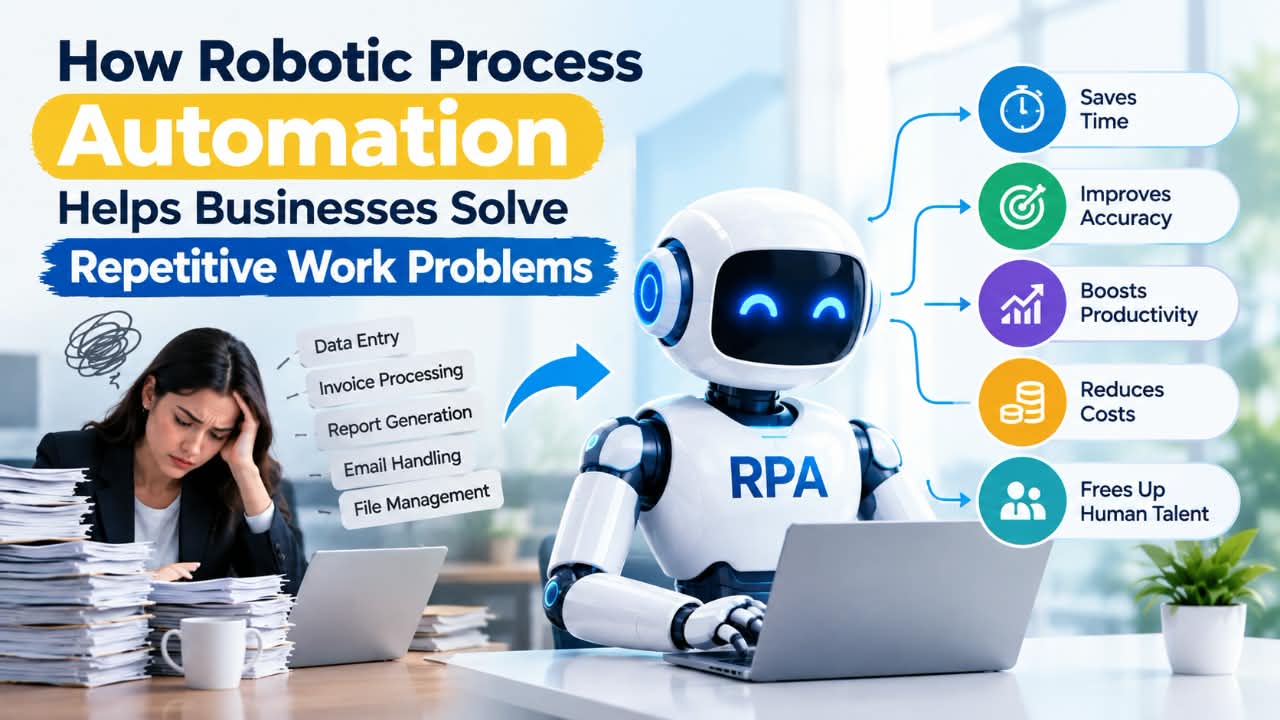
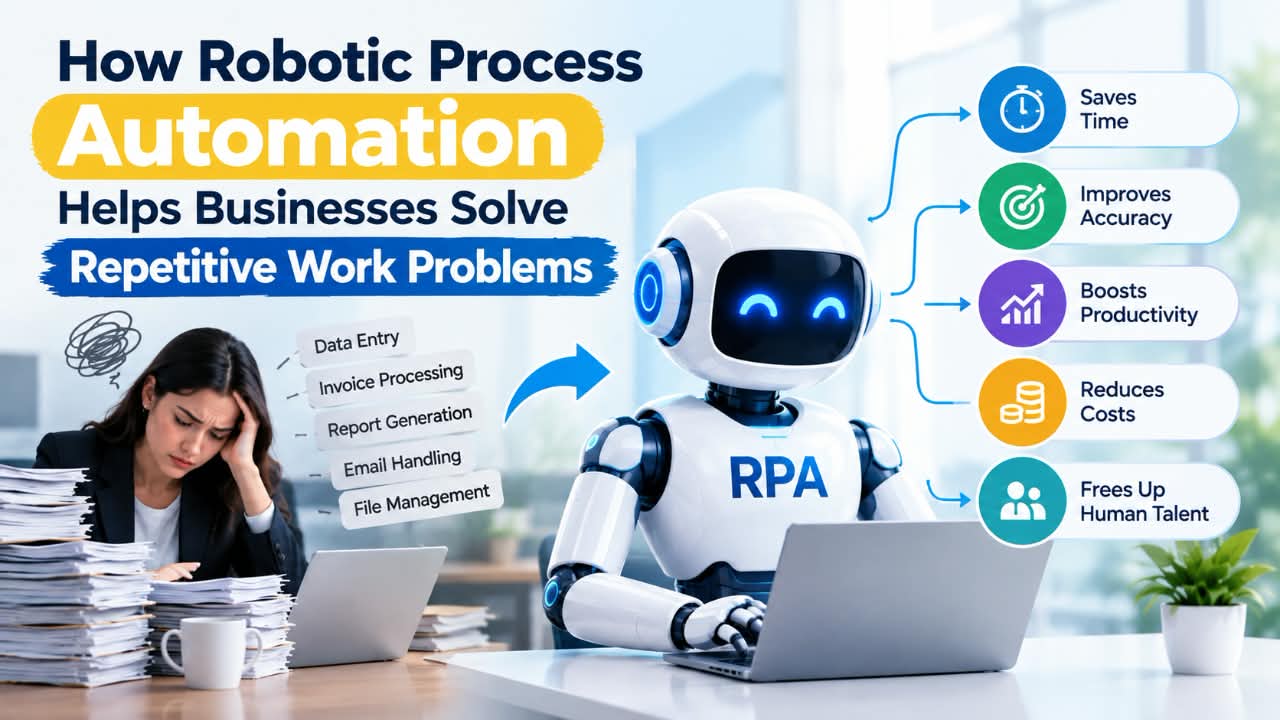
How Robotic Process Automation Helps Businesses Solve Repetitive Work Problems
Learn how robotic process automation helps businesses automate repetitive tasks, reduce errors, save time, and improve everyday workflow efficiency.
Think about how much time your team spends doing the same tasks every day. Maybe someone is copying data from one system to another, checking invoices, updating spreadsheets, or sorting through routine emails. These tasks are part of running a business, but they can quickly become tiring and time-consuming when there’s a lot of them.
That’s where robotic process automation (RPA) comes in. It can handle many repetitive, rule-based tasks automatically, giving employees more time to focus on work that needs human judgment, problem-solving, and creativity.
So, how does it actually work, and where can it make a real difference? Let’s take a closer look at what RPA can do, where it works best, its benefits and limitations, and some practical business examples.
What Is Robotic Process Automation?
Robotic Process Automation (RPA) is a technology that uses software bots to handle repetitive tasks on computers and digital systems. Instead of an employee carrying out the same steps over and over, a bot can follow set instructions and complete those routine actions automatically.
For example, a business might receive customer information through an online form and then manually enter it into another system. An RPA bot can be set up to transfer that information between the systems according to predefined rules.
RPA works best when a task is repetitive, predictable, and follows clear steps. It doesn’t mean that every business activity needs to be automated. The idea is to take routine work off employees’ plates where automation can genuinely make the process easier and more efficient.
Why Do Businesses Need RPA?
As a business grows, so does the amount of routine work behind the scenes. Employees may find themselves spending a large part of their day entering information, checking records, moving files, or completing the same steps in different systems.
The problem is not that these tasks are unimportant. They simply take time and can become difficult to manage when the workload increases.
RPA can help businesses deal with these challenges by automating suitable repetitive processes.
Less Time on Repetitive Work
When software handles routine steps, employees can spend less time on work that does not require constant human involvement.
Fewer Manual Errors
Typing or copying information repeatedly can lead to mistakes. A properly configured automated workflow can perform the same steps consistently.
Better Use of Employee Time
Instead of spending hours on routine activities, employees can focus on customer needs, analysis, problem-solving, and other tasks that require human judgment.
Easier to Handle Growing Workloads
As the number of transactions or requests increases, automation can help businesses manage suitable repetitive processes without relying entirely on additional manual effort.
How Does Robotic Process Automation Work?
RPA works by following a set of instructions that tell a software bot what to do and when to do it. Once a suitable process is identified and configured, the bot can repeat those steps whenever the task needs to be completed.
For example, imagine an employee receives customer information by email and then enters the details into a company system. If the process follows clear rules, an RPA bot can handle those routine steps instead.
1. Identify the Task
first, the business identifies a repetitive task that takes time and follows a predictable process.
2. Define the Rules
The steps are documented clearly so the bot knows what information to use, where to enter it, and what action to take.
3. Set Up and Test the Bot
The automation is configured and tested using different situations to make sure it works as expected.
4. Monitor the Process
Once it is running, the workflow should still be monitored. If a system, application, or business process changes, the automation may need to be updated.
What Tasks Can RPA Automate?
RPA is most useful for tasks that are repetitive, predictable, and based on clear rules. Many businesses deal with these activities every day, and automating them can reduce manual effort without changing the entire workflow.
Data Entry and Transfer
Moving information from one spreadsheet or system to another can be surprisingly time-consuming. An RPA bot can transfer the required details automatically, saving employees from repetitive copy-and-paste work.
Invoice Processing
Handling invoices often involves entering information, checking details, and sending documents to the right person for approval. RPA can take care of these routine steps and keep the process moving with less manual effort.
Report Generation
Some teams spend hours collecting information from different sources just to prepare regular reports. A bot can gather the required data and complete the routine parts of the process, giving employees more time to review the results and make decisions.
Email and File Handling
Sorting emails, organizing files, or moving documents between folders may seem like small jobs, but they can add up over time. When the instructions are clear, software can handle these actions automatically and keep information organized.
Updating Records
Keeping customer or employee information updated across different systems can involve a lot of repeated work. RPA can transfer the necessary details between platforms, helping reduce manual effort and keeping records more consistent.
Real-World Examples of RPA
RPA can be useful in many everyday business situations where employees repeatedly follow the same digital steps. It is not about replacing every human activity with software. Instead, the idea is to let technology handle the routine parts while people take care of work that needs communication, judgment, or problem-solving.
For example, when a customer fills out a form on a company’s website, someone may have to copy the information into another system and send a confirmation email. An RPA bot can handle these routine steps automatically, so the employee does not have to repeat the process for every customer.
The same idea can be used during employee onboarding. New staff members often need their information entered into different systems, documents organized, and standard emails sent. These predictable actions can be handled in the background, giving HR teams more time to focus on helping the new employee settle into their role.
Online businesses can also use RPA when processing orders. Once an order is received, software can move the relevant information between systems, update records, and trigger notifications. This can be especially helpful when a company is dealing with a large number of similar orders.
Finance teams are another common example. They often work with invoices, payment records, spreadsheets, and regular reports. Instead of manually moving information between different systems, automation can take care of repetitive data handling while employees focus on checking the information and dealing with exceptions.
Benefits of Robotic Process Automation
One of the biggest advantages of RPA is that it takes repetitive work off employees’ hands. Instead of spending hours entering information, checking records, or moving data between systems, employees can use that time for customer support, problem-solving, analysis, and other work that needs human judgment.
It can also help reduce mistakes in routine processes. When people repeatedly copy information or follow the same steps throughout the day, small errors can happen. A properly configured bot can follow the same instructions consistently, which can make suitable workflows more reliable.
RPA can be especially useful when the amount of work increases. For example, a company that receives hundreds of similar requests may struggle to handle everything manually. Software bots can take care of repetitive parts of the process, helping teams manage higher workloads without adding the same amount of manual effort.
Another benefit is consistency. When a process is carried out according to clearly defined rules, each case can follow the same basic steps. This makes routine operations easier to manage and gives employees more time to deal with situations that need personal attention or decision-making.
Limitations of Robotic Process Automation
Although RPA can make routine work easier, it is not the right solution for every process. It works best when the steps are clear and predictable. If a task requires frequent changes, personal judgment, or complex decision-making, relying entirely on a software bot may create more problems than it solves.
Another challenge is that the automation needs proper setup and maintenance. If a company changes its software, website, or internal process, an existing workflow may stop working correctly. Someone also needs to monitor the system and update it when the underlying process changes.There can also be an initial investment of time and resources. Businesses may need to identify suitable processes, configure the bots, test them, and train employees to work alongside the new system. For a very small or simple task, setting up automation may not provide enough value to justify the effort.
For these reasons, businesses should not automate a process simply because they can. It is more useful to look at where repetitive work is actually causing delays, errors, or unnecessary workload and then decide whether RPA is a practical solution
RPA vs Traditional Automation
RPA and traditional automation both aim to reduce manual work, but they usually approach the problem differently. Traditional automation often requires deeper changes to how systems communicate and may involve development work or direct system integration.RPA usually works on top of existing applications and follows the same actions a person would perform, such as opening a system, entering information, copying data, or moving files. This makes it useful when a business wants to improve an existing process without completely rebuilding its software systems.
The right choice depends on the process, the systems involved, and what the business is trying to achieve.
RPA vs AI: What’s the Difference?
RPA and AI are often mentioned together, but they do different jobs. RPA follows clear instructions to complete repetitive tasks, while AI can work with information that may require understanding, pattern recognition, or decision-making.
For example, an RPA bot can move customer details from a form into a database. An AI system could go a step further by reading a customer’s message, understanding what they need, and helping prepare a suitable response.
They can also work together. RPA can handle the routine actions, while AI can help with the parts that require more flexible analysis.
Who Can Benefit from RPA?
RPA can help businesses whenever employees are spending too much time on the same digital work every day. This could be a small company handling customer records or a larger organization dealing with invoices, reports, orders, or employee information.
It can be useful across different industries, including finance, retail, healthcare, HR, and e-commerce. But the industry itself is not what matters most. The real question is whether there are repetitive processes that are taking up time unnecessarily.
A good starting point is to look at the daily workload and ask: Which tasks keep people busy but don’t really need human attention? Those are often the processes worth considering for RPA.
How to Get Started with RPA?
Getting started with RPA doesn’t mean you have to automate your whole business. A better approach is to pick one routine process that takes up a lot of time and see if it can be handled more simply.
Start by looking at the work your team does every day. Find a task that is repeated often and follows the same basic steps. If it doesn’t require much human judgment, it could be a good place to begin.
After choosing a process, test the automation on a small scale. Keep an eye on the results and make changes if something isn’t working as expected. This way, you can see whether it is actually saving time and making the work easier before expanding it to other processes.
Common Mistakes to Avoid When Using RPA
One common mistake is trying to automate a process just because it can be automated. If the existing workflow is confusing or inefficient, putting a bot on top of it may not solve the real problem. It is better to improve the process first and then decide where automation makes sense.
Another mistake is ignoring changes after the setup. Business software, forms, and workflows can change over time, so an automation may need updates to keep working properly.
It is also important not to forget the people using the process. Employees should understand what the automation is doing and what they need to handle themselves. Good results usually come from combining the right technology with the people who understand the work.
Frequently Asked Questions About RPA
Is RPA only for large businesses?
No. Small and medium-sized businesses can also use RPA when they have repetitive work that takes up employees’ time. The key is finding a process where automation can provide a real benefit.
Does RPA replace employees?
RPA is mainly designed to handle repetitive digital work. It can reduce the amount of manual effort needed for certain tasks, while employees can focus on responsibilities that require communication, creativity, and decision-making.
Is RPA difficult to implement?
It depends on the process and the systems involved. Simple, well-defined workflows are generally easier to automate, while complicated processes may require more planning, testing, and maintenance.
Conclusion
Robotic Process Automation can make everyday business work easier by handling repetitive digital tasks that often take up valuable time. From processing invoices and updating records to managing customer information, it can help reduce manual effort and make routine workflows more consistent.
However, RPA is not about automating everything. The real value comes from choosing the right processes and using automation where it can solve a genuine business problem. Starting with one simple, repetitive task can help a company understand the benefits before expanding to other areas.
When used thoughtfully, RPA can give employees more time to focus on work that needs human attention, problem-solving, and decision making.