How LapZoo Built a High-Traffic Blog — And What You Can Learn From It

There's a type of website that quietly racks up thousands of monthly visitors while most business blogs struggle to hit triple digits. LapZoo is one of them. On the surface it looks like a straightforward tech and lifestyle blog. Under the hood, it's a case study in how to architect a content site for serious organic traffic. This article breaks down exactly what LapZoo does, how it got there, and — most importantly — how your team at LetDigitalFly can replicate and surpass that model for your own clients or brand.
What Is LapZoo?
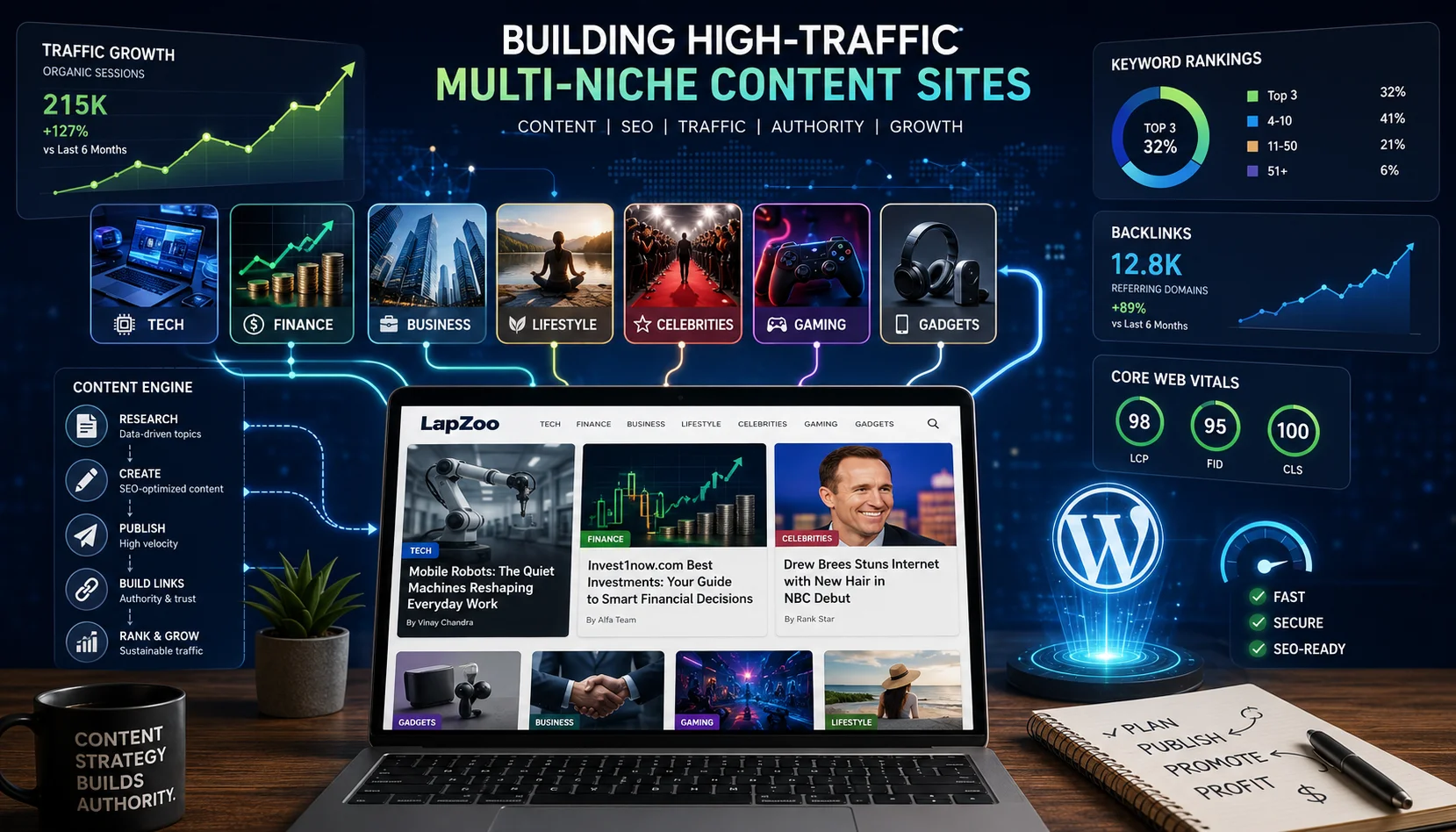
LapZoo (lapzoo.com) is a multi-niche content blog founded in 2021 and headquartered at an address in Palermo, Italy, with operations managed through outreachmedia.io. The site covers a broad array of topics including Tech, Finance, Business, Lifestyle, Celebrities, Gadgets, and Gaming. It is built on WordPress using the Elementor page builder and publishes content under a team of bylines — Vinay Chandra, Alfa Team, Backlinks Hub, Rank Star, and Blitz.
At first glance, LapZoo resembles hundreds of other informational blogs. What sets it apart is the deliberate content strategy, link-building footprint, and publishing velocity behind it.
Dissecting LapZoo's Traffic Model
1. Niche Diversification Without Losing Focus
LapZoo doesn't commit to a single topic. Instead it spans Tech, Finance, Lifestyle, Celebrities, and even Gaming — categories that individually attract massive search volumes. This multi-niche model creates multiple traffic streams. If one category takes an algorithm hit, others absorb the loss. Think of it as a portfolio approach to SEO.
However, each category maintains topical cohesion. Finance articles link to other finance articles. Tech reviews cross-link to gadget content. Internal linking is consistent, which tells Google that the site has genuine depth in each vertical.
2. High Publishing Velocity
Scanning recent posts, LapZoo publishes multiple articles per week across its categories. Titles like "Mobile Robots: The Quiet Machines Reshaping Everyday Work", "Heavy-Copper PCBs for EVs: Surviving High-Current Density", and "Drew Brees Stuns Internet with New Hair in NBC Debut" show a clear mix of:
- Evergreen technical content — detailed, search-intent-driven articles that rank over months and years
- Trending/celebrity content — high-click-potential articles around popular names and events
- Finance/investment explainers — a goldmine category because readers in this niche are high-value and sticky
This combination is deliberate. Trending articles spike traffic quickly. Evergreen articles build it steadily. Finance content retains it.
3. WordPress + Elementor — Speed Optimized
LapZoo uses WordPress with Elementor 4.1.3, alongside external CSS delivery and Google Font optimization (noted in its meta generator tags). These choices reflect awareness of Core Web Vitals, which directly impact Google rankings. Fast-loading pages, proper canonical tags, OpenGraph metadata, Twitter card support, and a structured sitemap are all configured correctly — these are not accidents.
4. SEO-First Content Titles
Posts like "Invest1now.com Best Investments: Your Guide to Smart Financial Decisions" or "5StarsStocks.com Nickel: The Ultimate Guide to Investing in Nickel Stocks" follow a recognizable pattern: target a branded keyword with purchase/research intent, write a comprehensive explainer, and rank for long-tail variations. This is a tactic called branded keyword hijacking — targeting searches for specific websites or tools that already have demand.
What LapZoo's Model Tells Us About Modern SEO
LapZoo's playbook reflects several truths about how high-traffic blogs actually work in 2026:
Volume beats perfection early on. Sites that publish consistently — even if not every article is exceptional — tend to accumulate indexation, backlinks, and topical authority faster than sites that publish one perfect article per month.
Monetization fuels reinvestment. LapZoo's footer link model generates passive income that likely funds content production. Revenue from the site funds more content. More content drives more traffic. More traffic makes the link placements more valuable. It's a flywheel.
Domain authority compounds. LapZoo has been live since 2021. Four-plus years of consistent publishing and link building creates a domain authority floor that new pages benefit from immediately on publication. A new article on an aged domain with strong backlinks can rank within days rather than months.
Breadth increases total addressable traffic. A site covering only one topic caps its potential monthly visitors. A site covering Tech, Finance, Lifestyle, and Celebrities has a nearly unlimited keyword universe to target.
How to Build a Website That Reaches LapZoo-Level Traffic
If you're working with LetDigitalFly to build a content site, a digital publication, or a brand blog with real organic traffic ambitions, here is the architecture that works:
Step 1 — Choose Your Niche Cluster
Don't pick a single niche. Pick 3–5 closely related or complementary niches. For a tech-focused brand like LetDigitalFly, ideal clusters would include: Web Development, SEO Strategy, App Development, AI Tools, and Digital Marketing. Each is distinct enough for its own content pillar but close enough to keep the domain topically coherent.
Step 2 — Build on WordPress with Performance in Mind
WordPress remains the dominant CMS for content sites that scale. Pair it with:
- A lightweight theme (GeneratePress, Kadence, or Blocksy — not Elementor-heavy templates)
- A CDN (Cloudflare is free and handles DDoS protection too)
- Proper caching (WP Rocket or LiteSpeed Cache)
- WebP image compression (ShortPixel or Imagify)
- Structured data / schema markup for articles, FAQs, and how-tos
Core Web Vitals scores directly influence rankings. A fast site with mediocre content often outranks a slow site with excellent content.
Step 3 — Develop a Content Strategy Around Search Intent
Every article you publish should map to one of these four intents:
- Informational — "How does X work?" (builds topical authority)
- Navigational — "Best X tools / platforms" (captures comparison traffic)
- Commercial — "X vs Y" or "X review" (high purchase-intent traffic)
- Transactional — Direct conversion content aligned with your services
LapZoo leans heavily on informational and commercial-intent content. LetDigitalFly's blog should do the same — but with service-to-content alignment. An article about "how to build a high-traffic website" can logically funnel readers toward a website development service inquiry.
Step 4 — Publish at Velocity (Then Refine)
Aim for a minimum of 8–12 articles per month during the first 12 months. After 6 months, run a content audit: identify which articles are gaining traction, expand and update them, and consolidate underperforming content. This is the publish-audit-refine loop that separates sites stuck at 1,000 monthly visitors from those hitting 100,000.
Step 5 — Build Backlinks Systematically
This is where most content sites stall. LapZoo's outreach agency roots are doing real work here. For a site like LetDigitalFly, a sustainable link-building approach looks like:
- Guest posting on relevant tech and digital marketing blogs (minimum DR 40+)
- Digital PR — pitch data-driven studies, original research, or industry surveys that journalists link to
- Link exchanges with non-competing but related sites in the digital space
- Resource link building — create genuinely useful free tools (calculators, generators, checkers) that other sites naturally reference
Aim for 5–10 quality referring domains per month in year one.
Step 6 — Monetize to Reinvest
LapZoo monetizes via link placements and likely display ads. For LetDigitalFly, the monetization model is different — content leads to service inquiries. But the principle is the same: the content operation should pay for itself through either direct monetization or qualified lead generation. Track this explicitly. Every blog post should have a UTM-tagged CTA that lets you measure its contribution to pipeline.
Step 7 — Technical SEO Foundations (Non-Negotiable)
Before you publish a single article, lock these in:
- SSL certificate and HTTPS
- XML sitemap submitted to Google Search Console
- Proper canonical tags on all paginated or duplicate content
- Robots.txt configured correctly
- Schema markup for articles (at minimum)
- OpenGraph and Twitter Card meta tags on every page
- 301 redirects for any changed URLs
- Mobile-first responsive design
LapZoo has all of these configured. Many would-be competitors don't — and that gap is where domain authority is built or lost.
The Honest Verdict on LapZoo
LapZoo is a professionally operated content and link-monetization property. It is not a passion blog. It is a calculated digital media business built to generate organic traffic at scale and sell that traffic's authority to other websites through link placements. This model works — and it works well when executed with the consistency LapZoo has shown since 2021.
The lesson for builders and marketers: high-traffic websites are not built on virality. They are built on systems — a publishing system, a link-building system, a monetization system, and a technical infrastructure system. Each reinforces the others.
At LetDigitalFly, we build exactly these kinds of systems for businesses that want organic traffic to become a durable asset rather than a line item. Whether you need the technical foundation, the SEO strategy, or the content architecture, the blueprint above is where every high-traffic site eventually traces back to.
Key Takeaways
- LapZoo operates as a multi-niche content site with deliberate SEO architecture, not a casual blog.
- Its traffic is driven by publishing velocity, topical diversity, strategic backlink monetization, and technical SEO fundamentals.
- To replicate this model, prioritize niche clustering, fast WordPress infrastructure, search-intent content, and systematic link building.
- Content sites compound over time — the earlier you start, the steeper your growth curve.
- Monetizing content through services, ads, or link placements creates a reinvestment loop that accelerates growth.
LetDigitalFly is a digital solutions agency specializing in high-performance websites, SEO, link building, and mobile app development. If you want to build a content site that drives real organic traffic, get in touch.