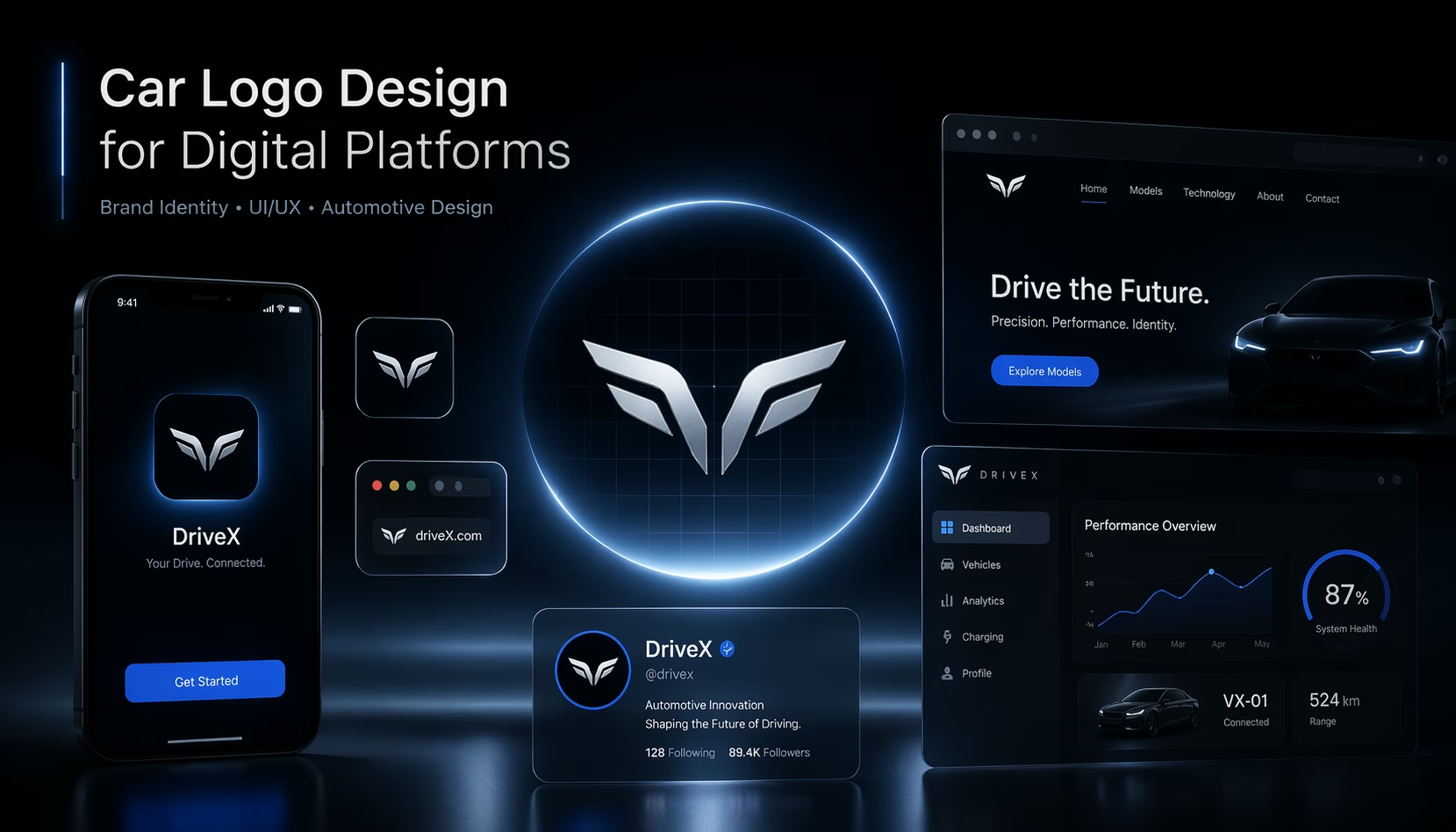
How to Design a Professional Car Logo for Your Brand and Digital Platform That Builds Strong Digital Identity

A car logo is no longer limited to just vehicles or physical branding. Today, it plays a crucial role in digital identity. Learn how to design a professional car logo that works seamlessly across mobile apps, websites, and modern digital platforms.
1. Introduction
In the modern digital age, a car logo is no longer just a metal badge on a grille. It has evolved into the central pillar of your entire brand identity, appearing on millions of smartphone screens, website headers, and mobile app icons before a customer ever steps into a showroom.
When you design a car logo today, you are not just designing for a vehicle. You are designing for a digital platform. Whether a user is booking a test drive via an app, configuring their dream car on a website, or using an in-dashboard UI, the logo must work flawlessly.
This article explores the deep connection between car logo design, automotive branding, and UI/UX design. We will look at how industry leaders use their symbols to build trust and provide a step-by-step guide to creating a logo that performs both on the highway and on the home screen.
2. What is a Car Logo and Why It Matters in Branding
A car logo is a unique graphic symbol, emblem, or signature that identifies a vehicle manufacturer. But in the context of brand identity design, it is the most valuable asset a company owns.
The Role in Brand Identity
A logo acts as the "face" of the company. It communicates the brand's personality—whether it is luxury, safety, innovation, or speed—without using a single word.
First Impression Factor
Psychological studies show that users form an opinion about a website or product within 50 milliseconds. The same applies to automotive brands. If a user opens your mobile app and sees a poorly rendered, pixelated, or ugly logo, they instantly distrust the vehicle's engineering quality.
Recognition and Trust
Why do drivers feel proud wearing a BMW shirt? Because the logo represents a legacy of quality. This emotional connection starts digitally.
Real-World Examples:
-
Tesla (The "T"): Stylized to look like a cross-section of an electric motor. It represents innovation, clean energy, and futuristic tech. On a digital platform, the minimalist "T" scales down beautifully to a 24x24 pixel app icon.
-
BMW (The Roundel): Often mistaken for a propeller, it represents the Bavarian flag. It conveys precision, performance, and heritage. In UI/UX, the circular shape is universally friendly and fits perfectly in navigation bars.
-
Audi (The Four Rings): Represents the merger of four companies. It symbolizes unity and technological perfection. The interlocking rings create a strong, balanced geometric shape that is highly legible on digital dashboards.
3. Core Principles of Car Logo Design
Before opening design software, you must master the principles that separate a timeless car logo from a forgettable one. These principles are crucial for both physical badges and logo design for apps.
-
Simplicity: The most recognizable logos (Nike, Apple, Mercedes) can be drawn by a child. A complex logo with fine lines will look like a grey blob when reduced to a mobile notification icon.
-
Memorability: A strong logo creates a mental "stickiness." When a user closes your app, the shape should linger in their mind.
-
Scalability: Your logo must look sharp on a 40-foot billboard and a 40-pixel smartwatch face. In UI/UX, we test this rigorously (e.g., favicon sizes).
-
Relevance: The logo must fit the brand story. A rugged off-road brand should not have a delicate, cursive serif font. An electric hypercar brand should avoid heavy, bulky shapes.
-
Versatility Across Platforms: The logo must work in horizontal, vertical, and square formats. It must look good in full color, black and white, and reversed out (white on a dark background) for dark mode UI themes.
4. Car Logo Design in UI/UX and Digital Platforms
This is where digital platform branding becomes critical. A car logo lives in a hostile digital environment surrounded by other icons, notifications, and text. How does it survive?
Mobile Apps
When a user downloads your car brand's app (for remote start, charging, or navigation), the logo is the app icon. On an iPhone or Android home screen, it competes with social media and banking apps.
-
Requirement: High contrast, rounded corners (often), and no small text.
-
Example: The Tesla app icon is simply the "T" on a dark or light background. It is instantly recognizable.
Websites
On a website, the logo usually sits in the top-left corner (Global Navigation). This is the anchor point. If the logo is poorly optimized, it slows down the website's Largest Contentful Paint (LCP), hurting SEO and user experience.
Dashboard UI (Infotainment)
Modern cars have massive screens inside. The logo appears on startup (splash screen) and in the settings menu.
-
Challenge: Drivers glance at screens for less than a second.
-
Solution: A high-contrast, flat vector logo that doesn't distract.
Visual Consistency
If your website uses a 3D, chrome-heavy logo, but your app uses a flat 2D logo, users get confused. UI/UX design branding demands absolute consistency. The logo must be part of a unified design system.
5. Step-by-Step Process to Design a Car Logo
If you are ready to create a car logo design for your brand, follow this structured process used by professional design agencies.
Step 1: Brand Research (The Discovery Phase)
Do not sketch yet.
-
Questions to ask: Who is the customer? (Luxury vs. Budget). What is the brand personality? (Aggressive vs. Calm). What is the unique selling point? (Battery range vs. Horsepower).
-
Output: A mood board and a list of keywords (e.g., "solid," "electric," "organic").
Step 2: Concept Development (Brainstorming)
Look for symbols. Does your brand name have an animal (Jaguar), a letter (Tesla's T), or an abstract shape (Audi rings)?
-
Typography: Decide if you need a custom font (emblem) or a standalone symbol (iconic).
Step 3: Sketching Ideas (Low-Fidelity)
Take a pencil and paper. Sketch at least 30-50 variations.
-
Focus on shapes: Circles (community), shields (protection), wings (speed), triangles (direction).
-
Test the silhouette: Color the sketch black. Does the shape still look like something? If not, scrap it.
Step 4: Digital Vector Design (High-Fidelity)
Move to software like Adobe Illustrator, Figma, or Affinity Designer.
-
Vectors only: Never use raster images (JPEGs). You need SVG files for web scaling.
-
Grid alignment: Use geometric construction (golden ratio or grid systems) to ensure perfect balance.
Step 5: Testing Across Platforms (UI/UX Review)
This is the most skipped step but the most important.
-
The Favicon Test: Shrink your logo to 16x16px. Can you still see the shape?
-
The Dark Mode Test: Put your logo on a black background and a white background.
-
The Color Blindness Test: Ensure the logo doesn't rely solely on red/green differences.
Step 6: Final Optimization and Export
Export your files in SVG, PNG (transparent), and WebP formats. Create a "Brand Guide" specifying minimum sizes, clear space, and prohibited uses.
6. Common Mistakes to Avoid in Car Logo Design
Many startups ruin their digital presence with bad logos. Avoid these pitfalls:
-
Overcomplicated Detail: Trying to put a full engine, tires, and a driver into the logo. This creates visual noise. Remember, simplicity scales.
-
Relying on Trends: Gradient chrome and 3D glass effects looked cool in 2007. Today, flat, clean vectors dominate UI/UX design because they load faster and render cleaner.
-
Poor Scalability (The "Ink Blot" effect): When you shrink the logo, it becomes an unrecognizable black dot. This happens when shapes are too close together (like some vintage luxury crests).
-
Ignoring UI/UX: Using a horizontal logo (very wide) as a square app icon. You will have to crop it awkwardly, cutting off text.
-
Lack of Uniqueness: Copying the Mercedes tri-star slightly altered. Legal issues aside, users will never remember your brand because they see a knock-off.
7. Business Perspective: Why Companies Invest in Logo Design
From a business ROI perspective, a logo is not an expense; it is an appreciating asset.
Branding Value
A strong automotive branding strategy increases customer lifetime value (CLV). A user who loves your logo will put a sticker on their laptop. That is free advertising.
Customer Trust
In a digital marketplace full of scams, a professional logo is a "trust badge." If your app icon looks amateur, users will assume your car’s safety features are also amateur.
Market Positioning
A minimalist, flat logo tells the market you are a modern, tech-forward brand (like Rivian or Lucid). A heavy, metallic, 3D logo tells the market you are a traditional, heavy-duty brand (like Ford or RAM). Your logo chooses your competitor.
Competitive Advantage
When a user searches for "SUV apps" in the App Store, your icon needs to stand out against 50 others. A unique, bold car logo idea stops the scrolling thumb.
8. How Businesses Can Build Complete Digital Branding Systems
A logo alone is not enough. To succeed, your logo must integrate into a digital branding system.
This system includes:
-
The Logo: (Primary, Secondary, Submark variations).
-
The Color Palette: Ensuring the logo colors meet WCAG accessibility contrast ratios for website text.
-
The Typography: Choosing a web-safe font that complements the logo's shape.
-
UI Components: Buttons, forms, and cards that reflect the "automotive" feel (e.g., sleek black glassmorphism or rugged matte textures).
When your logo flows seamlessly into your website's navigation, then into your app's dashboard, then into your digital ads, you create a "Unified Brand Experience." This reduces bounce rates and increases conversion rates because the user feels they are dealing with a serious, established company.
9. Conclusion:
Designing a car logo is a strategic act of balance. You must honor the heritage of automotive design (speed, metal, engineering) while embracing the reality of the digital world (pixels, taps, and screens).
We have learned that simplicity ensures scalability, that testing prevents UI disasters, and that a logo is the silent ambassador of your brand. Whether you are a startup launching an electric vehicle (EV) or an existing brand refreshing your identity, never underestimate the power of a perfectly executed logo.